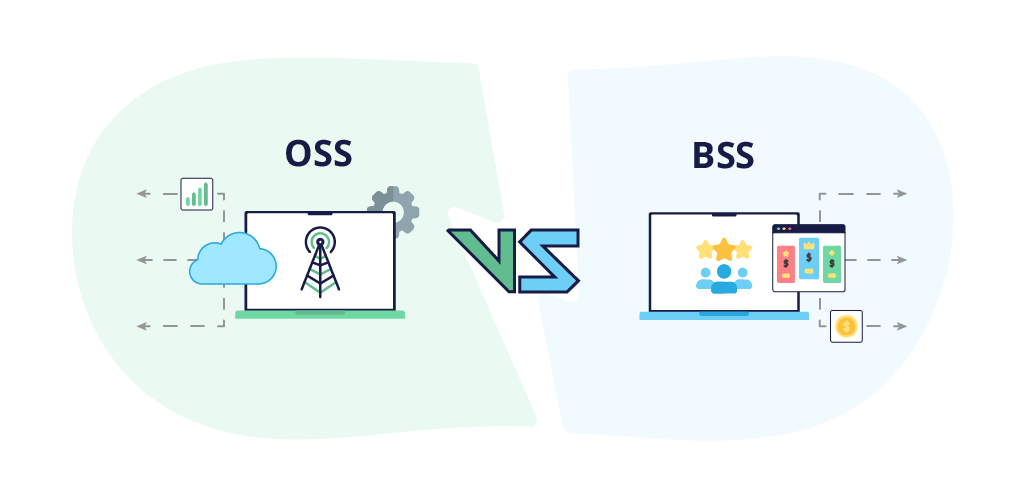


In this blog, we’ll cover the key differences between OSS vs. BSS in telecom and discover how companies can benefit from OSS/BSS digital transformation.
Table of contents
When it comes to telecom operations, the two terms you’ll hear a lot are OSS (Operational Support Systems) and BSS (Business Support Systems).
They’re often mentioned together – sometimes as OSS/BSS, sometimes amusingly as B/OSS – but their roles are very distinct and different.
In this blog, we’ll break down the key differences between OSS vs BSS.
We’ll look at how they support end-to-end telecom operations and why both are essential for success.
Plus, we’ll explore some OSS/BSS examples and discover how OSS/BSS digital transformation can unlock new possibilities.
Read on!
What is The Difference Between OSS vs BSS?
Telecom operations rely on both OSS and BSS:
- OSS (Operational Support System) focuses on keeping telecom infrastructure running smoothly, making it network-facing.
- BSS (Business Support System) manages the business side of telecom, making it customer-facing.
Here’s a quick comparison table of the differences between OSS vs. BSS:
| OSS | BSS | |
|---|---|---|
| Focus | Managing and maintaining telecom network infrastructure | Enhancing customer experience and driving business operations |
| Key Functions | Network planning, monitoring, maintenance, fault management, and service provisioning | Billing, CRM, order management, and revenue tracking. |
| Operation Type | Backend operations focused on network health and performance | Frontend operations focused on business processes and customer engagement |
| Primary Workforce | Developers, network engineers | Business professionals, sales teams, customer support |
OSS vs BSS in Telecom
OSS and BSS are deeply interconnected components of the telecom ecosystem.
Let’s look at the role they play.
How OSS Works
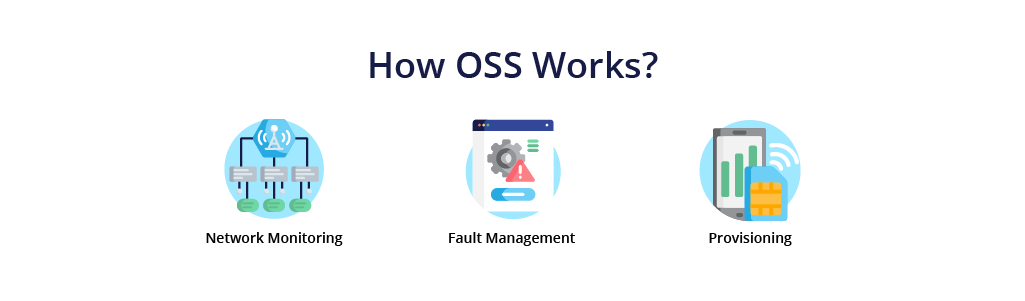
OSS focuses on the technical backbone of telecom. It ensures the network operates without interruptions by handling key operations, such as:
- Network Monitoring: Keeping tabs on system health.
- Fault Management: Fixing issues to avoid service interruptions.
- Provisioning: Activating services and connections for customers, e.g. SIM provisioning.
For example, an MNO (Mobile Network Operator) uses OSS to maintain and monitor its physical network infrastructure.
MVNOs, which rely on MNOs for network access, may use OSS tools developed in-house or provisioned by an MVNE (Mobile Virtual Network Enabler) to manage service provisioning and other technical configurations.
How BSS Works
BSS handles the business side of telecom. It ensures smooth interactions with customers and manages:
- Billing: Accurate charging for services.
- CRM (Customer Relationship Management): Manages customer relationships and support.
- Order Management: Ensures services are delivered on time.

BSS is just as important for MVNOs (Mobile Virtual Network Operators), who interact directly with customers, as it is for MNOs and MVNEs, which provide platforms for MVNOs.
How OSS and BSS Work Together
Whether it’s an MNO running its own network, an MVNO offering services through an MNO, or an MVNE supporting MVNOs, OSS and BSS need to work as a team.
OSS keeps the network running in the background. BSS ensures the business side runs smoothly, so customers get great service.
Here’s how they work together:
- Order Fulfillment: A customer places an order via the BSS. The BSS sends this request to the OSS for technical activation.
- Service Assurance: OSS monitors network performance and shares real-time data with BSS to ensure billing accuracy and customer satisfaction.
- Fault Resolution: If a network issue arises, OSS identifies and resolves it while notifying the BSS, which updates customers about service restoration.
Modern OSS/BSS integrations rely on APIs and middleware platforms to ensure seamless communication between both systems.
How to Measure Success with OSS vs BSS
Success with OSS vs BSS systems is often defined by their ability to meet goals – technical or business.
KPIs (Key Performance Indicators) are vital for tracking the success of OSS/BSS operations.
These metrics provide a clear picture of how well operations are running and pinpoint improvement areas.
By focusing on these OSS/BSS KPIs, telecom providers maintain their competitive edge while delivering reliable, customer-centric services.
Key OSS KPIs
With OSS focusing on technical operations and network health important KPIs are:
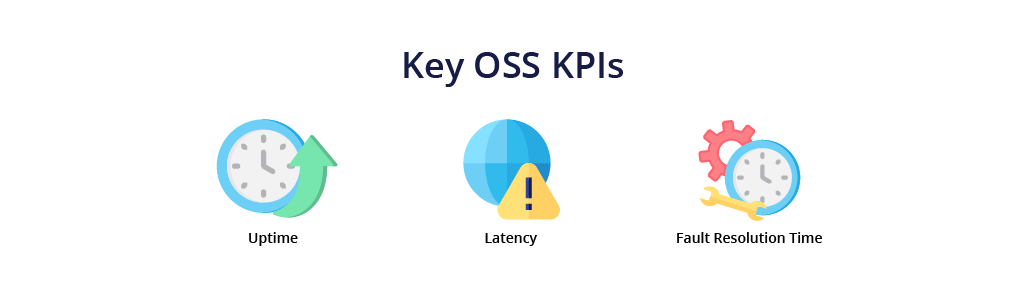
- Uptime measures the percentage of time the network is operational and available to users.
- Latency is the delay in data transmission, critical for applications like video calls and gaming.
- Fault Resolution Time tracks how quickly network problems are identified and fixed.
High uptime reflects a reliable service.
Lower latency means a faster, smoother experience.
Faster resolution ensures minimal service disruptions.
Key BSS KPIs
BSS prioritizes customer experience, billing, and revenue management. Key KPIs include:
- Churn Rate tracks the percentage of customers who discontinue their service in a certain period.
- ARPU (Average Revenue Per User) offers insight into the revenue generated per customer.
- Billing Accuracy ensures customers are charged correctly.

Lower churn rate means happier, loyal customers.
ARPU shows how well services are monetized.
Billing accuracy builds trust.
OSS/BSS Examples, Vendors & Solutions
Telecom providers often rely on integrated OSS/BSS platforms to manage their networks and business operations seamlessly.
These platforms support everything from network monitoring to customer billing, ensuring smooth service delivery and improved customer satisfaction.
OSS/BSS Examples
- OSS Example: A telecom provider uses OSS tools to monitor its 5G network, ensuring optimal performance and minimal downtime.
- BSS Example: A BSS system manages customer billing for a MVNO company offering bundled mobile, internet, and TV services.
Top OSS/BSS Vendors
Some of the most prominent vendors leading the OSS/BSS market include:
- Amdocs: A trusted provider of OSS/BSS solutions for large-scale telecom operations.
- Ericsson: Known for offering modular and flexible platforms tailored to evolving telecom needs.
- Nokia: A key player in delivering OSS/BSS systems optimized for the next generations of mobile networks.
OSS/BSS Solutions
Integrated OSS/BSS platforms allow telecom providers to bridge the gap between network operations and customer-facing services.
Combining these systems helps companies activate services faster, reduce operational costs, and ensure better customer engagement.
OSS/BSS Market by Solution Type
The global BSS/OSS market was valued at $36.85 billion in 2019, and it is projected to reach $102.14 billion by 2027.
OSS/BSS Transformation in Telecom
Digital transformation in telecom begins with modernizing OSS and BSS systems.

Tridens Monetization for Communications is a cloud-based converged billing platform and BSS helping telcos transform their ever-growing business with solutions that:
- Enhance scalability and flexibility for telecom providers.
- Reduce costs by eliminating legacy infrastructure dependencies.
- Leverage AI and automation to improve operational efficiency.
Ready to transform your telecom operations?
FAQs
OSS focuses on network operations and ensures the technical infrastructure runs smoothly, while BSS handles customer-facing business processes like billing and CRM.
Billing is a core function of BSS, as it directly relates to managing customer payments and revenue generation.
OSS/BSS transformation refers to modernizing these systems to enhance efficiency, integrate cloud-based technologies, and deliver better customer experience.