


Sfondo
A major European public transport operator runs scheduled bus services across multiple urban regions. Like most bus companies in the EU, it is electrifying its fleet under tight regulatory deadlines and sustainability commitments.
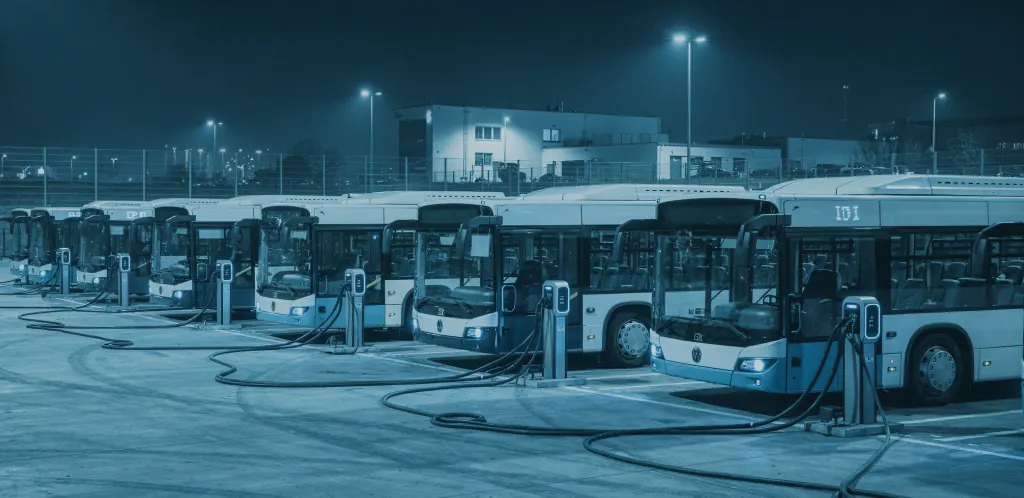
Each depot has dozens of electric buses that must roll out on schedule every morning, fully charged, pre-conditioned and ready for the first passenger. Manual coordination cannot keep up at this scale.
Sfida
The operator needed depot charging that works with its depot systems and follows the timetable:
- Timetable-driven charging: charging had to follow tomorrow’s timetable, not arbitrary plug-in times.
- No priority logic: the legacy backend treated every session the same, so teams rebalanced charging by hand every night.
- Manual pre-conditioning: batteries and cabins were pre-conditioned by hand, with inconsistent results across depots and shifts.
- Hard power limits: going over the depot’s grid connection capacity triggers demand charges and risks tripping the site.
- No VDV integration: the OCPP-only backend could not integrate with VDV 261 or VDV 463.
Soluzioni
Tridens EV Charge replaced the legacy charging backend with a VDV-native CMS. It connects to the operator’s depot management system (DMS) and intermodal transport control system (ITCS), talks to each bus and shares depot power by priority, so depot charging runs on its own.
Ricarica allineata agli orari
Through VDV 463, every scheduled departure flows into the platform with its arrival time, departure time, target state of charge and target energy. Each entry becomes a charging session with a defined start, end and priority. Buses departing at 5:00 AM get power first, and later departures are deferred into off-peak windows.
Precondizionamento automatizzato
Tridens EV Charge communicates with each bus through VDV 261 over the ISO 15118 connection. Buses report battery state, cabin temperature and pre-conditioning needs. The system responds with pre-warming start times, HVAC schedules and departure windows based on the timetable, so drivers arrive, disconnect and depart.
Distribuzione del carico consapevole della rete
Available power is shared dynamically across active sessions, and priority groups from the timetable get capacity first. Real-time meter values keep the depot within its contracted limits. When one bus finishes charging, the released capacity moves to the next bus in the queue.
Benefici
- Partenze puntuali: buses leave with consistent state of charge, warm cabins and pre-conditioned batteries.
- Costi energetici più bassi: smart load distribution into off-peak windows lowered energy costs.
- New depots in weeks: integrating a new depot now takes weeks instead of months.
Risultati
Buses now leave on time with consistent state of charge, warm cabins and pre-conditioned batteries. Smart load distribution into off-peak windows lowered energy costs, and depot teams no longer coordinate charging by hand at 4 AM. Integrating a new depot now takes weeks instead of months. The operator scaled from one pilot site to multiple depots without rewriting integration logic.