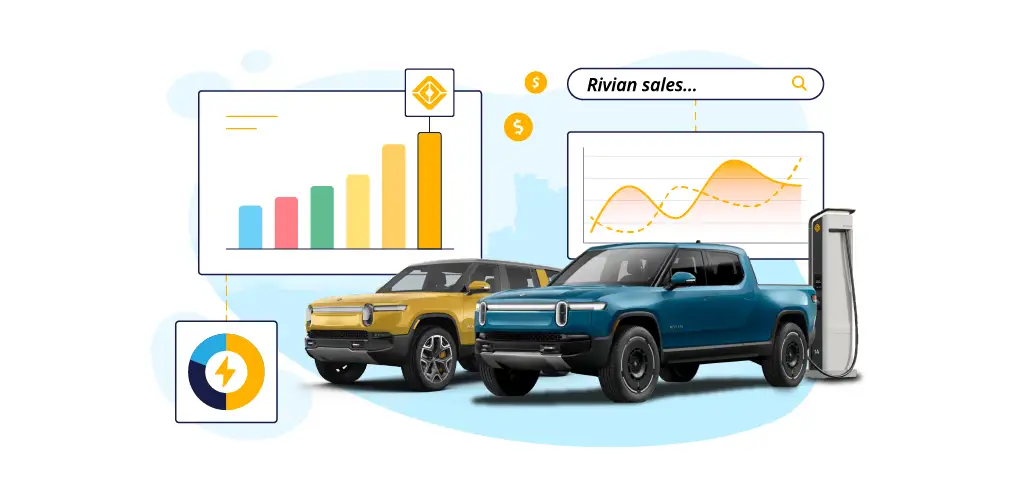
Explore Rivian’s 2025 sales, revenue, and production stats, plus R1T, R1S, EDV trends, the Rivian adventure network, and future outlook.
Table of contents
- Interesting Facts About Rivian
- Rivian’s Rise in the Electric Vehicle Revolution
- Key Rivian Statistics
- Where are Rivians Made?
- Rivian Manufacturing Locations
- Rivian Production and Deliveries
- Rivian Sales by Quarter
- Rivian Sales by Model
- Rivian Sales by Country 2025
- Rivian Annual Revenue
- Rivian Top Competitors
- Who Owns Rivian?
- Rivian Charging (Adventure) Network
- How Does Rivian Make Money?
- Rivian Employees
- Are Rivians Worth It?
- Rivian’s Future Outlook
This blog provides a comprehensive, data-driven exploration of Rivian’s sales, production, revenue, workforce, manufacturing, charging infrastructure (also known as the Rivian Adventure Network), for 2025 and future plans for 2026.
Whether you’re an EV enthusiast, investor, or curious about Rivian’s trajectory, this guide reveals how Rivian is powering the electric revolution.
Interesting Facts About Rivian
Rivian’s journey is marked by pioneering achievents and unique attributes, some of which include:
- First Electric Pickup: Launched in September 2021, the R1T beat competitors like Ford’s F-150 Lightning to become the first all-electric pickup truck on the market.
- Amazon’s Green Fleet: Rivian was contracted to deliver 100,000 EDVs to Amazon by 2030, with about 20,000 delivered by 2025, reducing Amazon’s carbon footprint.
- Adventure-Ready Design: Rivian’s vehicles boast 14.9 inches of ground clearance, 835 horsepower, and a 3-second 0–60 mph sprint (0-97 km/h), tailored for off-road enthusiasts.
- R1S Outshines Model X: In 2023, the R1S sold 24,783 units in the U.S., ranking 7th among EVs and surpassing Tesla’s Model X.
- Record-Breaking IPO: Rivian’s 2021 IPO raised $11.9 billion, one of the largest in U.S. history, valuing the company at $100 billion by the end of the first day of the IPO.
- Charging for Adventure: The Rivian Adventure Network (RAN) targets remote locations like national parks, with ~400 stalls operational by March 2025.
Rivian’s Rise in the Electric Vehicle Revolution
Rivian was founded in 2009 by RJ Scaringe. At first, the company was named Mainstream Motors, and then Avera Automotive, before it became Rivian Automotive.
Rivian is transforming the electric vehicle (EV) landscape with its adventure-focused electric trucks and SUVs.
A dirty truck is a happy truck. pic.twitter.com/QBox9BNWj8
— Rivian (@Rivian) June 20, 2025
The R1T, the first all-electric pickup truck to reach consumers; the luxurious R1S SUV; and the Electric Delivery Van (EDV) for commercial fleets have established Rivian as a leader in the mainstream EV market.
In the beginning Rivian had made plans for a sports EV called R1, but the plans were discontinued to pursue the mainstream market for the greatest impact.
Despite a modest 3% delivery growth in 2024 and a challenging Q1 2025, Rivian’s innovation, sustainability ethos, and strategic partnerships (most notably with Amazon) position the company as a formidable competitor to Tesla, Ford, and BYD.
Rivian’s pick-up truck was the first EV of its kind ahead of Tesla, Ford, and other notable names.
Key Rivian Statistics
Rivian’s 2026 performance reflects resilience amid economic headwinds and intensified competition in the EV industry.
Below are key metrics showcasing its market impact:
- Global Deliveries: 42,247 vehicles in 2025, down 18% from 51,579 in 2024.
- R1S U.S. Sales Rank: 10th among U.S. EVs in 2025.
- Revenue: ~$5.0 billion in 2025, approximately the same as 2024.
- Production Capacity: Normal, IL, factory supports 150,000 vehicles annually; Georgia plant planned for 2026 with 400,000-unit capacity.
- Charging Network: ~895 RAN (Rivian Adventure Network) stalls by March 2025, enhancing accessibility.
- Workforce: ~14,700 employees in 2025, down from ~16,500 in 2024.
- Amazon EDV Deliveries: 20,000 units by 2025, part of a 100,000-unit order by 2030.
| Metric | 2023 | 2024 | 2025 |
|---|---|---|---|
| Global Deliveries | 50,122 | 51,579 | 42,247 |
| Revenue | $4.4 B | ~$5.0 B | ~$5.0 B |
| Production | 57,232 | 49,476 | 42,284 |
| Employees | ~16,700 | ~16,500 | ~14.700 |
| Charging Stalls | ~200 | ~400 | ~895 |
Where are Rivians Made?
Rivian vehicles are manufactured at the company’s advanced facilities, with factory locations in Normal, Illinois, and a second plant under development in Georgia.

The Normal factory, a former Mitsubishi site, is the epicenter of Rivian’s production, assembling the R1T, R1S, and EDV.
Its 150,000-vehicle annual capacity supports Rivian’s North American orders, while the Georgia plant will enable global expansion starting in 2026.
Currently, all Rivians are manufactured and shipped in the United States and Canada.
The next section gives a detailed review of Rivian manufacturing facilities and their functions.
Rivian Manufacturing Locations
Rivian’s manufacturing and production infrastructure is scaling to meet current high demand for the EVs in the United States and future ambitions to expand internationally.
Below is a table detailing Rivian facilities and the main functions in these locations.
Smart EV Charging: Unlocking Its Full Potential
| Facility Location | Main Functions | Additional Notes |
|---|---|---|
| Irvine, California (HQ) | Vehicle engineering and design, propulsion and battery system development, commercial functions | Corporate headquarters; primary focus on design and commercial operations |
| Normal, Illinois (Factory) | Vehicle production, manufacturing battery packs, paint shop, robotics, stamping, injection molding | Facility size: 2.6 million sq ft; expansions planned to reach 3.9 million sq ft; all vehicle production currently here |
| Plymouth, Michigan | Vehicle engineering, prototyping, supply chain management, accounting | Key engineering and prototyping hub |
| Palo Alto, California | Software development, engineering, autonomous driving/self-driving features | Focus on software and self-driving capabilities |
| Carson, California | Electric power conversion | Specializes in electric power systems |
| Working, England | Advanced engineering | Advanced engineering initiatives; international site |
| Planned Georgia Plant | Planned battery and vehicle assembly plant, projected capacity of 400,000 vehicles per year, 7,500–10,000 workers | $5 billion project; expected to open in 2026; originally planned for 2024 production |
Rivian Normal, Illinois Factory
Acquired in 2017, the 3.3-million-square-foot Normal plant has a capacity of 150,000 vehicles annually.
The facility employs about 7,000 workers.
Rivian also has other facilities in Palo Alto; Working, England; Belgrade, Serbia; and Wittmann, Arizona.
Rivian Planned Georgia Plant
Set to open in 2026 near Atlanta, the Georgia plant will have a 400,000-vehicle capacity, producing the R2 SUV and R3 crossover for domestic and export markets.

Construction delays shifted the timeline from 2024.
Here’s a table comparign Rivian’s two main manufacturing facilities:
| Facility | Location | Capacity (vehicles/year) | Models Produced | Opening Year |
|---|---|---|---|---|
| Normal Plant | Normal, IL | 150,000 | R1T, R1S, EDV | 2017 |
| Georgia Plant | Stanton Springs, GA | 400,000 | R2, R3 | 2028 |
The Georgia plant starts construction in 2026 and is planned to begin production in 2028, expecting to create 7,500 jobs by 2030.
Rivian Production and Deliveries
Rivian’s production and delivery trends highlight its rapid scaling but an inability to meet demand since 2021.
Rivian Annual Vehicle Production
Production began in 2021 with 1,015 vehicles, peaking at 57,232 in 2023.
In 2025, output fell down to 42,284 due to a factory shutdown for retooling for the R2 and R3 models.

| Year | Total Annual Production | Growth (%) |
|---|---|---|
| 2021 | 1,015 | N/A |
| 2022 | 24,337 | +2,298% |
| 2023 | 57,232 | +135% |
| 2024 | 49,476 | -14% |
| 2025 | 42,284 | -14.5% |
Rivian Delivery Numbers
Deliveries grew from 920 in 2021 to 42,247 in 2025.
The 2025 figure is an 18% decrease from 51,579 in 2024.

| Year | Deliveries | Growth (%) |
|---|---|---|
| 2021 | 920 | N/A |
| 2022 | 20,332 | +2,109% |
| 2023 | 50,122 | +147% |
| 2024 | 51,579 | +3% |
| 2025 | 42,247 | -18% |
Rivian Sales by Quarter
Rivian’s 2025 quarterly performance showed the company’s resilience and potential. The drop after is due to factory shutdown in preparing for the R2 and R3 models.
Below are the quarterly Rivian vehicle sales from 2023 to 2025.

| Quarter | U.S. Production | Total Sales | Change in Production (%) | Change in Sales (%) |
|---|---|---|---|---|
| Q1 ’23 | 9,395 | 7,946 | -6.24% | -1.34% |
| Q2 ’23 | 13,992 | 12,640 | +48.93% | +59.07% |
| Q3 ’23 | 16,304 | 15,564 | +16.52% | +23.13% |
| Q4 ’23 | 17,541 | 13,972 | +7.59% | -10.23% |
| Q1 ’24 | 13,950 | 13,580 | -20.47% | -2.81% |
| Q2 ’24 | 9,612 | 13,790 | -31.10% | +1.55% |
| Q3 ’24 | 13,564 | 11,235 | +41.12% | -18.53% |
| Q4 ’24 | 12,972 | 14,230 | -4.36% | +26.66% |
| Q1 ’25 | 14,611 | 8,640 | +12.63% | -39.28% |
| Q2 ’25 | 5,979 | 10,661 | -59,1% | +23,4% |
| Q3 ’25 | 10,720 | 13,201 | +79,3% | +23,8% |
| Q4 ’25 | 10,974 | 9,745 | +2,4% | -26,2% |
Rivian Sales by Model
Rivian vehicle models include R1T, R1S, and EDV. These different models target diverse segments, from adventure seekers to commercial fleets for logistics.
The table below represents figures, based on annual delivery numbers, popular models, and industry news.

| Model | U.S. Sales | % of Total Sales | Key Market |
|---|---|---|---|
| R1S | ~25,000 | ~52% | Luxury SUV |
| R1T | ~11,000 | ~29% | Electric Pickup |
| EDV | ~8,000 | ~19% | Commercial, Fleet |
Rivian R1T: The Electric Pickup
The R1T was launched in 2021, and its best battery offers 314–410 miles (505-640km) of range with 835 horsepower, and a 3-second 0–60 mph (0-97km) sprint.
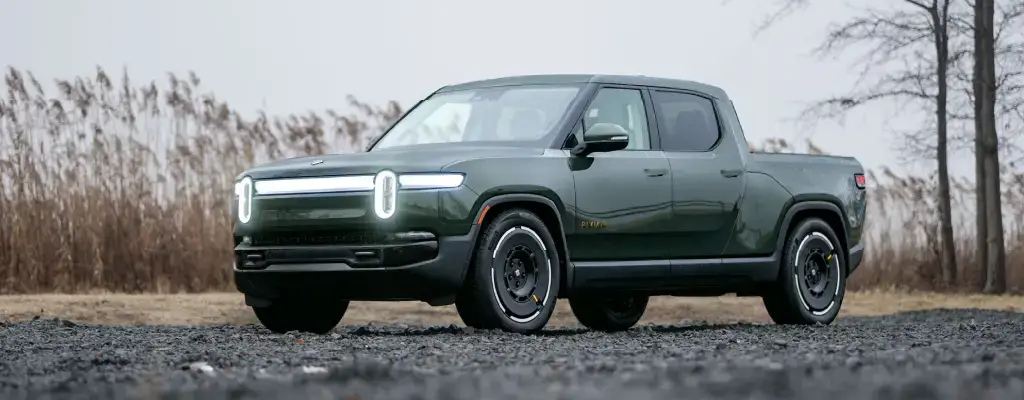
In 2025, it sold ~11,000 units in the U.S.
The R1T has a strong demand in rugged states like Colorado and Utah.
Rivian R1S: The Premium Electric SUV
The R1S, a 7-seat SUV with its best battery offering 316–400 miles (505-640km) of range.
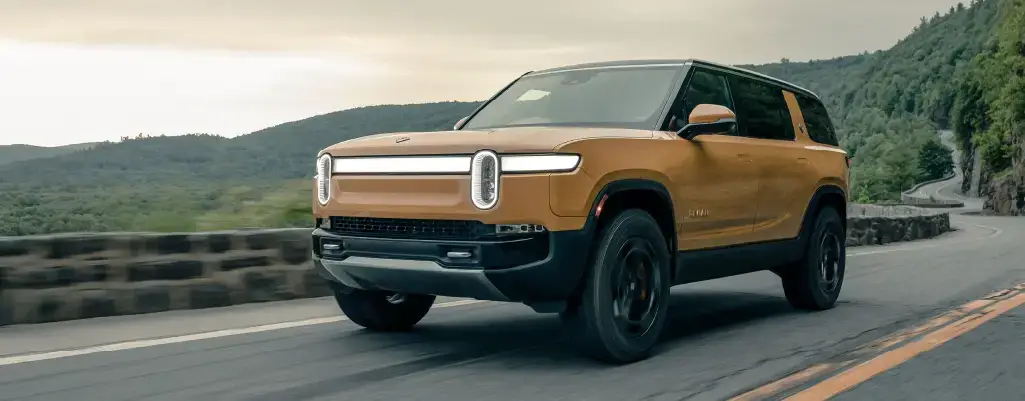
It sold ~25,000 units in 2025, building on its 2023 rank of 7th among U.S. EVs (24,783 units).
Its luxury features and towing capacity appeal to families in California and Texas.
Rivian EDV: The Commercial Van for Logistics
The EDV was originally designed for Amazon’s 100,000-unit order by 2030 (this was under an exclusivity clause that was later broken, and Rivian is now allowed to sell the EDV to other companies).

However, Rivian had delivered ~8,000 units in 2025.
The EDV 150–200-mile (240km) range suits urban logistics, reducing emissions for Amazon’s fleet.
Rivian Sales by Country 2025
Currently, Rivian’s sales are concentrated in North America and Canada.
Global expansion is planned for 2026 with the completion of the Georgia facility.
| Country | Deliveries | % of Total | Key Regions |
|---|---|---|---|
| U.S. | ~38,000 | ~90% | California, Texas, Colorado |
| Canada | ~4,200 | ~10% | Vancouver, Toronto |
| Others | 0 | 0% | / |
Rivian Sales United States: Core Market
The U.S. accounted for 90% of 2025’s 42,200 deliveries, driven by demand in California (around 30% of U.S. sales), Texas, and Colorado.
Rivian Sales Canada: Growing Presence
Canada contributed 10% (4,200 units), with sales since 2022 in urban centers like Vancouver and Toronto.
Limited service centers in Canada lack of right-hand-drive models constrain growth, but infrastructure expansion is planned for 2026.
Rivian Future Global Markets
Rivian has no sales outside North America as of 2024–2025.
Plans are underway to enter Europe (UK, Germany) and Asia by 2026 with the R2 and R3 models.
This will all be supported by the Georgia plants expected 400,000-vehicle capacity.
Rivian Annual Revenue
Rivian’s revenue reflects its scaling operations.
However, like Tesla in its initial years, profitability still remains a goal due to high R&D, expansion, and production costs.
Below is a table showing Rivian annual revenue as reported in from 2021:

| Year | Revenue (in Billions) | Growth (%) | Key Driver |
|---|---|---|---|
| 2021 | $0.055 B ($55 M) | / | R1T launch |
| 2022 | $1.7 B | 2,991% | R1T, R1S ramp-up |
| 2023 | $4.4 B | 159% | Volume growth |
| 2024 | ~$5.0 B | 14% | R1S, EDV sales |
| 2025 | ~$5.0 B | ~$0% | Pricing pressure, tax credit loss |
Revenue grew from $55 million in 2021 to ~$5.0 billion in 2025, driven by vehicle sales (95%) and minor contributions from services and accessories.
Rivian 2025 Revenue Outlook
According to the 2025 shareholders’ letter, revenue is estimated at ~$5.0 billion, about the same as 2024’s. There is no significant growth in revenue from 2025, most likely due to a mixed trend in deliveries.
Rivian Top Competitors
Rivian operates in a competitive EV market, especially in the United States. The competition in the U.S. can be put as Rivian v Ford or Rivian v Tesla.
Some of the companies that Rivian faces off with are:
- Tesla: Global leader with 1.6 million Model Y sales in 2025 and a vast Supercharger network.
- Ford: F-150 Lightning (~20,000 U.S. sales in 2024) rivals R1T in the pickup segment.
- BYD: Affordable EVs and global dominance, planning North American entry by 2026.
- GM: Hummer EV and Silverado EV target premium and pickup markets.
Who Owns Rivian?
Among institutional investors in 2025, the largest shareholder was Amazon, holding 13,05% of the company.
Other major stakeholders included Porsche Automobil Holding SE (12,10%), Abdul Latif Jameel (8,77%), The Vanguard Group (6,52%), and BlackRock (4,12%).
The remaining shares were distributed among other investors, highlighting a diverse ownership structure.
Rivian Charging (Adventure) Network
The Rivian Adventure Network (RAN) support Rivian’s adventure-focused brand by prioritizing charging in remote areas like parks and game reserves.
RAN focuses on North America, with stalls in the U.S. (e.g., Colorado Rockies, Great Smoky Mountains) and select Canadian sites (e.g., Banff).

Expansion will densify coverage by 2026.
Rivian Charging Stations in 2025
By March 2025, RAN had ~895 DC fast-charging stalls (200 kW, 140 miles in 20 minutes) across the U.S., targeting national parks and trails like Yosemite and the Rockies.
How Does Rivian Make Money?
Rivian’s revenue is primarily from vehicle sales (95% in 2025, ~$5.0 billion), with additional streams:
- Services: Maintenance, repairs, and over-the-air updates (~4%).
- Accessories: Gear like roof racks and camping kits (~1%).
- Amazon Contract: EDV deliveries provide steady income.
Rivian has also partnered with VW in 2024 to form the Rivian and Volkswagen Group Technologies.
Rivian VW Group Technology aims to drive innovation in software-defined vehicles.
The joint company develops flexible technology platforms suitable for various vehicle types, focusing on operating systems, zonal controllers, and cloud connectivity.
By merging Rivian’s software strengths with Volkswagen’s manufacturing expertise, the partnership seeks to cut production costs and boost competitiveness in the electric vehicle market.
Rivian Employees
Rivian’s workforce peaked at ~16,700 in 2023, dropping to ~14,700 in 2025 due to efficiency measures. The key roles at Rivian include engineering, manufacturing, and software development.

| Year | Employees | Growth (%) | Focus |
|---|---|---|---|
| 2020 | ~3,000 | / | R&D |
| 2021 | ~8,000 | +167% | Production |
| 2022 | ~14,000 | +75% | Scaling |
| 2023 | ~16,700 | +19% | Services |
| 2024 | ~16,500 | -1% | Efficiency |
| 2025 | ~14,700 | -11% | Cost discipline |
Are Rivians Worth It?
Rivian’s R1T ($73,000) and R1S ($78,000) are premium EVs with unmatched off-road capability, 300+ miles (480+ Km) of range, and luxury features like pet temperature control and a front-trunk.
Compared to Tesla’s Model Y (~$50,000), Rivian’s higher price reflects its adventure focus, durable build, and premium interiors.
Rivian owners praise performance and sustainability, though limited service centers and charging infrastructure are major drawbacks.
This is what it's all about! Adventure, community, and the incredible friendships made along the way. Here's to many more miles and memories together. 💛⚡ https://t.co/na7BmJHQE0
— Rivian (@Rivian) March 26, 2025
For adventure enthusiasts and eco-conscious buyers, Rivian’s value is compelling.
Rivian’s Future Outlook
R2 & R3 Models
Rivian will launch the R2 in 2026 at ~$45,000 which will be produced in their Georgia plant.
The R3 is expected to launch in late 2026 or early 2027 at a lower price than the R2 according to Rivian themselves.
Native NACS port integration is expected for all future models.
Additionally expect RAN to reach 1000 charging stalls, autonomous driving software updates and Driver+ app improvements.
Challenges and Opportunities
Rivian faces competition from Tesla, Ford, and BYD, plus high interest rates. Its Amazon partnership, premium brand, and RAN expansion position it for growth.
Rivian’s Road Ahead
Rivian’s journey from a 2009 startup to an EV powerhouse is inspiring.
With 42,247 deliveries, about $5.0 billion in revenue, and a growing Adventure Network in 2025, Rivian leads in premium EVs.
What’s your take on Rivian?
Comment down below and let us know!