

This is your ultimate guide to BYD sales and statistics. Updated in March 2026.
Table of contents
- BYD Facts and Statistics (Editor’s Picks)
- Where are BYD EVs Made?
- BYD Annual Car Production
- How Many Cars Did BYD Sell in 2025?
- BYD Sales by Month
- BYD Sales by Quarter
- BYD Car Sales by Year
- BYD Sales by Model
- BYD Sales by Country (China, US, Europe)
- BYD Annual Revenue
- BYD Market Share
- BYD Sales vs Tesla
- Number of BYD Employees
In January 2026, BYD reported 210,051 NEV sales.
2025, reflecting seasonal slowdowns, policy shifts, and intensified competition in China.
Exports remained strong at 100,482 units, highlighting overseas momentum.
BEV sales were 83,249 (-33.6% YoY).
However, it seems BYD enjoys a significant lead in the global EV market.
 Loading ...
In 2025, BYD officially became the world’s #1 electric vehicle maker, selling 2.26 million BEVs.
As a leading Chinese electric vehicle manufacturer, BYD has continued its focus on international expansion amid a competitive global landscape.
The company has deepened its presence in overseas markets, including Europe, North America, Latin America, and emerging regions like the Middle East and Southeast Asia.
BYD introduced fresh, eye-catching models in 2025, offering impressive range, fast charging capabilities, and a mix of BEV and PHEV options to cater to diverse consumer needs.
Many say BYD entered the market by copying its competitors and offering cheaper products.
But is that really true?
Read on to find all the most recent data and stats about this Chinese automaker, updated with 2025 full-year figures and January 2026 insights.
BYD Facts and Statistics (Editor’s Picks)
- BYD was founded in 1995 in Shenzhen, China, by Wang Chuanfu with 20 employees
- BYD acronym stands for “Build Your Dreams”
- BYD Auto started its automobile business in 2003
- BYD F3 was BYD’s first car, produced in 2005, priced at around USD ~10,000
- In 2008, Warren Buffett invested $232 million for a 10% share in BYD because he believed in ”new energy” vehicle success
- In 2009, BYD entered the bus industry, producing battery electric buses initiated by the Chinese government
- BYD entered the American market in 2011, establishing its North American headquarters in Los Angeles, California
- In 2016, BYD signed American actor Leonardo DiCaprio as the brand ambassador
- In 2021, BYD received 2,337 new patents in China and 297 overseas, totaling 19,837 Chinese patents and 3,411 overseas
- In 2022, BYD completely ended the production of internal combustion engine vehicles (ICE), focusing only on new energy vehicles
- BYD released its smallest and cheapest battery electric vehicle (BEV), called the Seagull, in April 2023
- In 2024, BYD introduced a cargo ship named BYD Explorer to carry their cars
- In 2025, BYD became the best EV maker in the world
- BYD is a leading producer of rechargeable batteries. They operate in the four core fields of Electronics, Automobile, New Energy, and Rail Transit
- Yangwang U9 Supercar can literally “dance” and jump all four wheels off the ground using its suspension
- BYD U9 is engineered to drive safely even if it completely loses a tire
- BYD Yangwang U8 can float on water for 30 minutes and paddle itself
- BYD U9 Xtreme recently became the world’s fastest production car, hitting 496 km/h
Where are BYD EVs Made?
The bulk of BYD’s electric vehicles are made in China.
However, the company also manufactures buses in facilities located outside of China:
- United States (California)
- Canada (Ontario)
- Brazil (Campinas)
- France (Beauvais)
- Hungary (Komárom)

BYD Cars Manufacturing Location
All BYD’s car manufacturing is in China:
- Shenzhen
- Xi’an
- Changsha and Chongqing
Headquarters: Shenzhen, China

BYD is building new plants in Thailand, Indonesia, Uzbekistan, and Mexico to support global expansion.
Source: BYD
BYD Annual Car Production
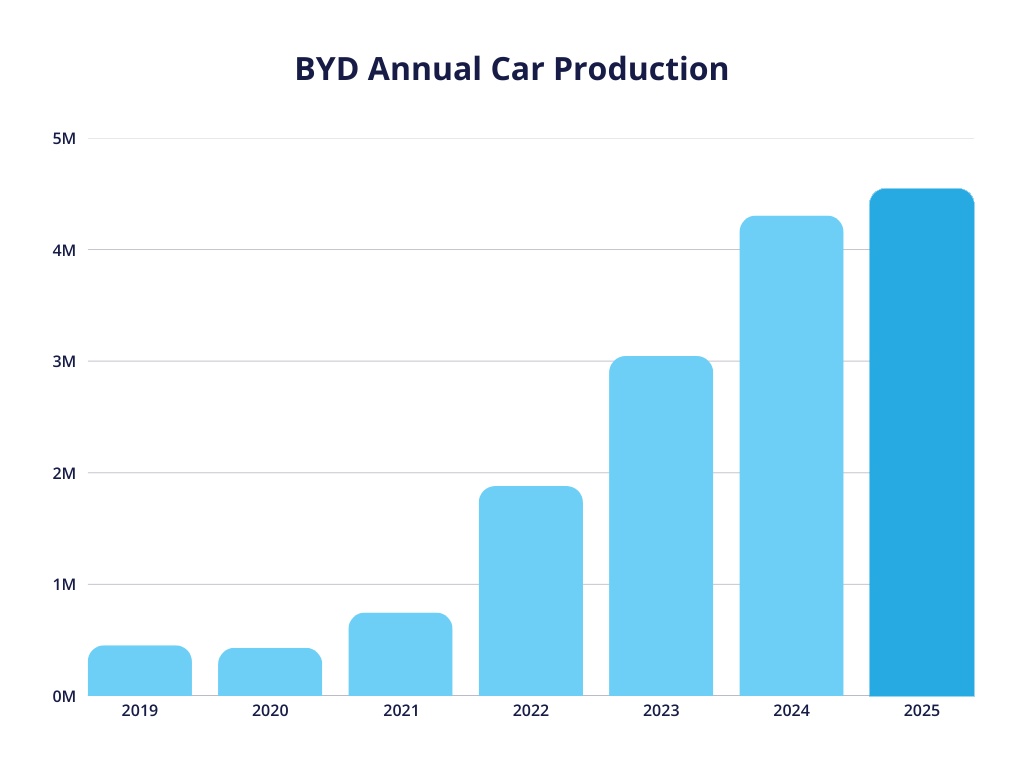
BYD had a solid year in 2025, with worldwide car production reaching new heights despite market challenges.
In 2025 (January to December), BYD produced 4,545,423 passenger vehicles (+6.94% YoY).
Of these, 2.26 million were battery-only passenger cars and 2.29 million hybrids.
BYD solidified its position as the world’s largest producer of electric passenger cars in 2025.
The table below shows BYD’s annual car production from 2019 to 2025:
| Year | Production |
|---|---|
| 2019 | 455,073 |
| 2020 | 431,954 |
| 2021 | 747,540 |
| 2022 | 1,881,669 |
| 2023 | 3,045,231 |
| 2024 | 4,304,073 |
| 2025 | 4,545,423 |
How Many Cars Did BYD Sell in 2025?
Chinese automaker BYD set new records in 2025, though growth slowed amid intense domestic competition and policy changes.
BYD sold a record 4,602,436 NEVs, a 7.73% increase from 2024.
Celebrating two historic achievements: BYD delivered more than 4.6 million New Energy Vehicles in 2025, proudly claiming the Global Sales Champion. For the first time, BYD's overseas sales have surpassed 1 million units in a single year.
— BYD Global (@BYDGlobal) January 1, 2026
Together with our customers worldwide,… pic.twitter.com/iondAvVXW8
Battery electric vehicle (BEV) sales reached 2,256,714, up 27.86% from 2024.
Plug-in hybrid vehicle (PHEV) sales totaled 2,288,709, down 7.91% from 2024.
Commercial vehicle sales reached approximately 57,013.
Overseas sales exceeded 1.04 million units, up over 200% YoY, driven by Europe and Latin America.
BYD Sales by Month
In January 2026, BYD sold 210,051 vehicles, 30.1% lower compared to January 2025, reflecting seasonal trends, subsidy reductions, and market saturation.
In January 2026, we achieved a total monthly sales of 210,051 New Energy Vehicles.
— BYD Global (@BYDGlobal) February 1, 2026
Together, we drive forward to a cleaner, brighter future! #BYD #BuildYourDreams pic.twitter.com/xO852thAQW
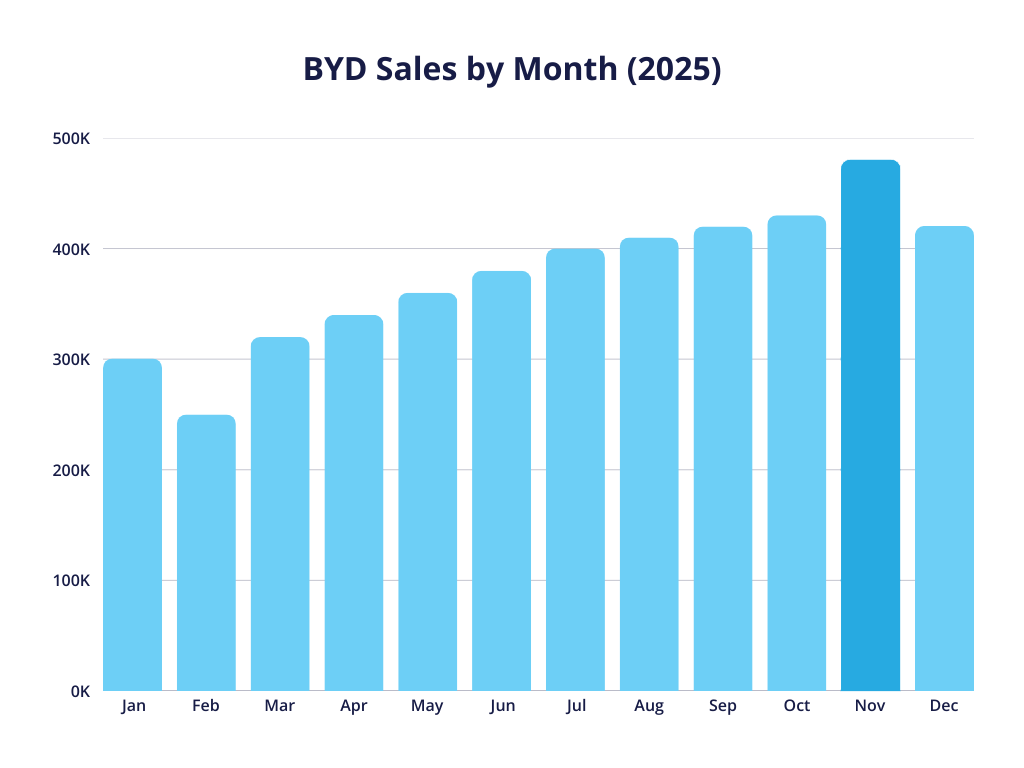
These are approximate BYD sales each month in 2025 (based on quarterly patterns and reports):
| Month | Sales |
|---|---|
| January | 300,538 |
| February | 250,000 |
| March | 320,000 |
| April | 340,000 |
| May | 360,000 |
| June | 380,000 |
| July | 400,000 |
| August | 410,000 |
| September | 420,000 |
| October | 430,000 |
| November | 480,186 |
| December | 420,398 |
November 2025 was the best month, with 480,186 units sold.
BYD Sales by Quarter
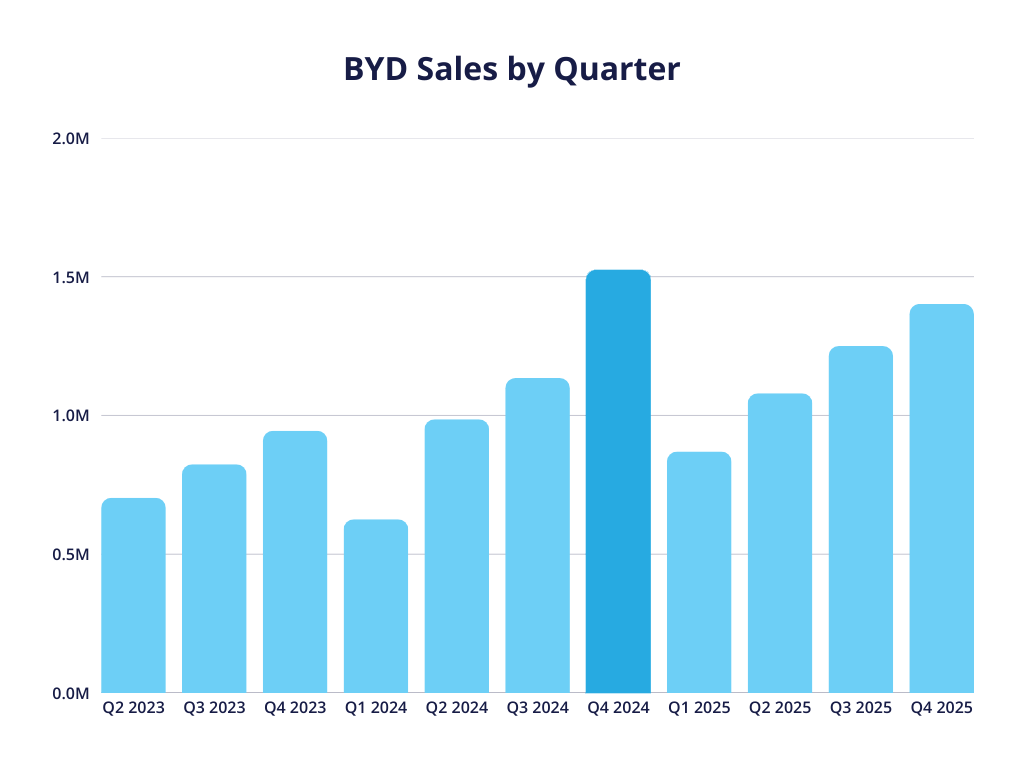
Q4 was the strongest quarter, with over 1.33 million vehicles sold.
| Quarter | Sales |
|---|---|
| Q2 2023 | 703,561 |
| Q3 2023 | 824,001 |
| Q4 2023 | 944,779 |
| Q1 2024 | 626,263 |
| Q2 2024 | 986,720 |
| Q3 2024 | 1,134,892 |
| Q4 2024 | 1,524,270 |
| Q1 2025 | 870,538 |
| Q2 2025 | 1,080,000 |
| Q3 2025 | 1,250,000 |
| Q4 2025 | 1,401,898 |
Sales increased each quarter, with the biggest jump in Q4.
Q4 2024 was BYD’s best quarter ever, with 1,524,270 car sales.
BYD Car Sales by Year
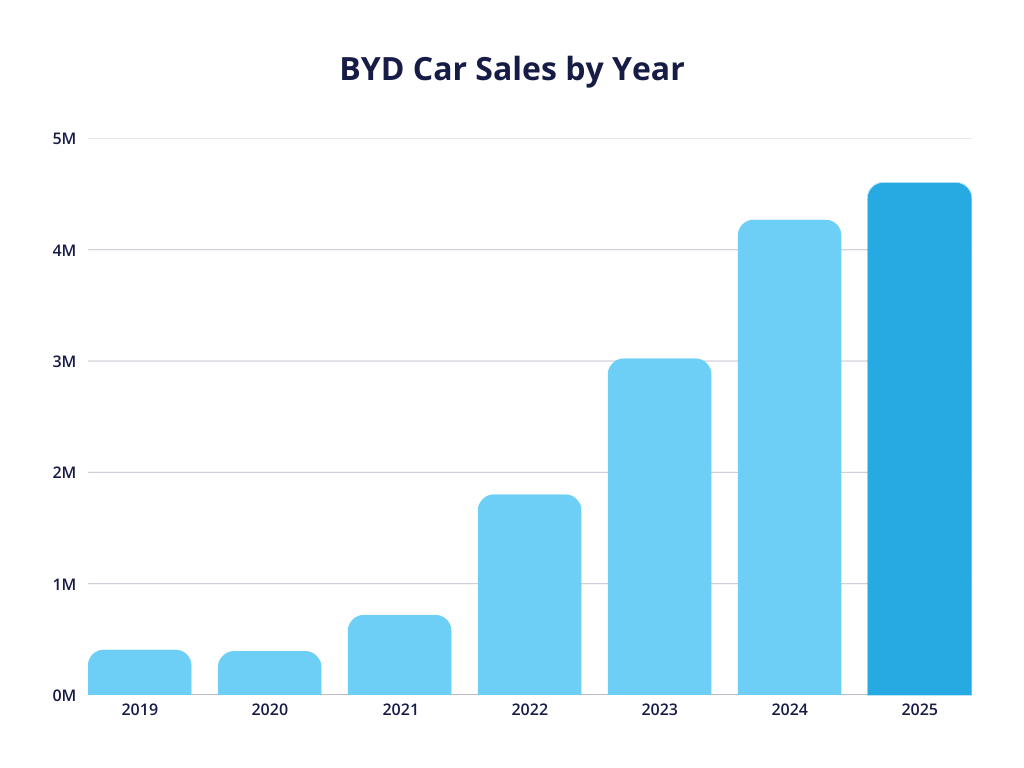
BYD car sales boosted significantly through 2024, but 2025 saw tempered growth due to market dynamics.
We show BYD car annual sales from 2019 – 2025:
| Year | Sales |
|---|---|
| 2019 | 409,421 |
| 2020 | 394,608 |
| 2021 | 721,328 |
| 2022 | 1,802,464 |
| 2023 | 3,024,417 |
| 2024 | 4,272,145 |
| 2025 | 4,602,436 |
BYD has experienced a significant boost in its sales, mainly due to its lower price range and hybrid versions in addition to battery-only powered cars.
How Many Cars Have BYD Sold in 2024?
BYD sold 4,272,145 vehicles in 2024, up 41.3% from 2023.
Breaking New Ground: BYD delivered more than 4 million New Energy Vehicles in 2024, proudly claiming the Global Sales Champion!
— BYD (@BYDCompany) January 2, 2025
Together with our customers worldwide, we're building a cleaner and brighter tomorrow.#BYD #BuildYourDreams pic.twitter.com/yaHUWlUnba
BYD Sales by Model
BYD’s 2025 sales reached 4,602,436 vehicles, with nearly half fully electric.
Ocean and Dynasty Sales
The Ocean and Dynasty Series remained bestsellers.
Together, they reached sales of 3.5 million units in 2024.
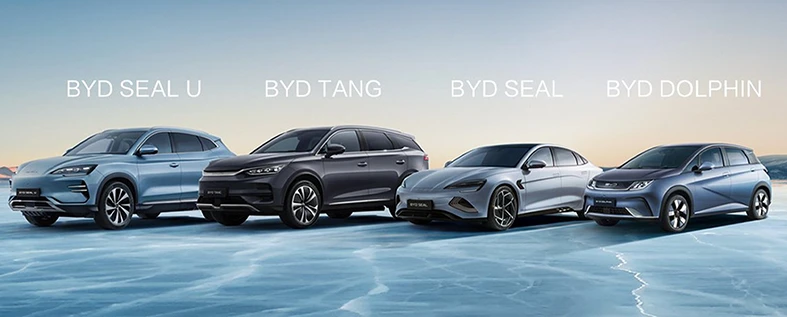
Ocean Models:
- BYD Seagull (Dolphin Surf): 529,537 (+10.48%)
- BYD Dolphin: ~162,744 (Jan-Sep estimate, full year ~400,000)
- BYD Seal: Growing in premium EV segment
Dynasty Models:
- BYD Song: 788,003 (-20.91%)
- BYD Qin: 661,090 (-9.72%)
- BYD Yuan: Stable mid-range performer
- BYD Tang: Premium SUV contributions
Sales of Other Models
There are other notable series and their models:
- Denza D9
- Yangwang U8
- Fangchengbao 5
The YANGWANG U8 doesn’t battle the terrain, it flows with it. From peak to coast, forest to desert… Master the elements to own every horizon! 🌍✨#BYD #BuildYourDreams #YANGWANGU8 pic.twitter.com/hV3gg3Il9i
— BYD Europe (@BYD_Europe) February 6, 2026
BYD Best-selling Models
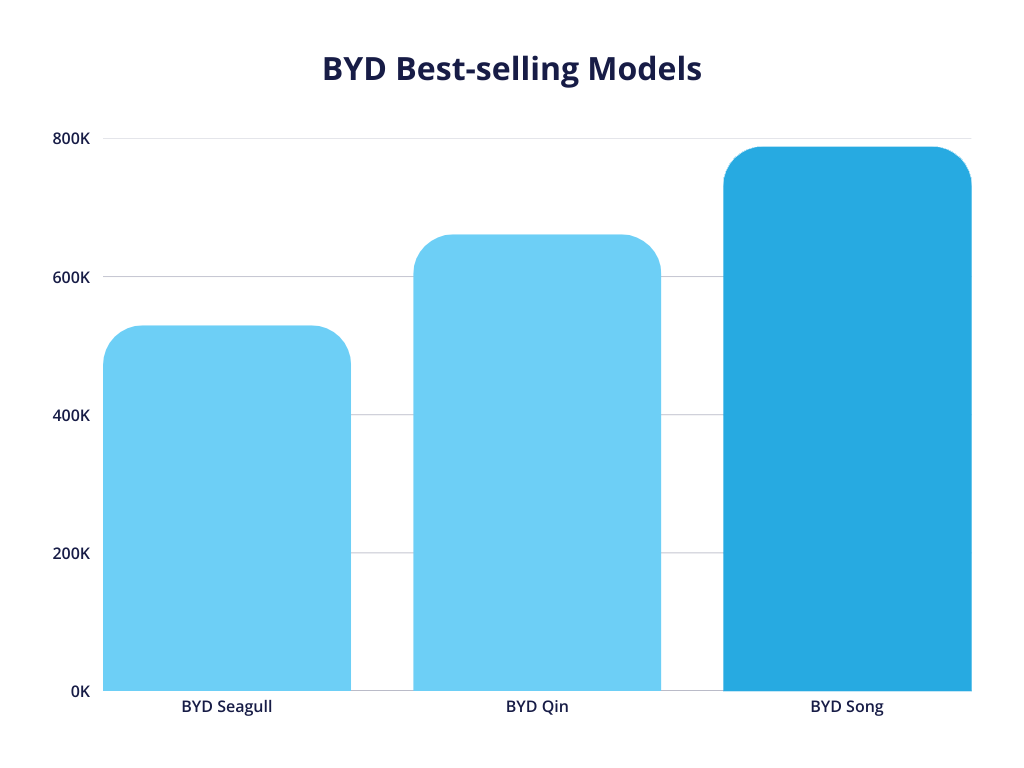
Here is a breakdown of BYD’s best-selling models in 2025:
| Model | 2025 Sales | YoY Change |
|---|---|---|
| BYD Song | 788,003 | -20.91% |
| BYD Qin | 661,090 | -9.72% |
| BYD Seagull | 529,537 | +10.48% |
Best-selling BYD car: BYD Song
BYD SONG PRO and BYD DOLPHIN earn top industry recognition in 2025. pic.twitter.com/L3Uc4C3huS
— BYD North America (@BYDNorthAmerica) January 12, 2026
Sources: BYD, Statista, Electrek, Statista
BYD Sales by Country (China, US, Europe)
The company is working very hard to create an international market presence.
Growth was driven by strong hybrid demand in China, but overseas became a key engine.
In December 2025, BYD exported 133,000 vehicles; annual exports topped 1.04 million.
BYD Sales Worldwide
BYD operates in over 100 countries, selling in 70+ across 6 continents.
In 2025, BYD captured ~18% of the global EV market, selling 4.6 million NEVs out of ~23 million global EVs.
Significant growth, with most from China but overseas surging.
BYD Sales in China
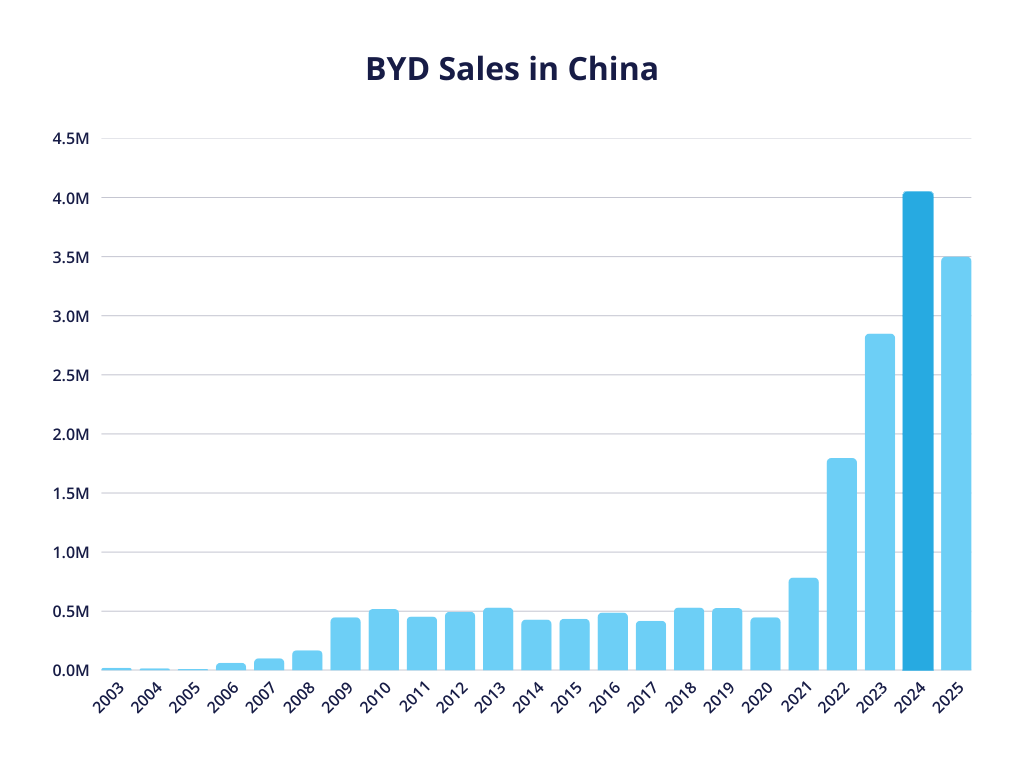
BYD was by far the best-selling EV in China in 2024.
~3.5 million vehicles sold in China (~76% of total, down from 95% due to exports).
Here is a graph that shows the total BYD annual sales in the Chinese market since 2003:
| Year | Sales |
|---|---|
| 2003 | 21,253 |
| 2004 | 17,900 |
| 2005 | 11,038 |
| 2006 | 63,592 |
| 2007 | 101,665 |
| 2008 | 170,880 |
| 2009 | 448,458 |
| 2010 | 519,745 |
| 2011 | 456,152 |
| 2012 | 495,610 |
| 2013 | 531,745 |
| 2014 | 429,946 |
| 2015 | 435,685 |
| 2016 | 489,554 |
| 2017 | 420,294 |
| 2018 | 532,059 |
| 2019 | 528,106 |
| 2020 | 447,994 |
| 2021 | 784,297 |
| 2022 | 1,795,459 |
| 2023 | 2,850,000 |
| 2024 | 4,050,000 |
| 2025 | 3,500,000 |
These figures only show how popular BYD is in China and how dominates its home market.
Source: Good Car Bad Car
BYD Sales in the US
The US presents the biggest challenge for BYD.
Are BYD cars sold in the US?
BYD cars are not yet sold in the US passenger market.
Focus remains on buses and commercial.
The Lancaster facility has produced over 300 buses.
BYD Sales in Europe
By becoming a local European manufacturer with a facility in Hungary with an annual capacity of 300,000 vehicles.
In fact, BYD is “just getting started” selling in Europe, with plans to increase market share.
BYD’s new vehicle registrations in Europe reached 187,657 units in 2025.

In December 2025, BYD registered 27,678 vehicles across Europe (+229.7% YoY).
BYD sales in Germany
In 2025, 23,306 units registered in Germany.
New sales record was set in December with 4,109 BYD units sold.

In January 2026, BYD recorded 2,629 sales.
Interesting fact: BYD was the UEFA EURO 2024 Official Sponsor, hosted in Germany
BYD sales in the UK
In the UK, BYD registered 51,422 vehicles in 2025, benefiting from the lack of tariffs on Chinese-made BEVs.

The UK has become one of BYD’s most successful international markets, with sales in the first nine months of 2025 (+576.9% YoY).
BYD sales in Northern Europe
Norway saw sales double to 5,927 units in 2025 (strong EV adoption at 95% of new sales).
Denmark declined slightly to 2,429 units from 2,766 in 2024.
Sweden also saw minor drops.
BYD sales in Southern Europe
Italy and Spain emerged as high-growth areas.
In Italy, sales increased to 3,347 units in December 2025.
In Spain, BYD sales soared from 3,801 units in 2024 to 15,857 units in 2025.

BYD Annual Revenue
What is BYD yearly revenue?
Full 2025 revenue pending annual report (March 2026).
9-month 2025: 566 billion yuan (~$80 billion USD, up 12.75%).
Estimated full-year ~750-800 billion yuan, driven by hybrids but pressured by competition.
This growth was mainly because of strong plug-in hybrid sales.
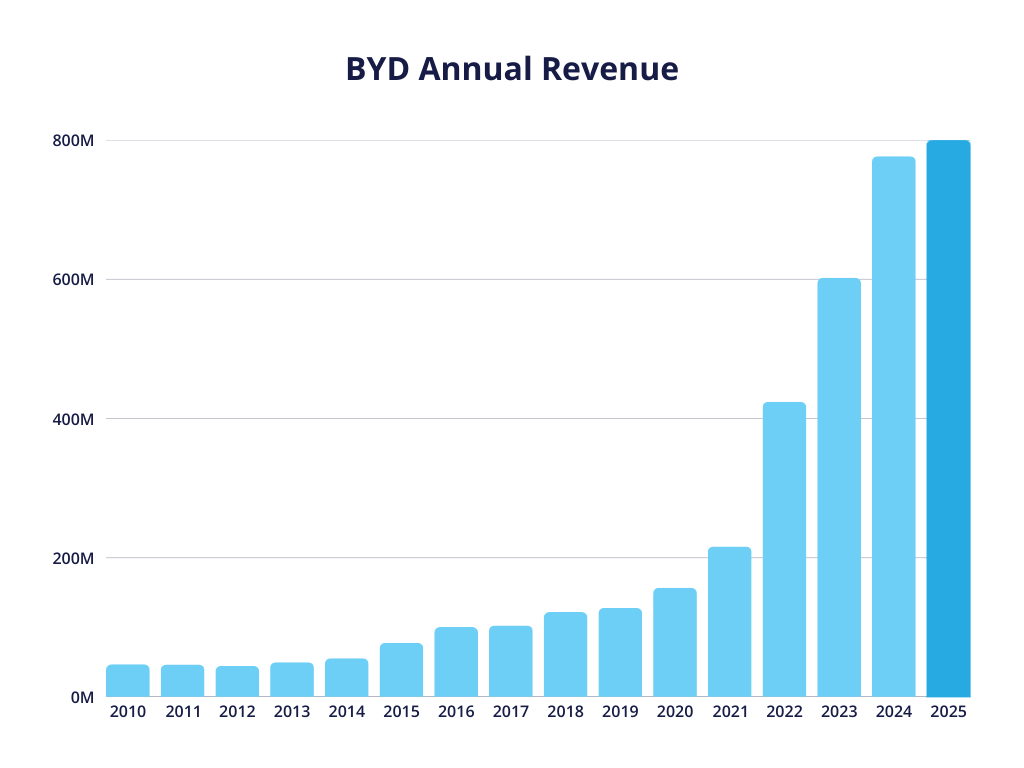
| Year | Revenue (in millions) |
|---|---|
| 2010 | 46.69 |
| 2011 | 46.31 |
| 2012 | 44.38 |
| 2013 | 49.77 |
| 2014 | 55.37 |
| 2015 | 77.61 |
| 2016 | 100.21 |
| 2017 | 102.65 |
| 2018 | 121.79 |
| 2019 | 127.74 |
| 2020 | 156.60 |
| 2021 | 216.14 |
| 2022 | 424.06 |
| 2023 | 602.32 |
| 2024 | 777.10 |
| 2025 | ~800 (est.) |
Sources: BYD
BYD Market Share
BYD is the world’s largest PHEV maker and top BEV producer in 2025.
Global plug-in EV share 2025:
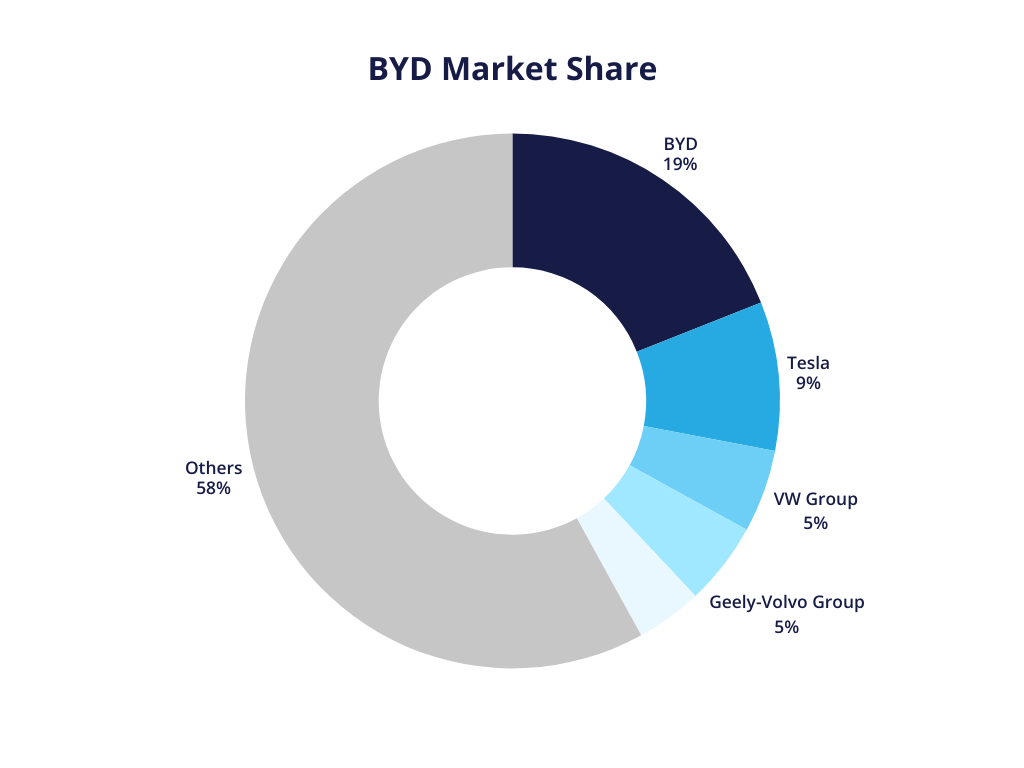
| Manufacturer | Market Share |
|---|---|
| BYD | 19% |
| Tesla | 9% |
| VW Group | 5% |
| Geely-Volvo Car Group | 5% |
| SAIC | 4% |
| Others | 58% |
China NEV share: 36%
Source: Statista
BYD Sales vs Tesla
Tesla: 1.64 million BEVs; BYD: 2.26 million BEVs.
BYD led in BEVs and total electrified vehicles.
Challenges: Western market entry, profits; strengths: cost efficiency, integration.
Related read: Tesla Sales and Statistics for 2025
Loading ...Number of BYD Employees
Over 650,000 employees globally, with 30+ industrial parks and 40+ branches.

Source: Statista
Conclusion
BYD targets 1.3 million overseas shipments in 2026 (up 24% from 2025).
Focus is on Europe and Latin America despite tariffs and market saturation in China.
Challenges include declining domestic demand, but vertical integration in batteries supports cost advantages.
It seems this Chinese manufacturer will remain a major player in the global shift towards electric vehicles in 2026.
What do you think? Let us know in the comment section below!