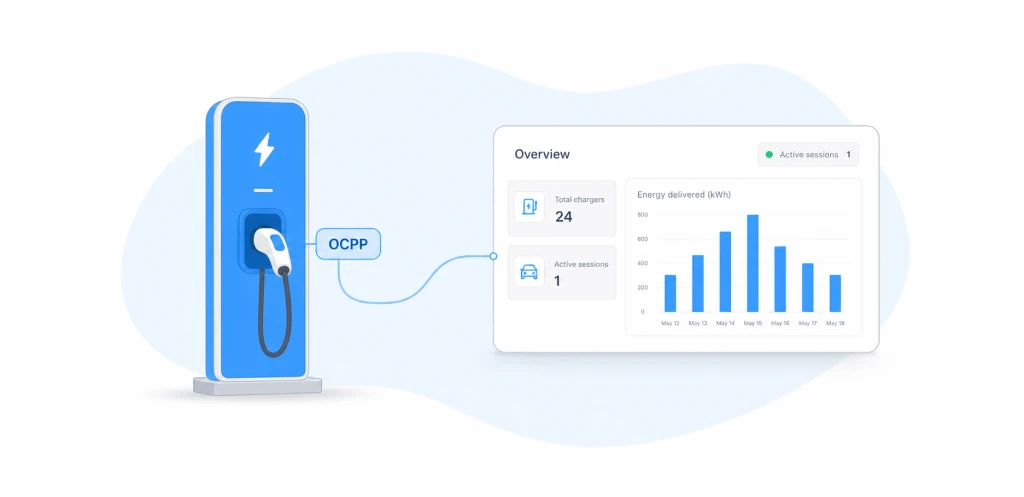


Connect OCPP-compliant hardware, monitor sessions in real time, manage tariffs, support roaming, and bill customers with OCPP software.
OCPP software is the control layer behind a charging network. It connects your chargers to one backend so you can monitor status, manage sessions, push remote commands, control energy use, and turn charging activity into billable revenue.
Almost every platform claims OCPP support, so that claim tells you little. The decision that actually matters is whether the software fits your charger mix, supports OCPP 1.6J today with a clear path to 2.0.1 and 2.1, and handles the commercial work around pricing, payments, roaming, and reporting. OCPP is the communication standard. OCPP software is the business and operations layer that runs on top of it. This guide helps you compare platforms by operating need rather than by a protocol checkbox.
 Loading ...
What OCPP software actually does
OCPP software communicates with charge points via the Open Charge Point Protocol, which defines how a charger and a central system exchange messages for status, authorization, meter readings, transactions, remote commands, firmware updates, diagnostics, and smart charging.
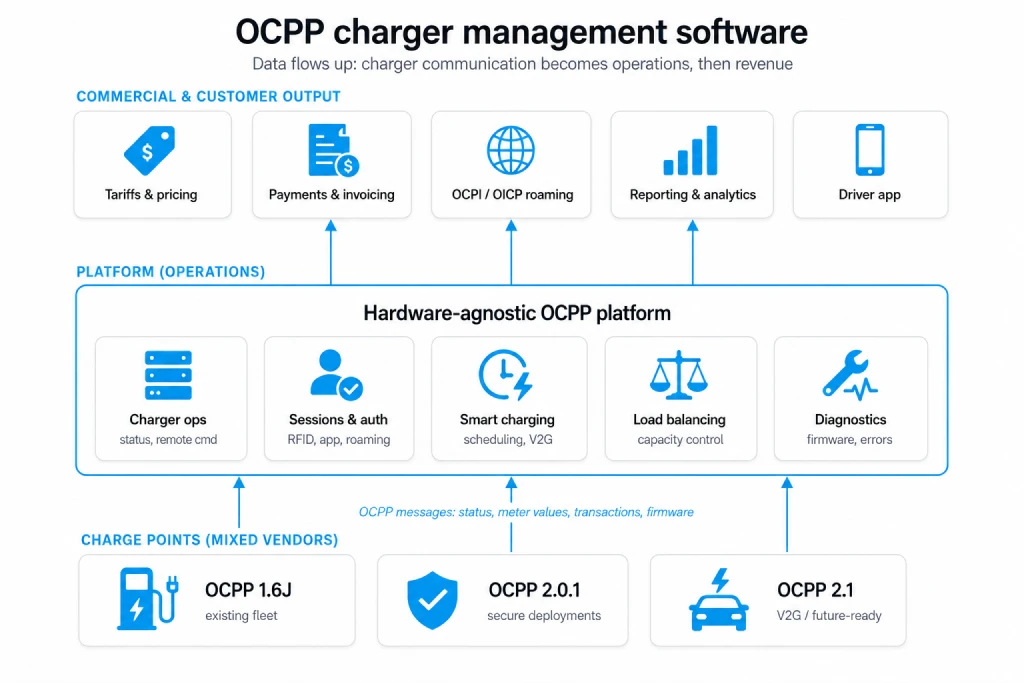
In daily use it is your operations command center. Teams onboard chargers, watch connector status, manage sessions, send remote commands, troubleshoot faults, control energy, and connect that activity to billing, settlements, and driver-facing services.

What to look for in OCPP software
The right platform helps you run the charging business, not just connect chargers to a backend. Evaluate it across these areas.
OCPP version support. Support for OCPP 1.6J covers the bulk of deployed chargers, with a clear upgrade path to OCPP 2.0.1 and 2.1 for newer security, device management, smart charging, and future V2G use cases.
Hardware-agnostic charger management. You should be able to connect chargers from different manufacturers without being locked into one hardware ecosystem. This is the single biggest reason buyers look for OCPP software, and it matters most for operators that expand across sites, acquire networks, or work with multiple vendors. Good software exposes connection status, boot notifications, connector state, meter values, configuration keys, diagnostics, and errors in a form your team can act on.
Real-time operations. Look for live charger status, connector availability, session monitoring, alerts, remote commands, firmware updates, diagnostics, and error handling. If operators cannot see and fix issues fast, uptime suffers.
Monetization. Session data should flow straight into tariffs, payments, invoices, subscriptions, fleet pricing, roaming settlement, taxes, and reporting. Expect pay-as-you-go, prepaid, postpaid, time-of-use, location-based pricing, fleet rates, vouchers, and group discounts. Tridens EV Charge covers these commercial layers. Without them, the platform runs operations but creates manual work for finance.
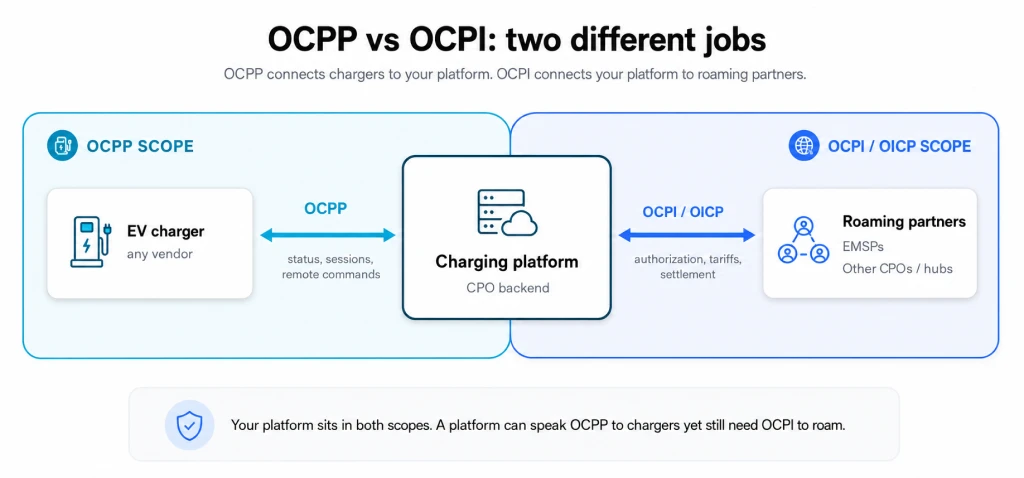
Roaming and driver experience. OCPP handles charger-to-platform communication, but public networks also need roaming via OCPI or OICP, so that authorization, tariffs, session data, and settlement can move across partners. Branded app, payments, receipts, notifications, and support workflows should be evaluated together, or drivers get a fragmented service.
Smart charging and load balancing. As networks scale, power availability becomes a business constraint at depots, destination sites, fast-charging hubs, and grid-connected locations. Dynamic load balancing distributes capacity, prioritizes selected sessions, reduces the risk of overload, and can delay expensive infrastructure upgrades.
Reporting and integrations. Charging data has to reach payments, tax, accounting, CRM, ERP, customer portals, apps, and roaming networks. Weak integrations push reconciliation back onto your team.
Ready to get started?
Learn how your business can thrive with #1 OCPP software.

OCPP 1.6J, 2.0.1, and 2.1 at a glance
Most networks need to support more than one version. The practical answer is software that runs your current 1.6J chargers while providing a path to 2.0.1 and 2.1, protecting existing investments and reducing migration risk.
| OCPP 1.6J | OCPP 2.0.1 | OCPP 2.1 | |
|---|---|---|---|
| Charger compatibility | Widest (most deployed) | Growing | Newest |
| Security | Basic | Stronger | Stronger |
| Device management | Limited | Improved | Improved |
| Smart charging | Basic | Advanced | Advanced |
| ISO 15118 / V2G | No | Partial | Yes (15118-20, bidirectional) |
| Best fit | Existing fleets, migration | New secure deployments | V2G and future-ready networks |
For ISO 15118, Plug & Charge, and V2G, assess how the software handles certificate workflows, authorization, session management, and the more complex metering and settlement required for bidirectional energy flows.
Is free or open-source OCPP software enough?
Free and open-source OCPP tools are useful for testing chargers, learning the protocol, or running small pilots. Commercial networks usually fall short on their own. A production CPO also needs uptime monitoring, user management, pricing, billing, payments, roaming, support, reporting, security, and integrations. When those layers are missing, teams end up building and maintaining custom systems around the OCPP backend. That can suit an engineering-led organization, but for most growing operators, a complete CPO platform that covers OCPP and the business processes around it is the lower-risk choice.
How to choose: a practical evaluation
Start with your operating model, not a vendor feature list.
- List what you must support. Charger models, OCPP versions, sites, power levels, and countries, including planned chargers, not just installed ones.
- Define your business model. A public CPO, fleet depot, utility program, retail host, parking operator, and hardware maker each needs different workflows.
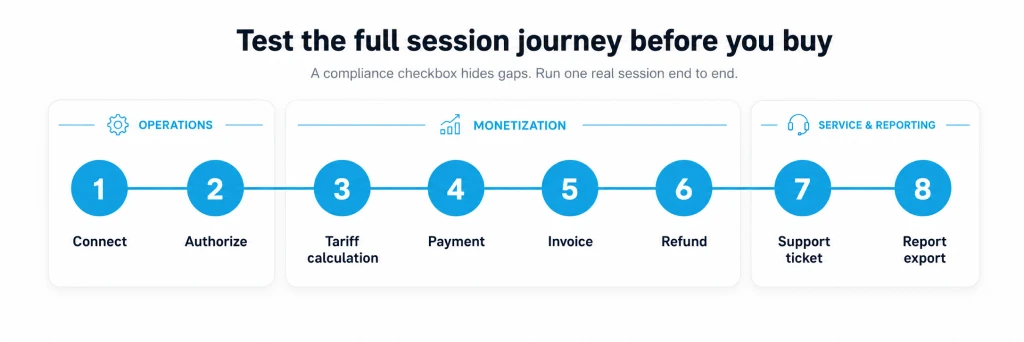
- Test the full session journey. Run a session from connection through authorization, tariff calculation, payment, invoice, refund, support ticket, and report export. This exposes gaps a compliance checklist misses.
- Pressure-test scale. Ask about onboarding, APIs, charger migration, integrations, monitoring, alerting, implementation support, and troubleshooting.
Your shortlist should demonstrate charger interoperability, support modern pricing, integrate with payments and roaming, and provide operators with enough visibility to catch problems early.
Why choose Tridens EV Charge for OCPP charger management
Tridens EV Charge is a hardware-agnostic platform built for companies that need OCPP-compliant software as part of a complete charging business. It supports OCPP 1.6J, 2.0.1, and 2.1, with ISO 15118 V2G readiness, and connects real-time monitoring, remote actions, dynamic load balancing, pricing, payments, customer management, reporting, eRoaming through OCPI and OICP, and a white-label driver app.
The advantage is not OCPP support by itself. It is connecting charger communication to the commercial workflows that decide whether a network can scale.