

Learn about OSS in Telecom and discover how robust network operations can scale your business.
Table of contents
Before the 70’s, OSS activities were performed manually, usually through long administrative processes.
Since the rise of computer technology, telecom companies developed various computer systems that automated telecom tasks.
Those systems were later referred to as OSS (Operations Support Systems).
OSS Meaning – What Does OSS Stand For?
OSS (Operations Support Systems) are computer systems used by telecommunications service providers to manage network-facing aspects of organizations.
They primarily support management functions, such as network management, service provisioning, assurance and fulfillment.
When used together with BSS (Business Support Systems), operations support systems are able to support end-to-end telecom services.
Without both systems, reaching a sophisticated level of telecom management is difficult, if not impossible.
What is OSS in Telecom?
OSS in telecom assists network operators with managing communication networks.
Specifically, OSS focuses on providing information about physical telecommunications infrastructure and comms network administration.
OSS in the Telecom Domain
OSS in the telecommunications domain was originally known as TMN (Telecommunication Management Network) tools.
Since their early days, these solutions have become much more sophisticated and efficient.
Operations support systems allow an organization to coordinate network-facing services, resources, processes and activities.
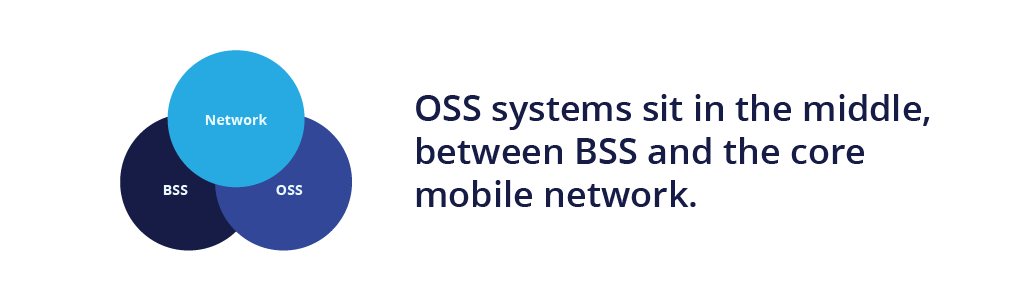
For MVNOs (Mobile Virtual Network Operators), and other CSPs, OSS systems sit in the middle, between BSS (Business Support Systems) and their core mobile networks.
OSS Management Systems
OSS management systems in telecom help with the following key operations:
- Network Management: Ensures the stability and administration of communications networks.
- Service Fulfillment: Processes and ensures completion of customer requests provided by BSS.
- Service Assurance: Identifies and notifies BSS about service issues, for minimal downtime and customer complaints.
- Service Delivery: Manages network resources to reduce wastage and over-provisioning.

Operations Support Systems tend to be specific to the telco industry.
They are primarily used by MNOs (Mobile Network Operators) and other CSPs (Communication Service Providers) looking for a robust platform for their network infrastructure operations.
This is why main OSS suppliers are commonly network equipment vendors themselves, like Ericsson and Nokia.
OSS Integration in Telecom
OSS integration in telecom is important for efficient communication with BSS.
Operations Support Systems (OSS) have emerged as a backbone of IT in telecommunications infrastructure.
However, the saying: “The chain is as strong as its weakest link.” certainly applies to OSS systems.
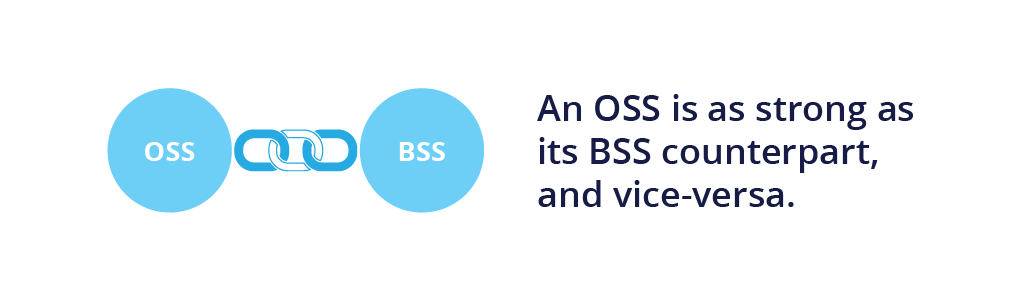
An OSS is as good as its Business Support System (BSS) counterpart, and vice-versa.
Effective OSS must communicate outages, maintenance, and other network issues to BSS systems.
This, in turn ensures customers stay informed and avoids provisioning issues.
This process, known as Service Assurance, is crucial for customer satisfaction.
Efficient OSS integration with BSS is vital for smooth network operations and high customer satisfaction in telecom infrastructure.
OSS Architecture in Telecom
OSS architecture in telecom is utilized by Communication Service Providers (CSPs) to manage complex network infrastructure.
The architecture provides a structured and thought-out approach to network management needs of CSPs.
It enables them to handle the growing demand for reliable and high performance network services.
OSS Layers: Standardized Telecom OSS Architecture
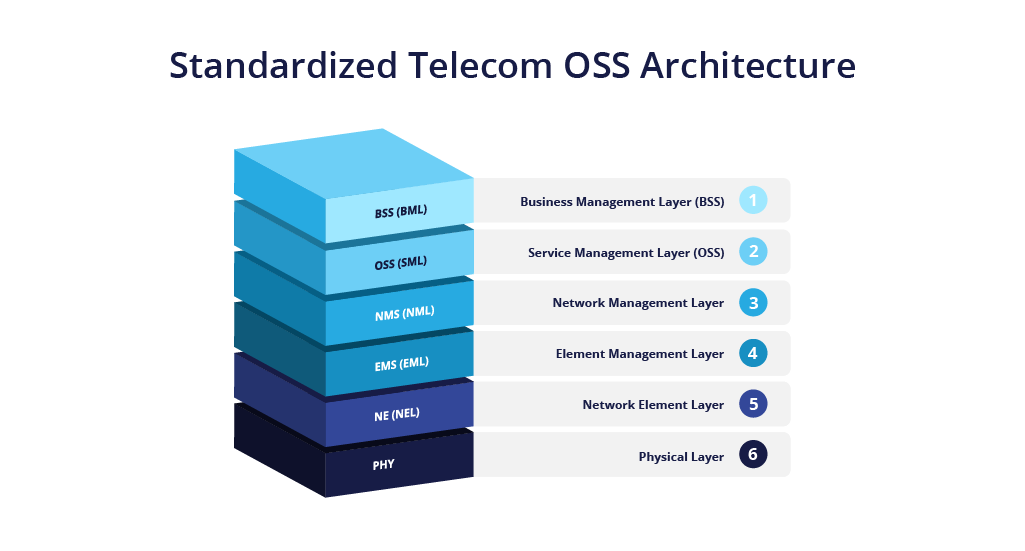
Standardized telecom OSS architecture was defined in the 90’s by ITU Telecommunication Standardization Sector (ITU-T).
They developed a TMN (Telecommunications Management Network) model, which shows the following six layers of a telecom OSS:
- BML: Business Management Layer – roughly similar to BSS functionality.
- SML: Service Management Layer – roughly similar to OSS functionality and is responsible for defining the services offered by carriers.
- NML: Network Management Layer – provides overall management view of the network.
- EML: Element Management Layer – definition and coordination of a collection of network devices.
- NEL: Network Element Layer – represents customer network devices.
- PHY: Physical Layer – represents the connectivity between devices, including cables, joints, and other hardware.
Top OSS Systems Vendors for Telecom (Examples)
According to recent data from 2023, North America leads the OSS/BSS market – with over 45% market share.
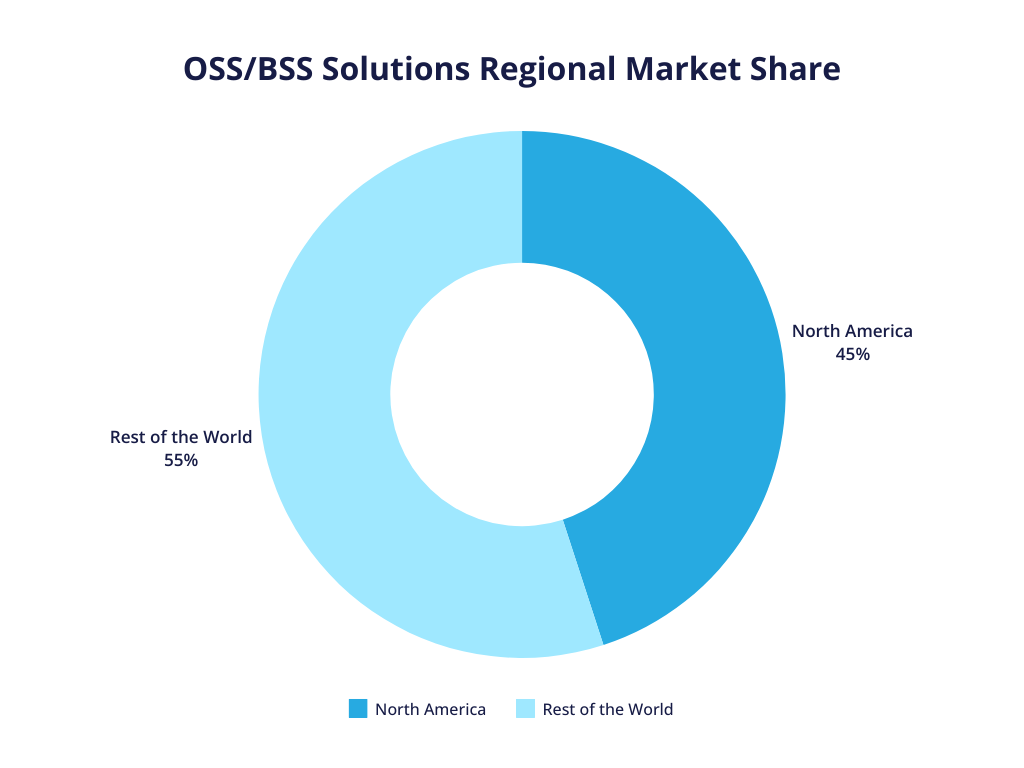
They are driven because of advanced telecom infrastructure and also a high adoption rate of new technologies.
Let’s look at some examples of leading OSS system vendors worldwide and the key features that distinguish them from their competitors.
Nokia
Nokia is a global leader in telecom solutions.
It offers advanced AI-powered OSS systems for modern networks.
Key features:
- AI Integration and Automation
- Dynamic network slicing
- Scalable cloud solutions
IBM
IBM is a leader in robust enterprise technology solutions.
It offers OSS systems designed to enhance efficiency and security for modern enterprises.
Key features:
- Advanced encryption and key management
- Real-time tracking
- Multi-cloud environment support
Huawei
Huawei provides leading ICT solutions.
They offer advanced OSS systems, tailored for digital economy.
Key features:
- OSS-as-a-service
- Real-time automation
- Cloud integration
Tridens Monetization for Communications
Tridens offers a tailored and personalized BSS/OSS solution, designed for telecom industry professionals.
We will make sure that your business receives dedicated and easily accessible customer support.
Our cloud-native software, tailored to your management needs, can simplify your telecom operations, making it easier than ever to enhance efficiency.
Key features:
- Personalized and tailored BSS/OSS solutions, for seamless telecom management.
- API-first design and no code configuration.
- Integration support for payment, tax and automation services.

Ready to transform your telecom operations with a partner who understands you needs?
Discover how Tridens Monetization for Communications can help you succeed.