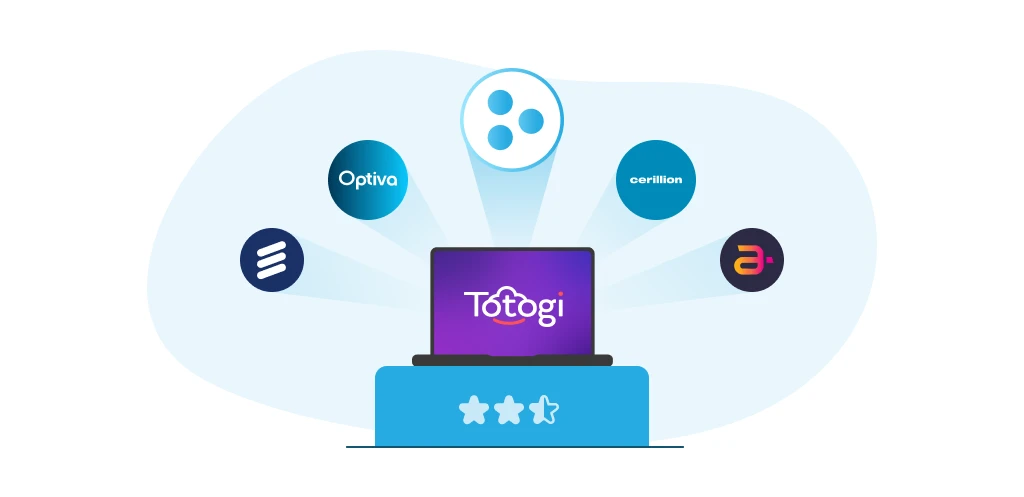
Looking to replace Totogi? Here are 5 powerful BSS alternatives for 2026, with a detailed look at the pros and cons of each one.
Inhaltsverzeichnis
Why Look for Totogi Alternatives?
Are you growing frustrated with Totogi’s telecom monetization platform?
In this article, we’ll explore the top 5 Totogi alternatives with a detailed look at the pros and cons of each.
These alternatives can help telecom providers find a better option than Totogi.
What is Totogi?

Totogi is a cloud-native, AI-driven telecom charging and BSS platform owned by Danielle Rios (TelcoDR).
It promises hyperscale capabilities and limitless scalability.
Totogi enables rapid plan creation and personalized offers by using AI to bypass the usual months of manual programming.
With its advanced AI solution, Totogi BSS Magic, Totogi can automate the modernization of telecom business systems.
In short, it’s definitely an ambitious product aiming to revolutionize telco monetization.
But can they compete with the industry giants?
Here are some of the main weaknesses of Totogi and common reasons why organizations look for alternatives:
- Product maturity and limitations: As a newer platform (launched in 2021), Totogi’s feature set is still evolving. It focuses heavily on charging and AI automation, which may leave gaps in traditional BSS functionality or customization.
- Integrations and extensibility: Some integrations with payment gateways and migrations from legacy BSS/OSS systems may be more limited due to Totogi’s newer platform.
- Pricing and support quality: Very expensive with minimal support.
- Bedenken hinsichtlich der Bindung an einen bestimmten Anbieter: If you’re already a customer, transitioning away from Totogi’s platform can be complex due to potential data portability challenges and contractual terms with tricky exit clauses.
Totogi Alternatives and Competitors
| Alternativen | Wesentliche Merkmale | Am besten für |
|---|---|---|
| Tridens Monetization | Robust, all-in-one cloud-native BSS solution. Real-time convergent charging, metered billing, built-in CPQ, unified payment automation, multi-model billing support, full system integration, branded self-service portal, automated revenue recognition, product catalog, rating, invoicing, payments, customer management. | MNOs, MVNOs, and Tier-1 CSPs and subscription-based businesses that need agile, no-code billing, complex billing models, real-time usage tracking, and fast time-to-market with scalable cloud-native architecture. |
| Ericsson | Convergent real-time charging & billing, powerful product catalog, cloud-ready, scalable architecture | Large Tier-1 CSPs and MVNOs upgrading legacy BSS for 5G and IoT, operators requiring carrier-grade reliability. |
| Amdocs | Convergent billing and charging, product catalog and order orchestration, customer experience and CRM tools, Cloud deployment flexibility | Tier 1 operators, ideal for those launching 5G or managing complex service portfolios with strict compliance or multi-market needs. |
| Optiva (Qvantel) | Cloud-native convergent charging, AI automation, no/low-code, 5G ready | CSPs and MVNOs seeking a modern, agile BSS with fast time-to-market (especially medium and large operators). |
| Cerillion | Convergent billing and charging (fixed and mobile), enterprise product catalog and CRM, self-care portals, interconnect billing, cloud/SaaS options, TM Forum–compliant APIs. | MVNOs, MVNEs and digital brands who want a flexible, modular BSS/OSS suite with strong subscription billing and MVNO support. |
Tridens Monetization

Tridens Monetization is a comprehensive BSS solution for charging, billing, and revenue management.
Tridens offers a full BSS stack, convergent charging, and billing in one system.
Tridens Monetization BSS is designed for flexibility and automation. It supports complex pricing models and real-time charging for any service type: prepaid, postpaid, subscriptions, and usage-based.
The software is engineered to handle high transaction volumes with minimal latency (millions of users), making it more robust than Totogi and other alternatives.
Tridens incorporated AI to transform billing from a manual task into a proactive business strategy.
Wesentliche Merkmale
- Convergent Billing & Charging: Tridens offers convergent charging and billing in one system. It can instantly rate and charge events in real-time as services are consumed, preventing revenue leakage. Online (prepaid) and offline (postpaid) charging are both supported with flexible consumption rules and real-time notifications.
- Product Catalog & Offer Design: Includes an advanced product catalog for innovative offer design. Telcos can configure a wide range of products, plans, bundles, discounts, and contract terms to create tailored offers. This makes it easy to launch new packages or custom plans without custom development.
- Customer Management & Self-Service: Provides integrated customer management tools. Users can manage accounts, hierarchies (for enterprise or family plans), contracts, and more. Tridens also supports customer and partner self-service portals (web or mobile app) for tasks like viewing usage, managing subscriptions, and payments.
- AI Features: Tridens AI-Agenten automate repetitive workflows, enabling teams to focus on growth and strategy.
- Analytics & Revenue Assurance: Tridens comes with built-in reporting and analytics dashboards to track revenue, customer behavior, and service usage in real-time. It also has fraud detection and monitoring tools to ensure revenue assurance and compliance.
- Integration-Friendly & Cloud-Ready: The platform has a modular, API-first design for easy integration with CRM, ERP, payment gateways, tax engines, and more. Deployment can be cloud (SaaS or private cloud) or on-premises, depending on the operator’s needs – offering more deployment flexibility than Totogi’s AWS-only approach.
Why Do Companies Choose Tridens Monetization Over Totogi?
- Greater Flexibility and Configurability: Tridens Monetization supports a wide range of business models and customization options. For example, it handles any combination of prepaid, postpaid, subscription, and one-time charges within a unified system. Operators can tailor pricing rules and discounts extensively. This adaptability makes Tridens suited to diverse needs – from traditional telecom services (voice, SMS, data) to digital and IoT services – whereas Totogi’s approach can feel more “one-size-fits-all” with its preset AI-driven plans.
- Proven Reliability and Performance: Tridens is built on mature technology that emphasizes low latency and high uptime. It delivers quick real-time response for charging and monitoring, ensuring the billing process never lags the network. This focus on performance and stability helps mitigate the connectivity/reliability concerns that a cloud-only platform like Totogi raises. In short, Tridens can be faster and more responsive under load.
- Broad Integration Capabilities: Tridens offers out-of-the-box connectors and a modular API design that integrates with CRM systems, ERPs, external product catalogs, payment gateways, and taxation services. This makes it easier to slot into existing IT environments. Totogi is API-driven, but as a newer platform, it may require more custom work for certain legacy integrations.
Für wen ist Tridens Monetization eine gute Wahl?
Tridens Monetization BSS is a top solution for CSPs that want to transform their business, as well as agile telcos looking to outpace the competition. It eliminates the friction of traditional billing, allowing providers to launch innovative services instantly without the burden of back-office complexity.
Its flexible architecture serves communications providers of all sizes, from emerging digital service providers up to Tier-2/Tier-1 operators, making it a primary choice for those looking for Totogi alternatives.
Lesen Sie dazu: Tridens vs Totogi
Was echte Benutzer über Tridens Monetization sagen
Here are some reviews from Kapitelra.
We are satisfied with the platform because it gives us the tools to support our business cases and enables our current and future growth. We established a genuine partnership relationship with the vendor.
Goran H. – Kapitelra
The product configurability and versioning options are a very welcome feature which allowed me to omit multiple other tools I was using previously, and saved a lot of manual work. I can create new offers for my clients on-the-fly by bundling together my existing products. I would definitely recommend Monetization.
Ana A. – Kapitelra
Robust and scalable product with a great UX experience. The support team is always there to help you.
Marko B. – Kapitelra
Ericsson Digital BSS

Ericsson’s Digital Monetization Platform (often called Digital BSS) is a carrier-grade convergent charging and billing system.
It handles “all customers and services in a real-time, streamlined, convergent charging and billing system, covering prepaid and postpaid, voice and data, fixed and mobile, and retail and wholesale”.
In other words, prepaid mobile plans, postpaid data, fixed-line subscriptions, enterprise services – all run through one platform.
Wesentliche Merkmale
- Fully convergent real-time charging and billing: Supports unified billing and charging for all service types whether mobile, fixed-line, or wholesale.
- Flexible product catalog and offers: Allows telecom providers to design and manage sophisticated pricing plans, bundles, promotions, and discounts.
- Support for multi-play services and IoT: Handles bundled offerings across voice, broadband, TV, and IoT devices.
- Robust REST APIs and integration: Enables seamless communication with third-party systems and tight alignment with Ericsson’s operations and business support solutions.
- Cloud-native options: Designed to run efficiently in modern cloud environments using containerization and orchestration platforms like Kubernetes.
- Real-time analytics and AI optimizations: Provides real-time insights into customer behavior and service performance, using artificial intelligence to help operators automate decisions.
Ericsson Strengths & Weaknesses
| Strengths | Weaknesses |
|---|---|
| Trusted by Tier-1 operators | Complex to deploy |
| Scalable and reliable | Higher cost of ownership |
| End-to-end solution | Complex migration from legacy systems |
| Strong partner ecosystem | Too broad for smaller MVNOs |
| Suitable for 5G/IoT scenarios | Not very suitable for smaller companies |
Who Is Ericsson a Good Fit For?
Ericsson is primarily a good fit for bigger enterprises with complex MVNO models.
Amdocs

Amdocs is one of the most established names in telecom software, offering a comprehensive suite of BSS and OSS solutions used by many of the world’s largest operators.
Its portfolio includes systems for billing, charging, customer care, ordering, catalog management, and digital engagement. Amdocs is known for its scale, configurability, and global delivery capabilities.
With acquisitions like Vindicia (for subscription billing) and Openet (for policy and charging), Amdocs has expanded its real-time monetization offerings and supports next-generation use cases including 5G network slicing, IoT, and enterprise services.
Wesentliche Merkmale
- Convergent billing and charging: Handles all customer types—prepaid, postpaid, hybrid—and all service types within a unified platform.
- Product catalog and order orchestration: Offers a centralized product catalog with lifecycle management and strong support for complex offers, bundles, and fulfillment workflows, streamlining go-to-market operations across multiple services.
- Customer experience and CRM tools: Provides integrated customer care systems and digital engagement tools including chatbots, AI agents, and omnichannel support.
- Cloud deployment flexibility: Supports multi-cloud, hybrid cloud, or full on-premise setups, allowing operators to migrate at their own pace.
- Advanced analytics and 5G monetization: Includes real-time data insights, AI-based personalization, network slicing, QoS-based pricing, and enterprise self-service.
Amdocs Strengths & Weaknesses
| Strengths | Weaknesses |
|---|---|
| Trusted by Tier-1 operators | High cost of ownership |
| Deep telecom expertise | Mostly suited for enterprise |
| Good integration services | Steeper learning curve |
| Good fit for complex telco environments | Complex setup/implementation |
| User-friendly & modern UI | Lacks certain AI features |
Für wen ist Amdocs eine gute Wahl?
Tier-1 telecom operators, large MVNOs, and converged service providers looking for a scalable, enterprise-grade BSS/OSS suite with full lifecycle capabilities. Ideal for those launching 5G or managing complex service portfolios with strict compliance or multi-market needs.
For enterprises looking for Totogi alternatives, Amdocs is a tried and tested solution.
Optiva

Optiva’s BSS platform, now integrated into Qvantel’s Flex Suite, offers a cloud-native, real-time charging and billing solution.
The Optiva Charging Engine is 5G-ready and processes convergent charging across networks.
Combined with Qvantel Flex BSS (a modern digital BSS), the joint offering provides an AI-driven, low-code/ no-code platform.
Wesentliche Merkmale
- Cloud-native convergent billing/charging: Delivers real-time billing and charging for all service types (prepaid, postpaid, data, voice, and digital).
- AI-powered automation: Uses artificial intelligence to streamline tasks like pricing optimization, offer configuration, usage forecasting, and anomaly detection.
- No/low-code: Allows business users to design, launch, and manage products, workflows, and customer journeys without writing code.
- Support for multi-tier (B2B2X) models: Enables telecom operators to serve enterprise clients, resellers, and partners by managing complex hierarchies and custom offers.
- Hybrid cloud deployment: Offers flexible deployment on public cloud, private cloud, or a mix of both.
Optiva Strengths & Weaknesses
| Strengths | Weaknesses |
|---|---|
| Agile & Configurable | Steep learning curve for legacy operators |
| Real-time, 5G-ready stack | Higher cost of ownership |
| Extensive support | Complex migration from legacy systems |
| Stable product | Slower time to market |
| AI-driven optimization | Begrenzte Integrationen von Drittanbietern |
Who Is Optiva a Good Fit For?
Optiva is primarily suited for Tier 1 and Tier 2 MVNOs and MVNAs that are looking for an AI-driven BSS and CSPs that prefer a cloud solution.
Cerillion

Cerillion is a specialist telecom software company that offers a convergent BSS/OSS suite for billing, charging, CRM, and more.
Its core modules include a 3GPP-compliant real-time charging system, a product catalog and order management, an omni-channel CRM, and a convergent billing and revenue manager for multi-play services.
Recent releases have added AI capabilities – for example, Cerillion 25.2 introduced a natural language “Billing Agent” and AI-powered sales and workflow agents.
Cerillion also offers white-label mobile apps and self-care portals for end users.
Wesentliche Merkmale
- Konvergente Gebührenerhebung und Abrechnung: Supports unified billing for all service types (mobile, fixed, prepaid, and postpaid) from a single platform.
- Enterprise product catalog: Centralized catalog that lets operators create and manage complex service bundles, pricing plans, and promotional offers.
- CRM and customer tools: Provides built-in customer relationship management features like account management, trouble ticketing, and guided sales workflows.
- Real-time usage mediation: Collects, formats, and processes usage data (e.g., calls, data sessions) from various network elements in real-time, ensuring accurate charging.
- Selbstbedienungsportale: Offers customizable web and mobile portals for customers to manage their accounts, view usage, pay bills, and modify services.
Cerillion Strengths & Weaknesses
| Strengths | Weaknesses |
|---|---|
| Modular and flexible | Outdated UI design |
| Frequently updated | Legacy technologies |
| Cost-effective | Steeper learning curve |
| Evergreen SaaS model | 3rd party integration difficulties |
| Strong feature set for MVNOs | Langsame Unterstützung |
Who Is Cerillion a Good Fit For?
MVNOs, MVNEs, private networks and regional CSPs who need a fully-featured BSS/OSS without the complexity of big incumbents. Digital service providers (e.g. niche mobile brands, fixed broadband providers) will find Cerillion’s Telecom-tailored modules a good fit.
Tridens Monetization – The #1 Totogi Alternative
While Totogi provides a reliable digital BSS platform, it falls short in several critical areas.
Its lack of flexibility, prohibitive costs, and limited responsiveness leave businesses seeking a more adaptable and cost-effective solution.
That’s where Tridens Monetization BSS comes in.
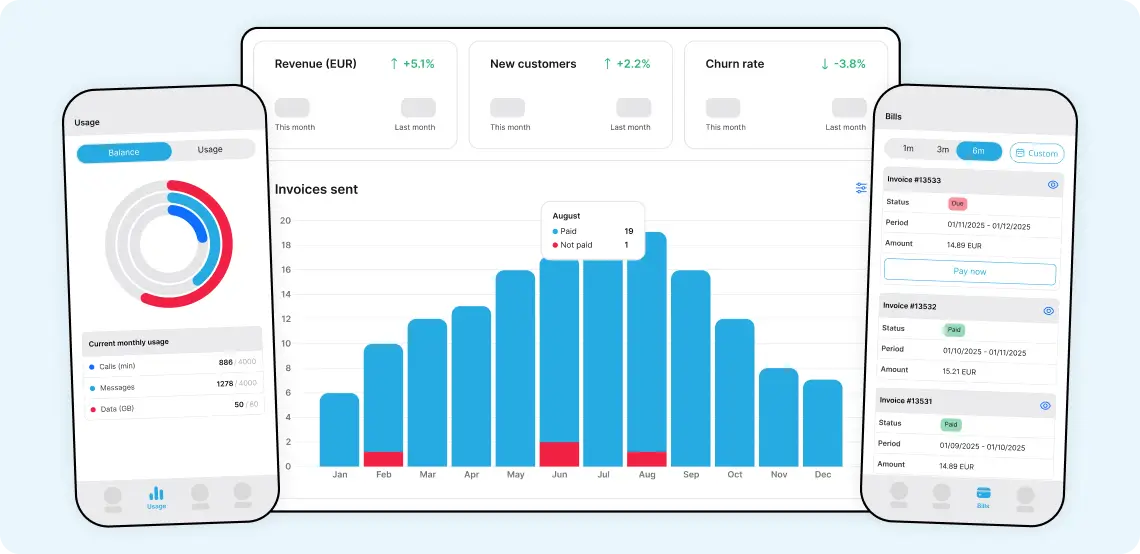
Tridens isn’t just one of the Totogi alternatives; it’s one of the best choices for monetization. With superior flexibility, AI-powered automation, and support for all sizes and models of telecom operators.
The platform’s faster, more responsive system ensures seamless operations, while competitive pricing delivers exceptional value ohne Kompromisse bei der Qualität.