mvno 计费软件

分享到

09/04/2026

目录

MVNO billing software is the single system that decides whether your mobile virtual network operator makes money or bleeds it.

There are over 2,000 active MVNOs worldwide right now. The global MVNO market is pushing past $150 billion. But here’s what nobody talks about: the operators that win aren’t the ones with the best ad campaigns. They’re the ones whose MVNO billing software rates calls in real time, generates accurate invoices, and collects payment before customers even think about switching.

Pick the wrong MVNO billing software and you’ll deal with revenue leakage, billing disputes, and a support team buried in spreadsheets. Pick the right one and you automate the entire quote-to-cash process while you focus on growth.

This guide covers exactly what MVNO billing software does, how it works, what features to look for, and which platforms are worth your money.

Schedule a free demo of Tridens Monetization →


What Is MVNO Billing Software and Why Does It Matter?

MVNO billing software is a platform that manages all financial operations for a mobile virtual network operator. It handles subscriber account management, real-time usage rating, invoicing, payment collection, and settlement with host MNOs.

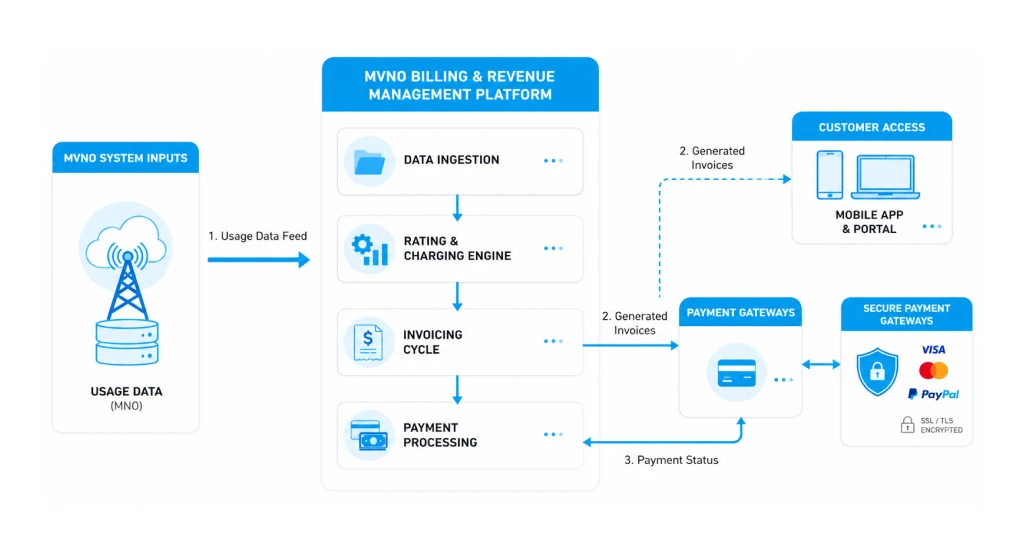
Think of it this way. Your MVNO leases network capacity from a mobile network operator (MNO). Subscribers use voice, data, and SMS on that network. The MVNO billing software sits in the middle — it tracks every usage event, calculates what each subscriber owes, bills them on time, and reconciles what you owe the MNO.

Without it, you’re running a telecom business on spreadsheets. And spreadsheets don’t scale past a few hundred subscribers.

A strong MVNO billing software should handle prepaid and postpaid plans, support eSIM provisioning, process CDR files from multiple carriers, integrate with CRM and payment gateways, and give you real-time analytics on revenue and usage patterns.

📊 [Insert image: MVNO billing software system architecture diagram showing data flow from MNO → rating engine → invoicing → payment]

Read more: What is an MVNO? Types, Strategies, and Customer Segments →


How MVNO Billing Software Works: Step by Step

Understanding MVNO billing software starts with the actual billing cycle. Here’s how it works from subscriber activation to cash in your account.

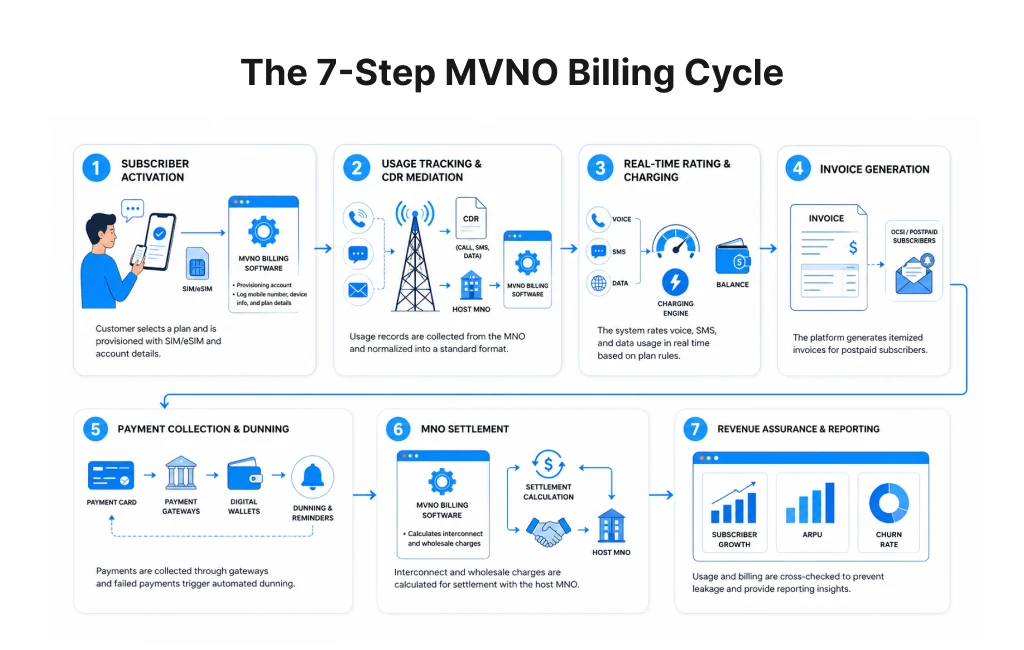
Step 1 — Subscriber activation. A customer picks a plan, gets a SIM or eSIM, and the MVNO billing software provisions their account. Their mobile number, device info, and selected plan are all logged in the system.

Step 2 — Usage tracking. Every call, text, and data session generates a Call Detail Record (CDR). The MNO sends these CDR files to your MVNO billing software for processing. This is called CDR mediation — the system normalizes data from different carriers into a standard format.

Step 3 — Real-time rating and charging. The rating engine inside your MVNO billing software calculates charges based on the subscriber’s plan, usage volume, time of day, roaming status, and any applicable discounts. For prepaid customers, this happens in real time — the system deducts balance instantly.

Step 4 — Invoice generation. At the end of each billing cycle, the MVNO billing software generates invoices for postpaid subscribers. These invoices include itemized usage, plan charges, taxes, and any one-time fees.

Step 5 — Payment collection and dunning. The system processes payments through integrated gateways (Visa, Mastercard, Apple Pay, Google Pay, or local payment methods). If a payment fails, automated dunning kicks in — reminders, retry attempts, and eventually service suspension for unpaid accounts.

Step 6 — MNO settlement. Your MVNO billing software calculates what you owe the host MNO based on wholesale rates. This is interconnect billing. Get this wrong and you leak revenue every single month.

Step 7 — Revenue assurance and reporting. The system cross-checks all usage data against billed amounts to catch discrepancies. Real-time dashboards show subscriber growth, ARPU, churn rate, and revenue trends.

📊 [Insert visual: Infographic showing the 7-step MVNO billing cycle]

5G的货币化:释放其全部潜力


    电子书插图

    Explore MVNO types and how billing differs for each →


    Key Features Your MVNO Billing Software Must Have

    Not all MVNO billing software is built the same. Here’s what separates a platform that works from one that drains your time and money.

    • Real-time rating and charging. If your MVNO billing software can’t rate usage in real time, your prepaid customers will overdraw their balance and your postpaid customers will dispute charges. Real-time charging is non-negotiable for any MVNO billing software in 2026.
    • Convergent product catalog. Your MVNO billing software should let you design prepaid plans, postpaid subscriptions, data bundles, voice packs, SMS packages, and digital add-ons — all from one product catalog. No-code configuration is a plus. You shouldn’t need a developer to launch a new plan.
    • CDR mediation and processing. CDR files come from MNOs in different formats. Your MVNO billing software needs a mediation layer that normalizes, deduplicates, and validates CDRs before they hit the rating engine.
    • eSIM and SIM management. The industry is moving toward eSIM fast. Your MVNO billing software should support SIM inventory management, eSIM provisioning, and number porting — all from the same platform.
    • Prepaid and postpaid in one system. Most MVNOs start prepaid and add postpaid later. If your MVNO billing software forces you to run two separate systems, your operational costs double.
    • 5G-ready architecture. If your MVNO billing software isn’t built on cloud-native microservices, it won’t handle 5G session-based charging. Look for platforms that support 5G CHF (Charging Function) integration.
    • CRM and payment gateway integration. Your MVNO billing software shouldn’t exist in a silo. It needs API-level integration with your CRM (for customer 360 views), payment processors (for automated collections), and tax engines (like Avalara or SureTax).
    • Partner settlement and interconnect billing. If you work with multiple MNOs or have reseller channels, your MVNO billing software must handle wholesale rate cards, partner commissions, and automated settlement reports.

    🎯 CTA: Want to see these features in action? Schedule a demo of Tridens Monetization →


    Benefits of Using the Right MVNO Billing Software

    The right MVNO billing software doesn’t just send invoices. It changes how your entire operation runs.

    You stop leaking revenue. Manual billing and rate card errors cause revenue leakage. Properly configured MVNO billing software captures every CDR, rates it accurately, and bills it on time. For mid-size MVNOs, this alone can recover 3-7% of revenue that was previously lost.

    You launch faster. Cloud-native MVNO billing software lets you go live in weeks, not months. Tridens Monetization, for example, supports go-live in under 30 days with full integration support. That’s the difference between capturing a market window and missing it.

    You reduce operational costs. Automated billing cycles, dunning, and invoicing mean fewer people doing manual work. Your operations team focuses on growth, not spreadsheet reconciliation.

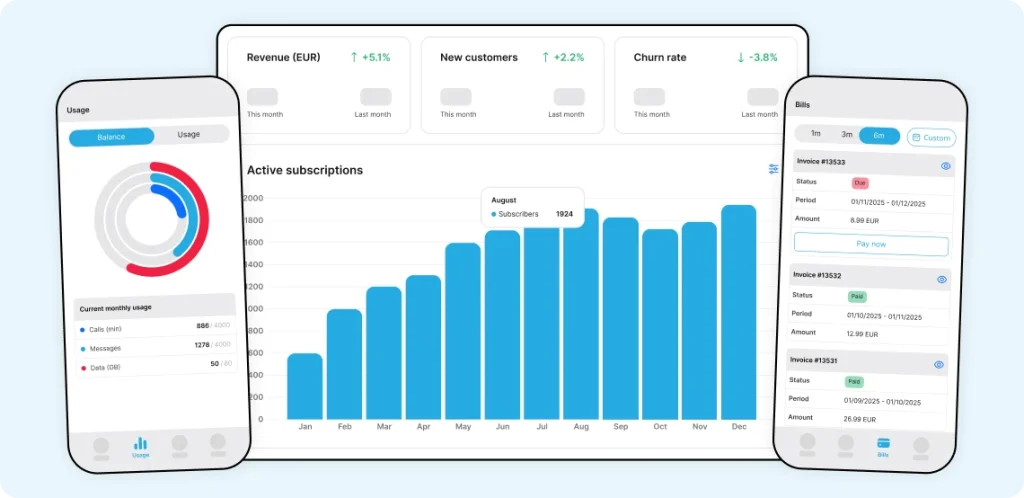
    You improve customer experience. When subscribers can check their balance in real time, manage their plans through a self-service portal, and get accurate bills every month — they stay. Churn drops. Lifetime value goes up.

    You make smarter decisions. MVNO billing software with built-in analytics shows you which plans are profitable, which subscribers are at risk of churning, and where your costs are trending. Data-driven decisions beat gut feelings every time.

    📊 [Insert image: Before/after comparison — manual billing vs automated MVNO billing software]


    Best MVNO Billing Software Providers in 2026

    Here’s an honest look at the MVNO billing software options available right now.

    Tridens Monetization – A Leading MVNO Billing Software

    Tridens Monetization — a state-of-the-art MVNO billing software solution that telecom and communication companies can use for end-to-end billing, converged charging, and revenue management – all from a single digital BSS solution. Best fit for light to full MVNOs that need a modern, scalable MVNO billing software without legacy baggage.

    📊 [Insert image: Slika naše platforme)

    PortaBilling - MVNO 计费解决方案

    PortaBilling (PortaOne) — A mature platform for communication service providers. Strong on real-time charging and partner settlements. Good fit for VoIP-heavy MVNOs.

    IDI 计费解决方案 - MVNO 计费软件

    IDI 账单解决方案 为电信公司提供计费和自动化 MVNO 解决方案,旨在帮助他们增加收入并提高客户满意度。

    该平台主要侧重于自动化和工作流程解决方案,帮助电信公司扩展业务并提高运营效率。  

    Telgoo5 - MVNO 计费

    Telgoo5 是一个端到端计费管理平台,可帮助包括电信和 MVNO 在内的各种通信服务提供商。

    TimelyBill — A US-based telecom billing platform focused on wireless carriers and MVNOs. Strong subscriber management and CDR rating. SOC 1 Type II compliant. Better suited for North American operators.

    ASTPP — An open-source VoIP billing platform with MVNO capabilities. Good for budget-conscious startups. FreeSWITCH-based. Community and enterprise editions available.

    BeQuick — Focused exclusively on the MVNO industry. Strong automation and payment processing. Has billed hundreds of millions of dollars over two decades.

    BillRun — Open-source BSS for MVNOs. Modular approach — use the full suite or just billing. Good for MVNOs that want independence from MNO back-office systems.

    When evaluating any MVNO billing software, always ask: Does it support real-time charging? Can it handle prepaid and postpaid? Is it cloud-native? What’s the go-live timeline? What’s the total cost of ownership?

    🎯 CTA: Compare platforms side by side. Watch a Tridens Monetization demo →


    How to Choose the Right MVNO Billing Software for Your Business

    Choosing MVNO billing software is a decision that will shape your operation for years. Here’s how to approach it.

    Start with your MVNO type. A skinny MVNO reselling under the MNO’s brand needs minimal billing capability. A light or full MVNO running its own BSS needs a comprehensive MVNO billing software with real-time rating, CRM integration, and financial reporting. Know your type before you shop.

    Map your billing requirements. Do you need prepaid only or both prepaid and postpaid? Will you support voice, data, SMS, or all three? Do you need multi-currency and multi-language support? International roaming? IoT billing? Write these down before talking to vendors.

    Evaluate total cost of ownership. The license fee is just the start. Factor in implementation costs, integration effort, ongoing support, training, and infrastructure. A cloud-native MVNO billing software often has lower TCO than an on-premise solution because you skip hardware, hosting, and maintenance costs.

    Check the integration ecosystem. Your MVNO billing software needs to work with your MNO’s network (HLR/HSS provisioning), your payment processor, your tax engine, your CRM, and your ERP. Ask vendors about their API capabilities and pre-built integrations.

    Test the vendor’s support model. Billing breaks at the worst possible times. Ask about 24/7 support availability, SLA guarantees, and how quickly they deploy patches. A vendor that takes three weeks to fix a billing bug will cost you subscribers.

    Read our full guide on how to start an MVNO business →


    FAQs About MVNO Billing Software

    What is MVNO billing software?
    MVNO billing software is a platform that manages subscriber accounts, rates voice/data/SMS usage, generates invoices, collects payments, and settles wholesale costs with host MNOs. It automates the entire billing cycle for mobile virtual network operators.

    How much does MVNO billing software cost?
    Costs vary widely. Open-source options like ASTPP start free (with paid support). Enterprise platforms like Tridens Monetization and PortaBilling typically use SaaS pricing models based on subscriber count. Expect anywhere from $2,000/month for a small MVNO to $20,000+/month for a full MVNO with hundreds of thousands of subscribers.

    What is the difference between MVNO billing and MNO billing?
    MNOs bill retail customers and handle network-level charging. MVNOs bill their own retail customers but also need interconnect billing and wholesale settlement with the host MNO. MVNO billing software must manage both sides — what subscribers owe you and what you owe the MNO.

    Can MVNO billing software handle prepaid and postpaid?
    Yes — most modern MVNO billing software supports both. Look for convergent billing platforms that manage prepaid balance deductions and postpaid invoice cycles within a single system.

    Is cloud-based MVNO billing software better than on-premise?
    For most MVNOs, yes. Cloud-native MVNO billing software eliminates hardware costs, scales on demand, and deploys faster. On-premise may make sense for MVNOs with strict data sovereignty requirements.

    What is CDR mediation in MVNO billing?
    CDR (Call Detail Record) mediation is the process of collecting raw usage data from MNO networks, normalizing it into a standard format, and feeding it into the rating engine. Without CDR mediation, your MVNO billing software can’t accurately charge for usage.

    Filip Stojanović 的图片
    Filip Stojanović
    Filip Stojanović是一名B2B的SaaS和金融技术文案,他有能力将复杂的软件术语转化为易懂和吸引人的内容。他对IT和软件技术充满热情,并保持着对数字趋势的关注。

    获取 您收件箱中的新闻!


      5 1 投票
      文章评分
      订阅评论
      提醒
      来宾

      0 评论
      最旧
      最新 最多投票
      内联反馈
      查看所有评论