

Eco-Movement integration helps charge point operators share charger location, tariff, and availability data from Tridens EV Charge with major navigation and mapping services.
For CPOs, public visibility is operational. Drivers need to find chargers, check availability, understand the cost, and navigate to the right location. If that data stays inside the charging management system, the network is harder to discover.
This guide explains how to connect Carga Tridens EV com Eco-Movement via OCPI, what you need before you start, and which setup checks matter before exposing charging infrastructure to external map and navigation providers.

Visão geral rápida
Eco-Movement and Tridens EV Charge are different participants in the roaming network. Tridens EV Charge provides hosting services for CPOs, while Eco-Movement serves as the aggregator of charging-point data, which can then be visible to navigation service providers.
Interoperability is achieved by using the Interface aberta do ponto de carregamento (OCPI) communication protocol.

What You Need Before Start?
Para estabelecer a integração como CPO, é necessário:
- An active Tridens EV Charge environment with chargers onboarded.
- Estabelecer um acordo with Eco-Movement to participate within navigation services for the charging locations visibility to external drivers.
- Roaming configuration for Eco-Movement in Tridens EV Charge. Set in Roaming.
- Generate registration token in Tridens EV Charge and send it to Eco-Movement integration contact.
- Informal pricing tariffs for the charging session expenses, as set in Tarifas de roaming.
Pronto para começar?
See how Tridens EV Charge connects charger operations, roaming, tariff data, and billing in one platform.

How Does Eco-Movement Communicate with Tridens EV Charge?
OCPI protocol is used for communication between Tridens EV Charge and Eco-Movement service.
Once the initial handshake and registration between the platforms succeed, the platforms start exchanging relevant information about the locations, chargers, and tariffs.
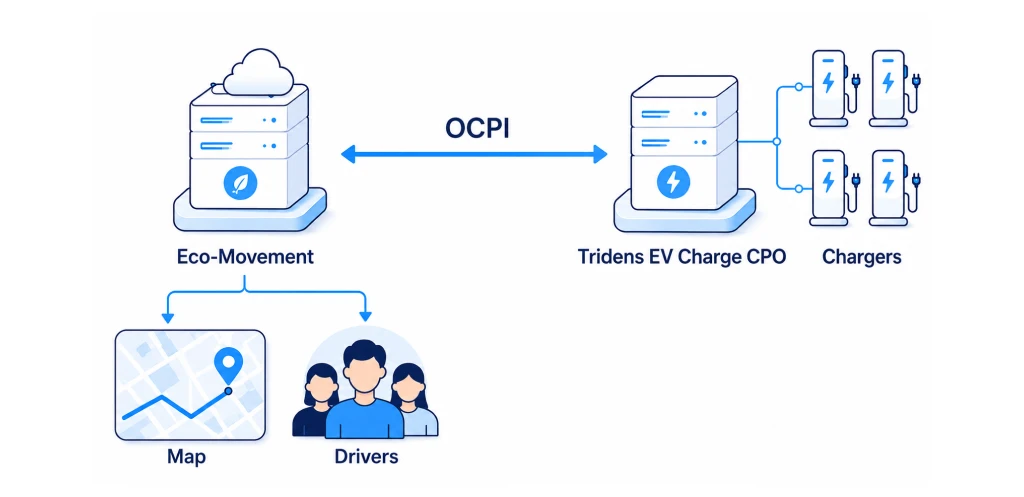
CPO publishes locations and charging infrastructure data with wholesale tariffs for ad-hoc or general charging expenses to Eco-Movement.
The integration does not make Eco-Movement an EMSP that starts and controls charging sessions. Drivers still start charging through the options enabled by the CPO, such as card payment, RFID, Plug & Charge, or the provider’s mobile app.

Configuring Eco-Movement with Tridens EV Charge
Let’s dive into the steps required to set up the Eco-Movement communication in Tridens EV Charge.
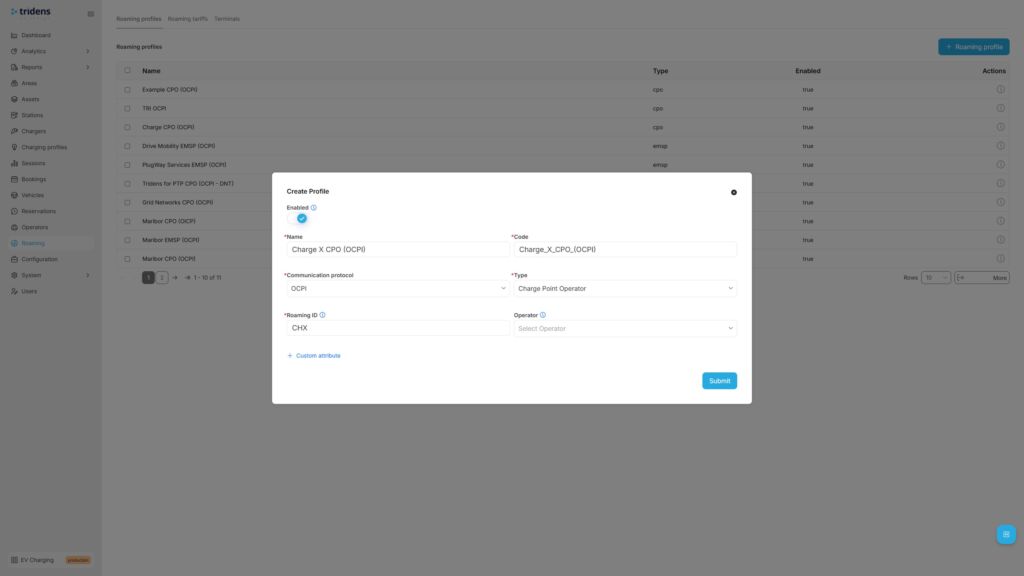
Passo 1: Adicionar perfil de roaming OCPI
Move to Tridens EV Charge environment, open Roaming in the left menu and create or reuse the Perfil de roaming which represents your CPO papel para o OCPI protocol. Set recognizable Name and Code of your business, select OCPI protocol, Role, and your three-letter ID de roaming which will represent you in the roaming network.
Step 2: Add Eco-Movement Roaming Platform
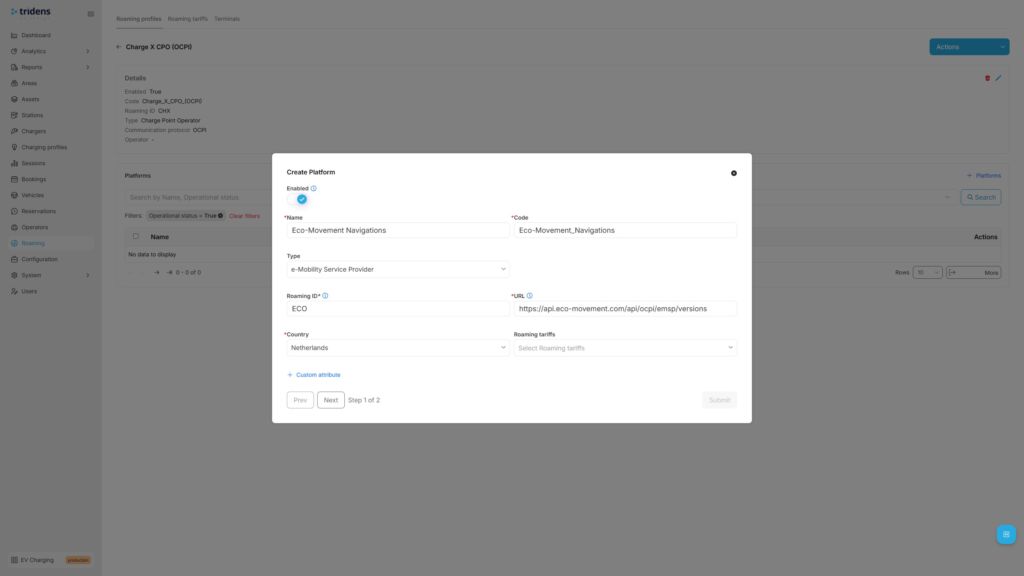
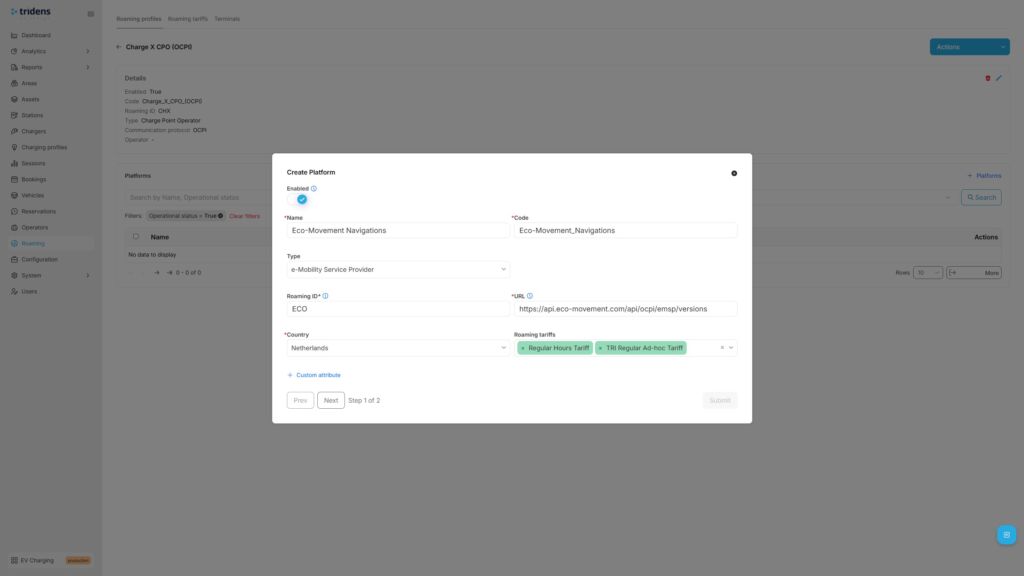
Next step in Tridens EV Charge is to go inside the Roaming Profile and add the Plataforma de roaming of Eco-Movement.
Fill in Eco-Movement platform’s recognizable Name with Code, select NSP ou EMSP Type, Eco-Movement’s ID de roaming, URL and operating Country.
Eco-Movement’s recommended settings:
| Field | Recommended value |
|---|---|
| Name | Eco-Movement |
| Tipo | NSP or EMSP |
| URL | https://api.eco-movement.com/api/ocpi/emsp/versions |
| ID de roaming | ECO |
| País | Países Baixos |
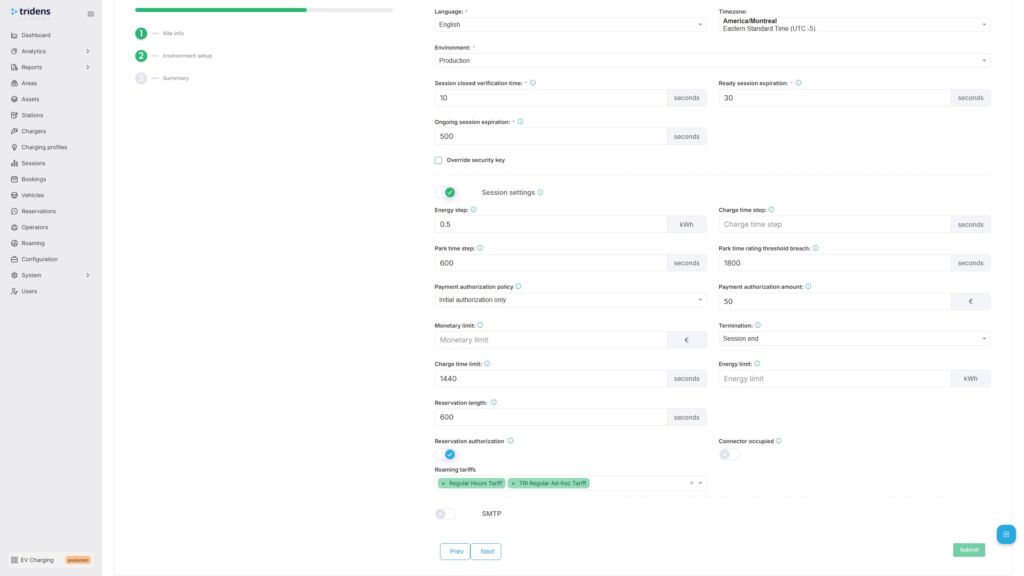
As a CPO, you can optionally add Tarifas de roaming later for the wholesale expenses calculation of using the chargers.

Step 3: Provide Token & Register with Handshake
In the next step of Roaming Platform configuration, registration dialogue shows up. Generate the registration token, forward it to Eco-Movement team and Submeter o formulário.
At this point, Eco-Movement can do the handshake to start communicating with Tridens EV Charge.
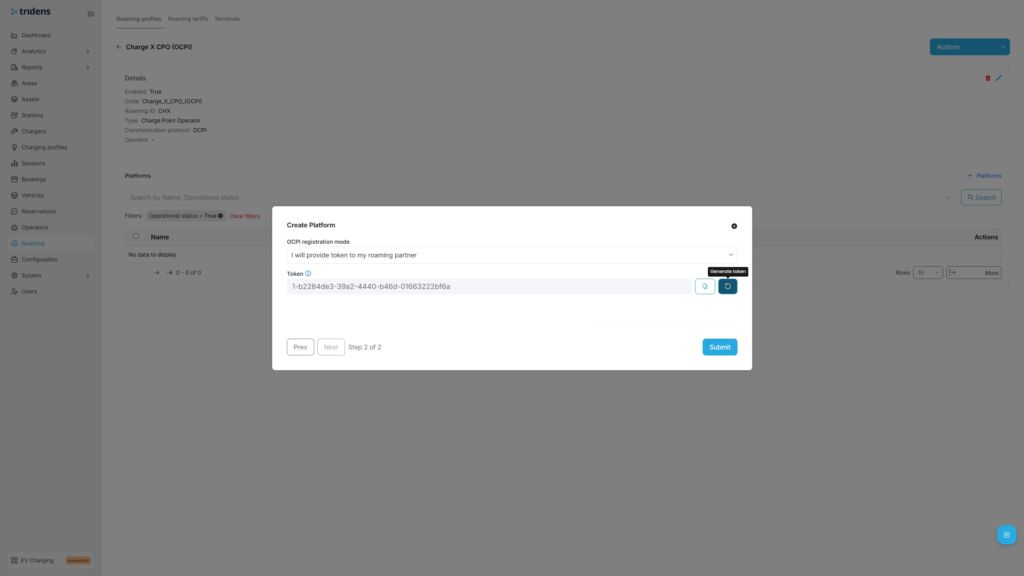
Pode mais tarde Atualizar credenciais para renegociar ou Invalidar credenciais para interromper a comunicação.
If interested to register credentials in the opposite direction, you can ask Eco-Movement team to provide you the registration token, which you can insert in the registration form (instead of generating) and hit Registar credenciais.
Carregamento inteligente de EV: Desbloqueando todo o seu potencial

Step 4: Expose the Charging Infrastructure
As a CPO, you want to expose your locations and charging infrastructure to the public. To achieve this, add unique ID de roaming para Área, Carregador e Conector and enable roaming on chargers. You can expose all your locations and chargers in roaming or just cherry-pick a few, decision is yours.
Navegar para Áreas in the left side menu and then select and edit the desired Area with roaming settings. From the Area, you can navigate downstream to the Estação, Carregador e Conector, para que as definições de roaming possam ser atribuídas nos dois últimos.
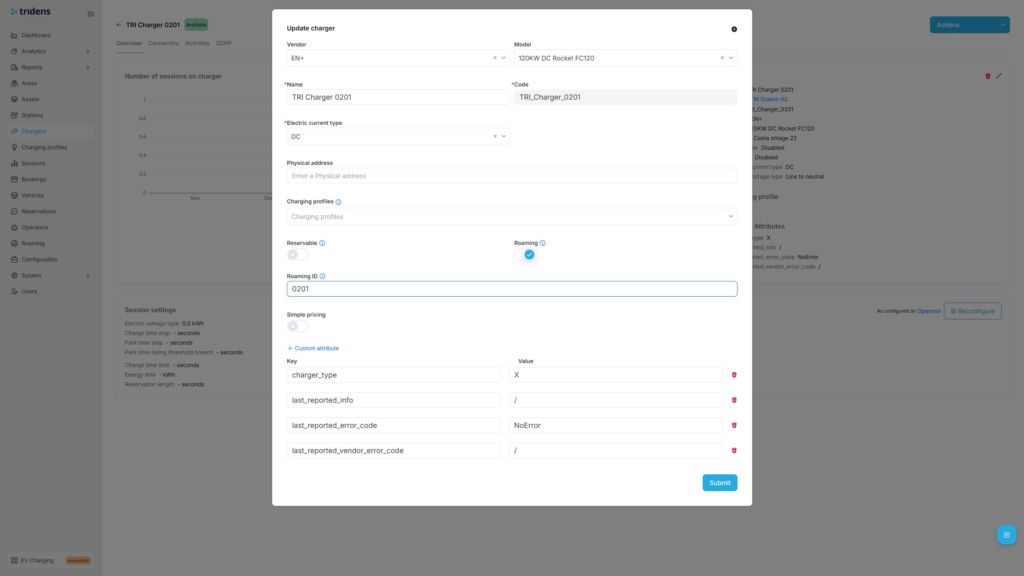
More details on applying the roaming settings on your charging infrastructure in Tridens EV Charge is described at Áreas e Perfis de roaming.
Initially, we advise you to trigger the first full push of locations and charging infrastructure to the Eco-Movement by navigating to the Plataforma de roaming for Eco-Movement, selecting it and triggering the Push infrastructure action. Further updated of your Area/Chargers/Connectors, including status updates will automatically be notified to Eco-Movement to reflect the latest state.
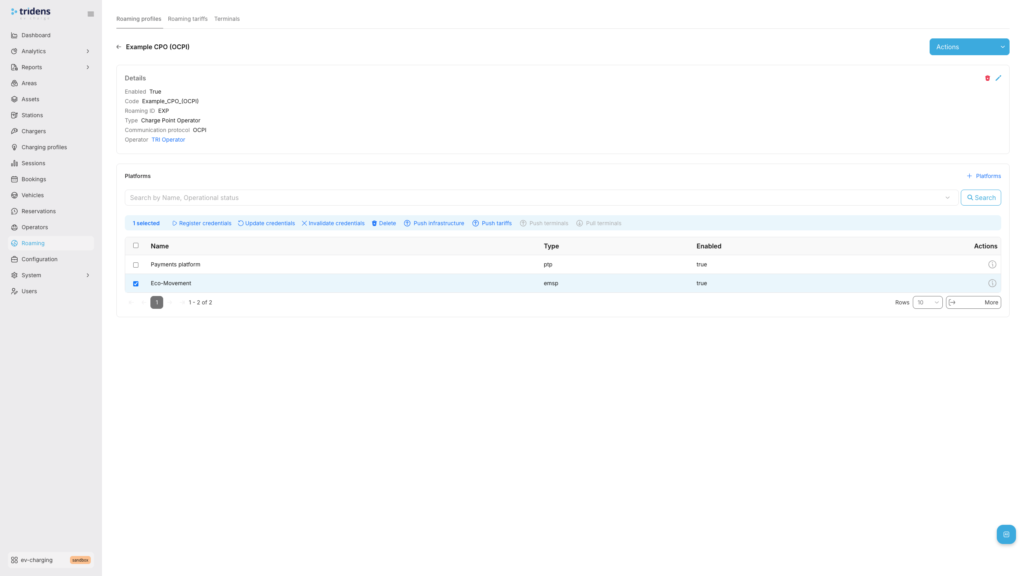
Step 5: Define Expense Tariffs
As a CPO, you would potentially want to inform the drivers about the pricing, whether in general or ad-hoc based (card payments) for the cost expenses of using your chargers. Tariffs are schedule-based, with recurrency and one-time options. Expenses can be configured for energy, charging time, parking time, reservation time, reservation flat and general flat fee, including VAT control and the upper amount limitation.
Aceda a Roaming no menu do lado esquerdo e selecionar Tarifas, where you can add new tariff definition first and then apply tariff details, covering different time ranges with cost rules.
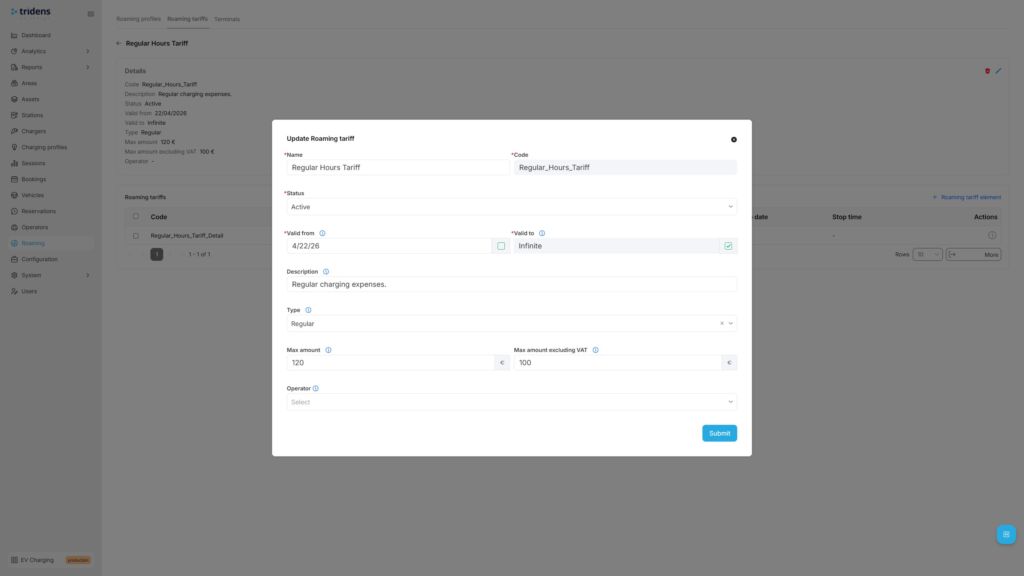
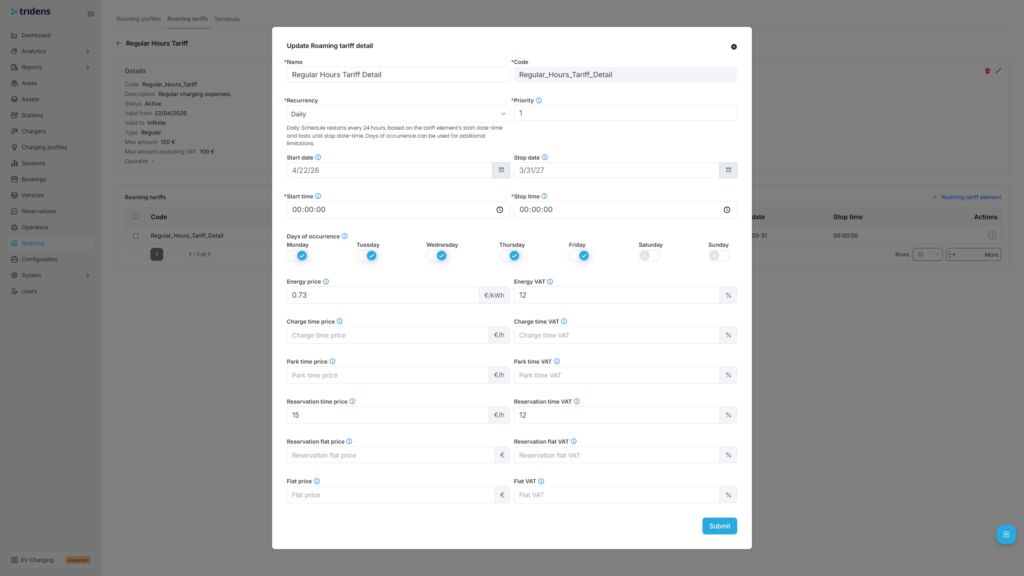
As tarifas de roaming devem então ser atribuídas no Plataforma de roaming and belonging charging infrastructure as described in Tarifas de roaming.
Testar o caudal total
Once the communication with Eco-Movement is established by the registration handshake, you can proceed to the test flow.
Test flow for a CPO:
- Confirm that each Area with Chargers and Connectors that you want to expose to Eco-Movement has ID de roaming assigned and that each such Charger has a itinerância flag enabled.
- Push locations and charging infrastructure by using the Push infrastructure action of Plataforma de roaming. Further data updates will happen automatically on data changes, including status change.
- Confirm with Eco-Movement whether all the desired locations and charging infrastructure with tariffs (if used) are visible at Eco-Movement.
Resolução de Problemas
| Occurrence | Razões | Solução |
|---|---|---|
| Locations and chargers data not in-sync | Mau funcionamento das credenciais | Repita o processo de registo e aperto de mão descrito no passo 3. |
| Problema de conetividade de rede | Ensure both platforms are communicating. Check out the status pages. Contact the platform operators, if necessary. Tridens Status Page | |
| Roaming desativado | Ensure roaming settings are still enabled in Tridens EV Charge environment: Roaming Profile, Roaming Platform and roaming settings of Area, Charger and Connector. | |
| Tariffs do not appear at Eco-Movement | Configuração das tarifas de roaming | Ensure that Roaming Tariff is properly configured in Tridens EV Charge with valid date-time scopes and cost. Tariff must then be applied to the Roaming Platform and charging infrastructure scope. Tarifas de roaming |
Connect charger visibility, roaming, and billing with Tridens
Eco-Movement integration gives CPOs a practical way to make their charging infrastructure easier to find. Tridens EV Charge provides operators with the control layer behind that visibility: charger management, OCPI roaming, tariffs, billing, and customer operations on a single platform.
For CPOs scaling beyond manual operations, that matters. Public visibility is only useful if the underlying charger, tariff, and availability data stay accurate.
FAQ about Eco-Movement integration
How do I activate Eco-Movement integration with Tridens EV Charge?
First, make an agreement with Eco-Movement. Then configure the roaming profile and Eco-Movement roaming platform in Tridens EV Charge, exchange the registration token, and register credentials.
Can I choose which chargers are exposed to Eco-Movement?
Yes. You can control which areas, chargers, and connectors are exposed by assigning roaming IDs and enabling roaming only where needed.
How long does onboarding take?
The Tridens EV Charge setup can be completed quickly once the required data is ready. Eco-Movement and downstream navigation provider onboarding may take longer and can depend on provider timelines.
How secure is the OCPI setup?
OCPI communication uses HTTPS and access tokens. The access token is negotiated during registration and verified in later message exchanges.
Can drivers start charging sessions through Eco-Movement?
No. Eco-Movement aggregates charging location, tariff, and availability data. Charging sessions still start through the CPO’s enabled payment, identification, or mobile app options.