


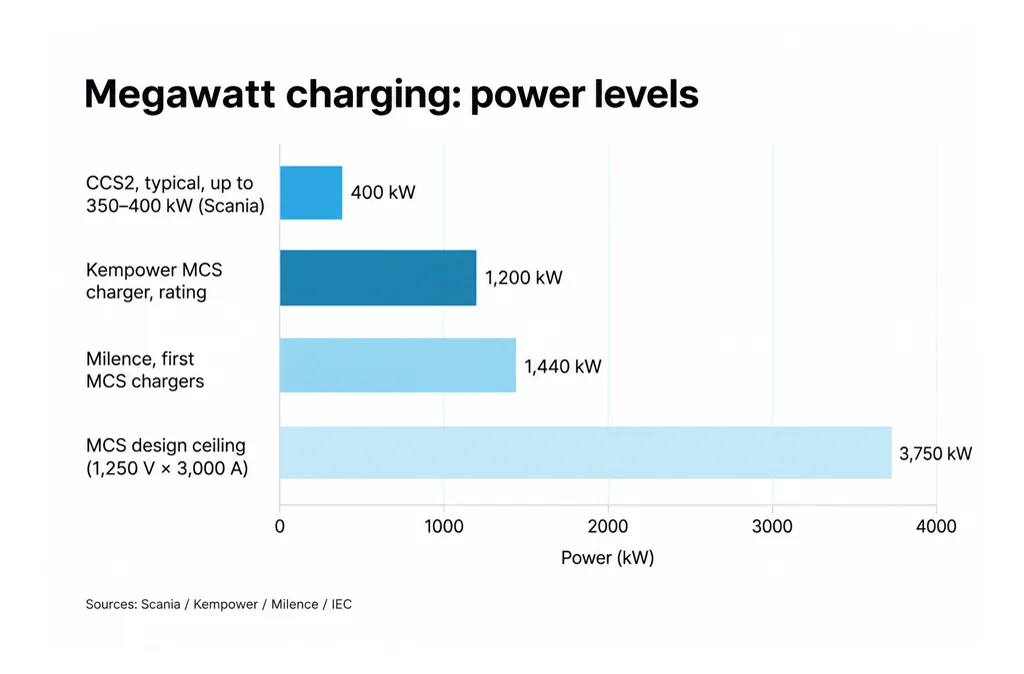
The megawatt charging system (MCS) is a high-power DC charging system for heavy-duty electric vehicles such as long-haul trucks and buses. It uses a single connector, typically liquid-cooled, and is designed for up to 3.75 MW (1,250 V, 3,000 A).
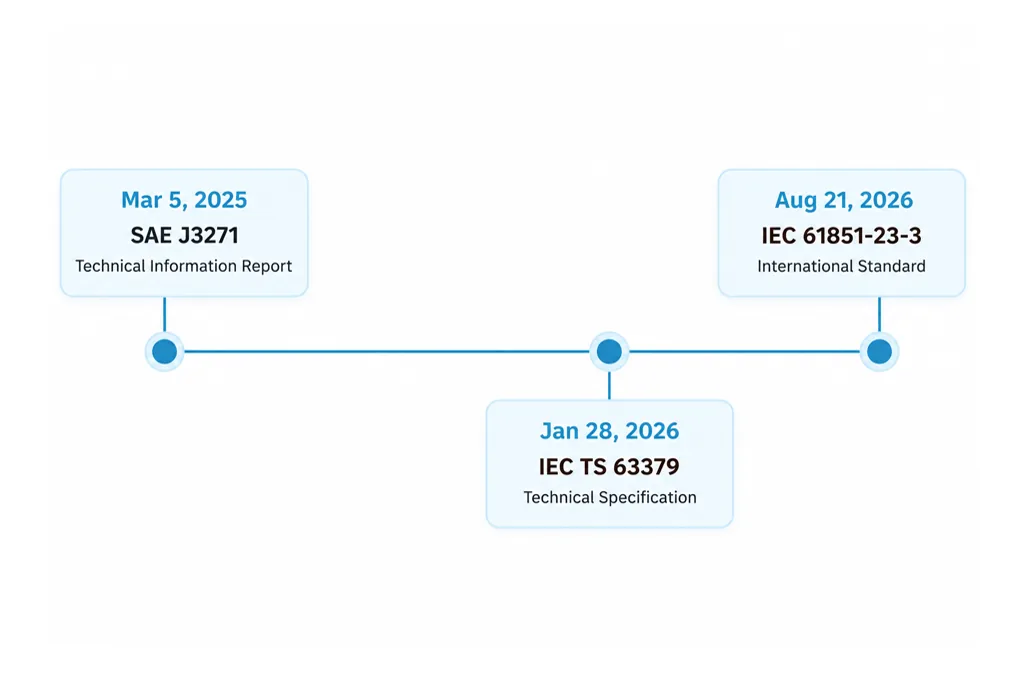
Since 2025, megawatt charging has gained published specifications and standards, and the first public sites have opened. SAE International published its J3271 report in March 2025. The International Electrotechnical Commission (IEC) published the coupler specification in January 2026 and the charging equipment standard in August 2026.
The IEC documents are international, SAE International is a US-based body, and the EU’s Alternative Fuels Infrastructure Regulation (AFIR) sets the charging targets covered below.
What Is a Megawatt Charging System (MCS)?
MCS (also called megawatt charging) is built for commercial vehicles that can accept more than 1 MW of charging power. CharIN, an industry association, started the task force behind it in 2018, and SAE and IEC have since published documents on it. It focuses on Class 6, 7 and 8 vehicles, the US weight classes for medium and heavy trucks, and CharIN names buses as a possible use.
Why Trucks Need It
A long-haul truck carries a far larger battery than a car. Volvo Trucks uses the example of a Volvo FH Aero Electric with eight batteries and 780 kWh.
EU rules give drivers a natural charging window. Under Regulation (EC) No 561/2006, truck drivers covered by the regulation must take a break of at least 45 minutes (or a rest period) after four and a half hours of driving, and the break can be taken as 15 minutes followed by 30 minutes. Scania and Volvo both position MCS around that window.
In a 45-minute break, Volvo’s figures show a 350 kW charger on CCS (Combined Charging System, the current DC standard) adding 235 kWh, about 30 percent of that battery.
Where the 3.75 MW Comes From
The ceiling combines two limits: up to 1,250 V on the vehicle side and up to 3,000 A.
| Item | Value | Source |
|---|---|---|
| Vehicle-side voltage, charging equipment | Up to 1,250 V DC | IEC 61851-23-3 |
| Coupler rated operating voltage | Up to 1,500 V DC | IEC TS 63379 |
| Rated current | Up to 3,000 A | IEC TS 63379 |
| Maximum power | 3.75 MW | Calculated from IEC values (1,250 V × 3,000 A); Milence also cites up to 3.75 MW |
The coupler specification allows a higher voltage than the charging equipment standard, so the 3.75 MW figure uses the lower 1,250 V limit.
Available hardware sits well below that ceiling. Milence, a European truck-charging network, supports up to 1,440 kW in its first MCS chargers. Charger maker Kempower rates its MCS charger at up to 1.2 MW.
How Does MCS Work?
The MCS Connector and Cooling
CharIN’s list of requirements under discussion describes a single plug on the left side of the vehicle at roughly hip height, capable of being automated. CharIN’s page also says the design still allows drivers to charge by hand, without the help of a machine or robot. The cable is slightly thicker and liquid-cooled, according to Scania’s MCS explainer.
The MCS Charging Protocol and the Charger Backend
CharIN’s list of requirements under discussion names Ethernet with ISO 15118-20 for communication between vehicle and charger. That standard family also underlies Plug & Charge, where the vehicle authorizes itself at the charger.
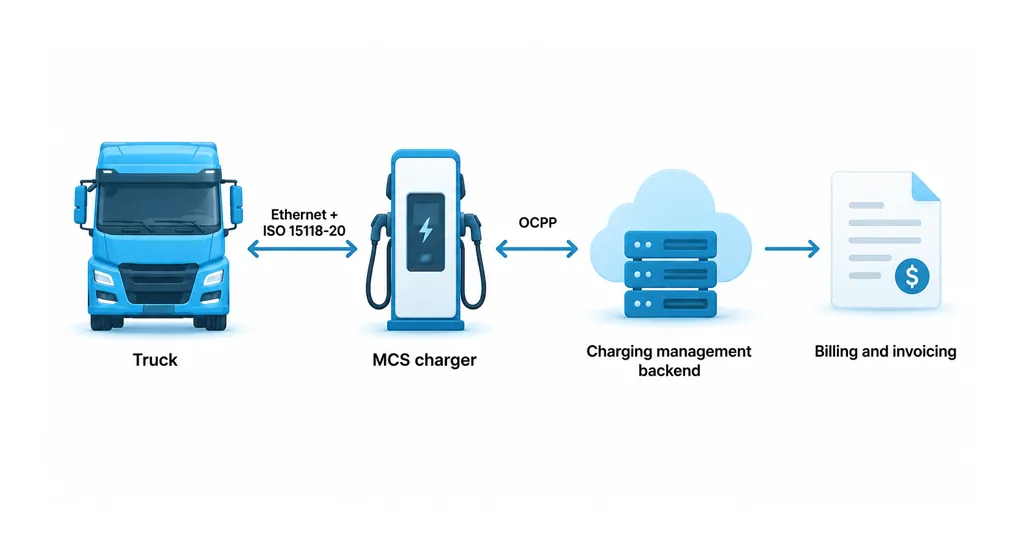
The MCS documents do not define the backend link. The charger still reports to a backend system, typically over OCPP (Open Charge Point Protocol). The Open Charge Alliance lists ISO 15118 support in OCPP 2.0.1, and OCPP 2.1, released in 2025, adds support for ISO 15118-20.

MCS vs CCS: What Changes for Trucks
CCS remains in use. The difference is power, and with it the energy a truck can add during a driver break.
| CCS | MCS | |
|---|---|---|
| Charger power | Up to 350–400 kW (Scania, CCS2) | Up to 3.75 MW design limit; 1.2 MW (Kempower rating) to 1.44 MW (Milence chargers) |
| Energy added in a 45-minute break, Volvo FH Aero Electric (780 kWh) | 235 kWh (350 kW charger), about 30% of the battery | 436 kWh (720 kW charger), about 56% of the battery |
Volvo’s figures use average charging speeds and a 720 kW MCS charger, not the 3.75 MW ceiling.
Scania puts that ceiling at roughly ten times a typical CCS2 charger, the CCS version used in Europe. Against Scania’s 350–400 kW, today’s MCS chargers are three to four times as powerful. Kempower compares MCS with heavy-duty CCS chargers of around 560 kW and says MCS can almost double that.
How Long Does MCS Charging Take?
Scania says a truck can charge from 20 to 80 percent in under 30 minutes on MCS. Volvo estimates about 40 minutes for the same range. That estimate and Volvo’s 45-minute table above do not line up exactly, and Volvo does not explain the difference. Treat all of these as manufacturer estimates.
Will MCS Replace CCS?
No, both are expected to coexist. Volvo expects both CCS and MCS chargers to be available, and Scania says its trucks can be fitted with both connectors. Milence’s Antwerp hub, covered below, offers both.
MCS Standards in 2026
Three documents cover the megawatt charging system: the connector, the charging equipment and the overall system. Communication is defined separately in ISO 15118-10 and ISO 15118-20, which IEC 61851-23-3 references.
| Document | Type | Published | Covers |
|---|---|---|---|
| SAE J3271 | Technical Information Report | Mar 5, 2025 | Couplers, communication and controls, cables, use cases, interoperability testing |
| IEC TS 63379 | Technical Specification | Jan 28, 2026 | Vehicle connector, inlet and cable assembly; up to 1,500 V DC and 3,000 A |
| IEC 61851-23-3 | International Standard | Aug 21, 2026 | Charging equipment with a coupler according to IEC TS 63379; up to 1,250 V DC on the vehicle side |
Only IEC 61851-23-3 is a full International Standard. IEC TS 63379 is a technical specification, and SAE describes J3271 as a guide toward standard practice that is subject to change.
Bidirectional charging, where power flows from the vehicle back to the grid or a site, is not settled for MCS yet. IEC 61851-23-3 says its requirements for bidirectional power flow are still under consideration, although OCPP 2.1 already supports bidirectional power transfer with ISO 15118-20.
Where MCS Is Being Deployed
Early Public Sites
Milence announced its first MCS deployment on February 25, 2025, at Truck Parking Ketenis in the Port of Antwerp-Bruges. Two Power Electronics chargers went onto two additional bays, bringing the hub to 22 bays with 4 MW of CCS and 2.8 MW of MCS capacity. Milence had tested the solution through 2024.
Volvo Trucks’ June 2025 article reports that Milence has secured up to €111 million in EU funding for 284 more MCS charge points across 71 locations, expected to be completed by the end of 2027.
What EU Rules Require
AFIR sets heavy-duty charging targets for Member States in AFIR Article 4. TEN-T is the Trans-European Transport Network, the EU’s main transport network; the targets apply to its road part, which has a core and a comprehensive layer. A pool is one or more charging stations at one location, and the regulation does not mention MCS or megawatt charging by name.
| Date | Target | Min power per pool | Points of at least 350 kW per pool |
|---|---|---|---|
| Dec 31, 2025 | At least 15% of the TEN-T road network | 1,400 kW | At least 1 |
| Dec 31, 2027 | At least 50% of the TEN-T road network; core network pools | 2,800 kW | At least 2 |
| Dec 31, 2027 | Same coverage; comprehensive network pools | 1,400 kW | At least 1 |
| Dec 31, 2030 | Core network, pools at most 60 km apart | 3,600 kW | At least 2 |
| Dec 31, 2030 | Comprehensive network, pools at most 100 km apart | 1,500 kW | At least 1 |
Pools are generally required in each direction of travel. One pool can serve both directions only if it is easy to reach from both, adequately signposted and meets the distance, power and charge point requirements for both directions. The first target date, December 31, 2025, has already passed.
A pool that must reach 3,600 kW can be built from about eleven 350 kW charge points or from a few megawatt chargers, so MCS is one route to those power levels, not a legal requirement. Our review of EV charging trends for 2026 puts AFIR next to the other changes shaping charging.
What Megawatt Charging Changes for Charging Operators
An MCS session can carry much more energy than a CCS session in the same time, which changes how a site earns and loses money.
Grid Connection and Power Sharing
Adding 2.8 MW of MCS capacity can put a large extra load on a site’s grid connection, and Volvo notes that MCS will raise grid capacity issues. Where the connection limits what the site can deliver, operators can use load balancing to share the available power between charge points.
Pricing and Payment Rules
Public MCS charge points fall under AFIR Article 5. Its main rules are below, and our EV charging billing guide covers the tariff structures behind them.
- For publicly accessible charge points of 50 kW or more deployed since April 13, 2024, the ad hoc (pay-as-you-go) price must be based on the price per kWh delivered.
- At those charge points, operators may add an occupancy fee per minute, and the price per kWh and any occupancy fee must be shown at the station before the session starts.
- Publicly accessible charge points that require payment and were deployed since April 13, 2024, must accept ad hoc payment through at least a payment card reader or a contactless device that can read payment cards (below 50 kW, a QR-code-based option is also allowed). From January 1, 2027, this also applies to older charge points of 50 kW or more on the TEN-T network or at safe and secure parking areas.
- Operators of publicly accessible charge points may not discriminate through prices between end users and mobility service providers, or between different mobility service providers. Price levels may differ only if the difference is proportionate and objectively justified.
What Higher Session Values Mean for Revenue
Take Volvo’s 45-minute example: 436 kWh on MCS against 235 kWh on a 350 kW CCS charger, about 1.9 times as much. At an illustrative price of €0.40 per kWh, the MCS session is worth about €174 and the CCS session about €94.
A 50 kW charge point, where AFIR’s per-kWh price rule starts, delivers 37.5 kWh in the same 45 minutes, worth about €15. On these illustrative figures, a failed or blocked MCS session loses about 1.9 times the revenue of a CCS session and about 12 times that of a 50 kW session.
Pro tip:
Set a separate occupancy fee for MCS bays before launch.

Roaming and Charge Detail Records
Operators that join roaming networks let other providers’ customers charge at their sites. They exchange tariffs, sessions and charge detail records (CDRs) over OCPI (Open Charge Point Interface), and the CDR is the record a roaming partner bills from. A missing or wrong CDR on an MCS session is therefore a bigger correction than on a 50 kW session.
Where Billing Software Fits
Tridens EV Charge, our charging management software, works with chargers over OCPP 1.6 and 2.0.1. Through Tridens Monetization, our billing and revenue management platform, it connects charging sessions to subscriptions, invoices and payments.
Whether a specific MCS charger works with it depends on the model, firmware and required functions, so confirm compatibility with your charger vendor and with Tridens.
FAQ about Megawatt Charging System
What is MCS in EV charging?
MCS stands for Megawatt Charging System, a connector and charging system for commercial vehicles that can accept more than 1 MW. IEC TS 63379 covers the coupler, and IEC 61851-23-3 covers the charging equipment.
What is the MCS charging protocol?
Vehicle and charger communicate over Ethernet using ISO 15118-20, according to CharIN’s requirements under discussion; IEC 61851-23-3 refers to ISO 15118-10 and ISO 15118-20. The charger-to-backend link is a separate layer, typically OCPP.
How fast is megawatt charging?
By design up to 3.75 MW. Scania cites 20 to 80 percent in under 30 minutes, and Volvo estimates about 40 minutes.
How much does an MCS charger cost?
We found no published per-charger price from the manufacturers, operators or standards bodies reviewed for this article, so we do not quote one.
Can a CCS truck use an MCS charger?
Not through its CCS connector. MCS needs its own connector, distinct from CCS, according to Volvo. Trucks fitted with both connectors, as Scania offers, can use either type of charger.
Is megawatt charging for cars the same as MCS?
Not necessarily. CharIN’s MCS task force focused on Class 6, 7 and 8 commercial vehicles. BYD announced a 1,000 kW peak passenger-car platform in March 2025, with its own terminals rated up to 1,360 kW; its release does not mention MCS.
