

Discover how Tridens brings tap-and-go card payments to EV chargers across Europe, removing friction for drivers and operators alike.
Table of contents
EV drivers expect charging to be as simple as fueling up at a petrol station. Tap a card, charge, drive away. No apps, no accounts, no hassle.
For EV charging providers, delivering that experience at scale, across markets, charger brands, and payment regulations, has been anything but simple. That’s why we partnered with CCV from Fiserv.
The Problem We Set Out to Solve
Tridens EV Charge is a converged platform that serves both sides of the e-mobility ecosystem. For CPOs, it delivers real-time charger management, smart energy distribution, monitoring, and analytics. For EMSPs, it adds the commercial layer: billing, customer management, a white-label driver app, and roaming. All from one cloud-native platform.
But accepting bank cards directly at the charger — with pre-authorization, PIN support, and compliance across multiple European markets — requires deep payment infrastructure expertise. Building that in-house would mean years of development, certifications, and acquiring relationships.
Why CCV from Fiserv
CCV is one of Europe’s leading payment solution providers, trusted by over 150,000 businesses across retail, parking, vending, public transport, and EV charging. As part of Fiserv, they bring global payment processing scale combined with deep local market knowledge across the DACH region, Benelux, France, Poland, and the UK.
CCV handles the full payment chain: processing transactions, connecting to card schemes, and settling funds to the merchant’s account. Their primary financial service runs through CCV by Fiserv, but they also support third-party acquirers such as Payone and Elavon, giving operators flexibility in how they manage their payment relationships.
What made CCV the right fit for us was their Cloud Connect EVC solution. It uses OCPI, the same open protocol our platform already speaks natively, so the integration is fast, standardized, and future-proof. No proprietary lock-in, no custom middleware.
What This Partnership Delivers
For CPOs using Tridens EV Charge, the integration unlocks clear advantages:
- Drivers pay via contactless card—no apps, accounts, or RFID tags required
- Seamless cloud-to-cloud OCPI integration eliminates the need for station-level development or custom middleware
- Support for both station-specific and kiosk setups allows one terminal to serve multiple chargers, optimizing site costs
- White-labeling options include logos, color themes, and audio jingles for a consistent brand experience.
- A defined split of duties ensures CPOs manage power, handle billing, and CCV secures payments
- Ready for European expansion with built-in compliance across DACH, Benelux, France, Poland, and the UK
Getting Started
Setting up card payments through the Tridens and CCV integration is a straightforward process with three key steps:
1. Merchant agreement
In the Tridens EV Charge ecosystem, Tridens serves as the Charging Management System (CMS), which is used by CPOs to operate EV charging stations. To enable card payments, merchants can get a payment processing, acquiring, and settlement agreement through CCV.
2. OCPI integration
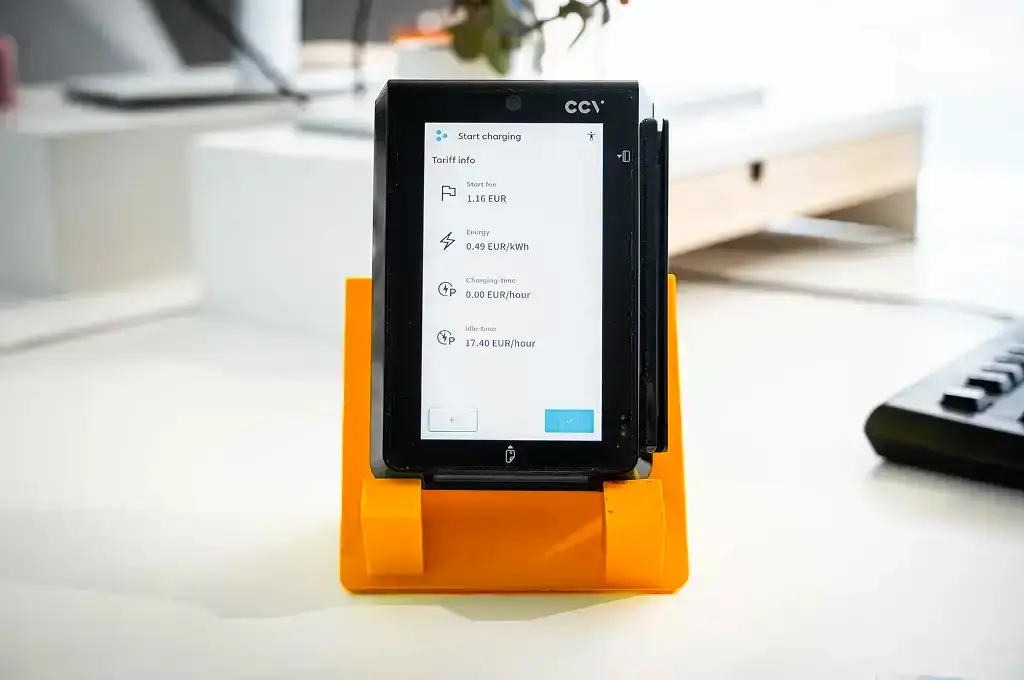
The Tridens Charging Management System and CCV are fully integrated using the OCPI protocol. This integration is available for all CPOs using the Tridens CMS, allowing operators to focus on running their charging network. CCV takes care of compatibility with the different terminal models, and the OCPI integration makes sure EV drivers have access to clear information on tariffs and can start and stop charging sessions in a modern and intuitive user interface (CCV Charge).
3. Setting up
The CCV payment terminal is installed at the charging location and linked to the Tridens CMS either to a specific charger or a selection of chargers as a kiosk. The terminals require power and internet and can then be managed remotely. CCV payment terminals can also be ordered with an embedded 4G modem, so even remote locations are covered.
Built on Open Standards, Not Lock-In
A core principle at Tridens is hardware and vendor neutrality. Our platform is certified for OCPP protocols, supports over 600 charger models, and integrates with any payment gateway via REST APIs.
The CCV partnership follows this same philosophy. Because Cloud Connect uses OCPI, it slots into our platform as a native module, not a bolt-on. CPOs can enable card payments across their networks without rearchitecting their setups.

Looking Ahead
As European regulations increasingly require open payment options at public charging stations, having a proven, compliant solution in place is no longer optional — it’s a competitive advantage.
With Tridens EV Charge and CCV, EV charging providers get a solution that is ready today and built to evolve tomorrow. Whether you’re launching your first charging hub or scaling to thousands of connectors, the platform grows with you.