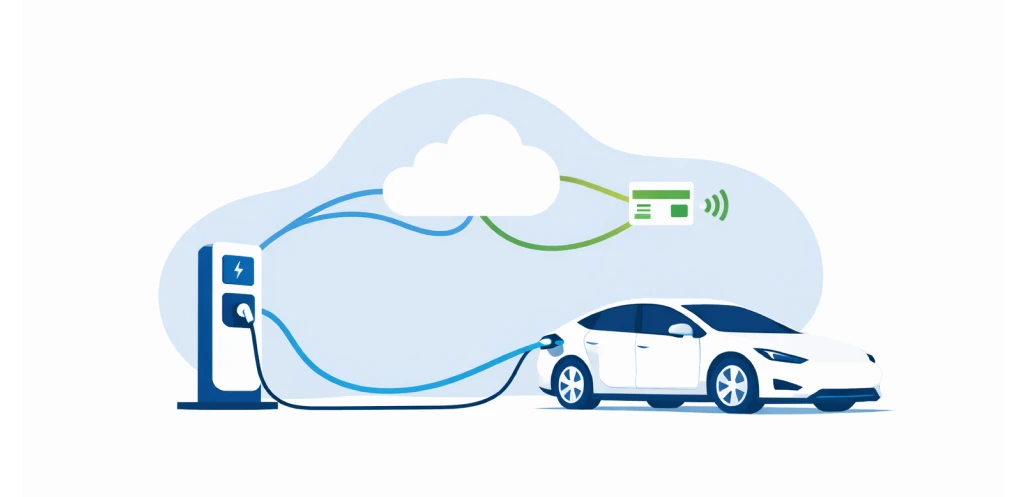


L'interopérabilité de la recharge des VE favorise la fiabilité, les paiements et la conformité. Apprenez ce qui échoue, pourquoi c'est important, et comment les principaux CPOs le résolvent avec des études de cas réels.
Table des matières
- Ce que signifie réellement l'interopérabilité de la recharge des VE
- Le coût commercial d'une mauvaise interopérabilité de la recharge des VE
- Les points de rupture de l'interopérabilité des systèmes de recharge des VE (trois schémas critiques)
- Les normes qui comptent
- Ce qu'il faut rechercher dans une plate-forme
L'interopérabilité de la recharge des VE devient rapidement le défi opérationnel déterminant pour les opérateurs de points de charge. Il s'agit de la capacité des chargeurs, des plateformes logicielles, des systèmes de paiement et des réseaux d'itinérance à fonctionner ensemble. Et pour de nombreux opérateurs, c'est le facteur auquel ils sont le moins bien préparés.
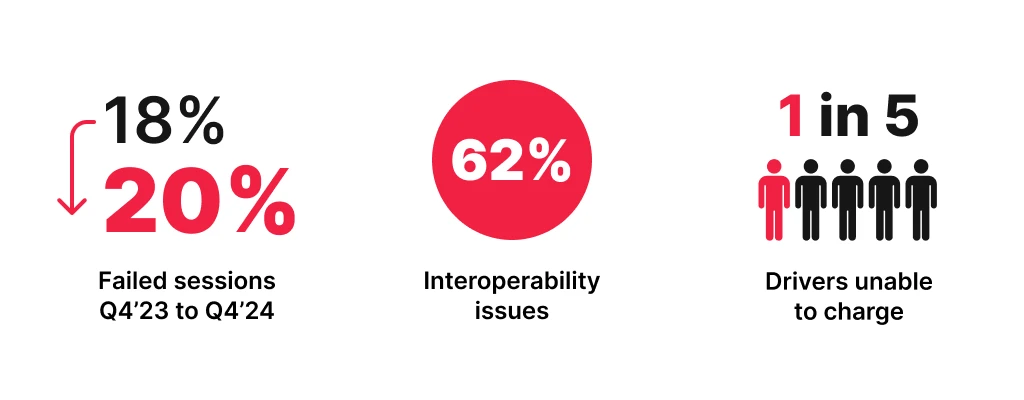
Les données sont claires. Au quatrième trimestre 2023, 18% de toutes les tentatives de recharge publique aux États-Unis ont échoué. Au quatrième trimestre 2024, ce chiffre est passé à 20%. Les dysfonctionnements et les équipements hors service représentaient 62% de ces échecs.
Il ne s'agit pas d'opérateurs marginaux. Ces pannes concernent les plus grands réseaux d'Amérique du Nord. La cause première n'est pas uniquement le matériel. Il s'agit d'une défaillance de l'interopérabilité de la recharge des VE. Le chargeur, le système dorsal, le processeur de paiement et le réseau d'itinérance ne parviennent pas à communiquer.
Pour les CPO qui gèrent des réseaux publics de recharge, il ne s'agit pas seulement d'une question technique. Elle a une incidence sur les recettes, la fidélisation de la clientèle et la situation réglementaire. Les observateurs du secteur s'attendent à ce que moins de la moitié des opérateurs actuels survivent d'ici 2030.
Ce billet de blog examine les points de rupture de l'interopérabilité de la recharge des VE. Il s'appuie sur des études de cas réels et fournit un cadre pratique pour la résolution des problèmes.
Ce que signifie réellement l'interopérabilité de la recharge des VE
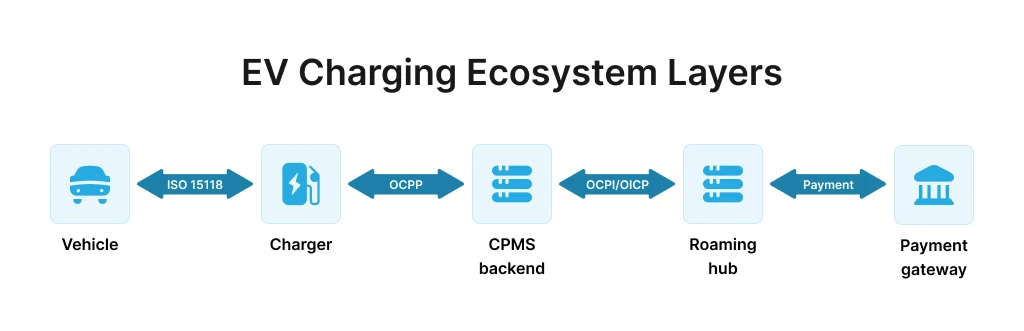
À la base, l'interopérabilité de la recharge des VE signifie une chose : un conducteur peut s'approcher de n'importe quel chargeur public, s'authentifier, charger et payer - indépendamment de la marque du chargeur, du réseau ou de la méthode de paiement.
Pour y parvenir, il est nécessaire d'aligner plusieurs couches. Le chargeur communique avec un système de gestion central par l'intermédiaire de OCPP (Open Charge Point Protocol). L'itinérance dépend de protocoles tels que OCPI et OICP. Les paiements doivent prendre en charge les cartes sans contact, Plug & Charge et les portefeuilles mobiles.
L'analogie de la station-service est utile. Vous vous arrêtez, vous faites le plein, vous payez et vous partez. Personne ne vous demande quelle marque de pompe vous préférez. Aujourd'hui, l'expérience de la recharge des VE est loin de répondre à cette norme. L'interopérabilité de la recharge des VE est ce qui permet de combler le fossé.
Le coût commercial d'une mauvaise interopérabilité de la recharge des VE
L'impact financier va au-delà d'une seule session perdue. Prenons l'exemple d'un CPO disposant de 500 points de charge. Si 20% des sessions échouent, cet opérateur perd un cinquième de ses revenus potentiels. Et les coûts de location des sites, de connexion au réseau et de maintenance restent inchangés.
Les effets en aval s'accumulent rapidement. Les conducteurs qui rencontrent des défaillances reviennent rarement. Les opérateurs de flotte choisissent des concurrents plus fiables. Les critiques négatives se répandent plus rapidement que ne peut le faire une campagne de marketing.
Le marché reflète ces pressions. Plusieurs grands fournisseurs de redevances publiques ont vu la valeur de leurs actions baisser de plus de 70%. La consolidation est en cours. Les opérateurs qui résoudront en premier l'interopérabilité de la recharge des VE seront en position de se consolider. Ceux qui ne le feront pas seront consolidés.
Les points de rupture de l'interopérabilité des systèmes de recharge des VE (trois schémas critiques)
En travaillant avec des opérateurs sur de multiples marchés, nous avons constaté que trois types d'échecs se répétaient. Chacun d'entre eux s'aggrave au fur et à mesure que le réseau prend de l'ampleur.
Problème 1 : Inadéquation de la version de l'OCPP pour les flottes mixtes
OCPP est l'épine dorsale de la communication entre le chargeur et le backend. Il existe en plusieurs versions : 1.5, 1.6, 2.0.1 et la version émergente 2.1. Chaque version diffère matériellement au niveau des profils de sécurité, de la recharge intelligente et de la gestion des appareils.
La plupart des opérateurs exploitent des flottes mixtes. Certains chargeurs parlent 1.6. D'autres parlent 2.0.1. Lorsque le backend attend une version et que le chargeur en envoie une autre, les sessions s'interrompent lors de l'authentification, du rapport d'état ou du paiement.
Étude de cas : Inadéquation des protocoles en Europe centrale
Une entreprise de taille moyenne qui se développe en Europe centrale s'est approvisionnée en chargeurs auprès de trois fabricants. Le premier lot fonctionnait avec OCPP 1.6J. Le deuxième prenait en charge la version 2.0.1. Le troisième revendique la conformité à la norme 1.6, mais n'en met en œuvre qu'un sous-ensemble.
Les commandes de démarrage à distance ont échoué à partir du troisième lot. Les mises à jour de l'état des chargeurs 2.0.1 sont arrivées dans des formats différents. Les mises à jour des microprogrammes nécessitaient des flux de travail distincts pour chaque groupe. En l'espace de six mois, l'équipe d'exploitation a consacré plus de la moitié de son temps au dépannage plutôt qu'à l'évolution.
L'opérateur a migré vers Tridens EV Charge, qui est certifiée pour OCPP 1.6J, 2.0.1 et 2.1. La plateforme normalise la couche de communication. Les commandes à distance, la gestion des sessions et les diagnostics fonctionnent de manière identique sur tout le matériel. La migration a été réalisée en quatre semaines environ.
Problème 2 : Fragmentation de l'itinérance et des paiements
L'itinérance des véhicules électriques (recharge sur n'importe quel réseau avec un seul compte) dépend de protocoles tels que OCPI et l'OICP, opérant par l'intermédiaire de plateformes telles que Hubject, Gireve, ENAPI et iVOLT.
Dans la pratique, les formats CDR (Charge Detail Record) varient d'un hub à l'autre. Les structures tarifaires ne se traduisent pas clairement. Les méthodes d'authentification sont contradictoires. Les cycles de règlement ne sont pas alignés, ce qui rend les flux de trésorerie imprévisibles.
Étude de cas : Le défi de l'expansion transfrontalière d'une EMSP
Un EMSP d'Europe occidentale s'est connecté à un grand centre d'itinérance pour offrir une tarification transfrontalière. Les CDR de certains CPO utilisaient une version différente de l'OCPI. Les données tarifaires arrivaient dans des formats incompréhensibles. Le calendrier de règlement a créé des frictions dans les flux de trésorerie. Les conducteurs ont signalé des échecs d'autorisation sur des réseaux spécifiques. L'EMSP a passé six mois à résoudre ces problèmes individuellement.
Tridens EV Charge pour les EMSP s'intègre à plusieurs centres d'itinérance simultanément en utilisant OCPI et OICP. Il gère automatiquement le rapprochement des CDR, le mappage des tarifs et le règlement multi-hub. Les intégrations de terminaux de paiement avec Payter, CCV et Nayax couvrent l'aspect matériel. La prise en charge logicielle de Plug & Charge, de l'auto-charge, du prépaiement et du paiement immédiat garantit qu'aucun conducteur n'est exclu.
Problème 3 : Conformité réglementaire multi-marchés
Chaque marché impose ses propres règles en matière de paiement, de comptage et de tarification. Le règlement AFIR de l'UE impose des paiements ad hoc et une tarification transparente. En Allemagne, l'Eichrecht exige que les données des compteurs soient signées par cryptographie. Le Royaume-Uni exige des paiements sans contact et l'affichage de la tarification au kWh.
Étude de cas : Une expansion multi-marchés qui s'est enlisée
Un fournisseur de services de paiement en expansion en Allemagne et au Royaume-Uni a découvert que ses données de comptage n'étaient pas conformes aux normes Eichrecht. Son flux de paiement britannique n'était pas doté de la capacité obligatoire de paiement sans contact. La logique fiscale était codée en dur pour un pays. L'expansion a été bloquée pendant près d'un an, tandis que des concurrents pénétraient sur les mêmes marchés.
Tridens a une expérience directe des marchés de l'UE, du Royaume-Uni et de l'Allemagne. La plateforme prend en charge les paiements conformes à AFIR, le comptage conforme à Eichrecht et les exigences de tarification du Royaume-Uni en tant qu'options de configuration - et non en tant que projets personnalisés.
Les normes qui comptent
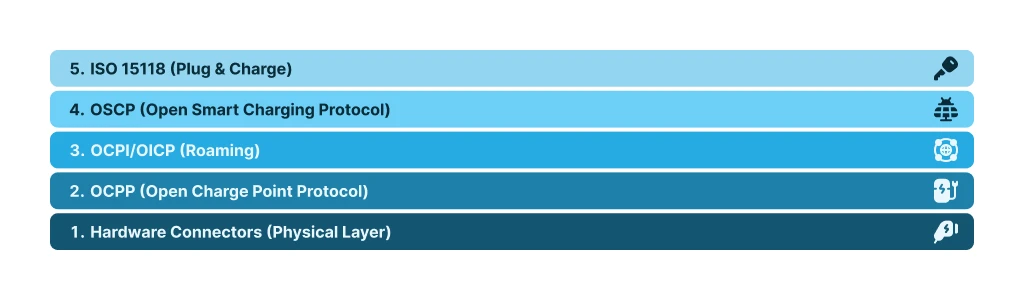
- OCPP régit la communication entre le chargeur et le backend. La prise en charge des versions 1.6J, 2.0.1 et 2.1 est essentielle.
- OCPI permet l'itinérance entre réseaux et l'échange de CDR. L'OICP remplit la même fonction grâce à l'écosystème Hubject.
- ISO 15118 est à la base de Plug & Charge - l'authentification la plus simple possible du conducteur.
- OSCP gère la distribution de l'énergie entre le réseau et les stations de recharge.
- Tridens EV Charge prend en charge l'ensemble des protocoles, certifiés et testés en production.
Ce qu'il faut rechercher dans une plate-forme
Sur la base des modèles d'interopérabilité ci-dessus, les opérateurs devraient évaluer les plateformes en fonction des critères suivants : architecture agnostique sur le plan matériel, prise en charge de l'OCPP multiprotocole (1.6J, 2.0.1, 2.1), intégrations natives de hub d'itinérance, infrastructure de paiement flexible, conformité multi-marchés intégrée, surveillance automatisée avec des diagnostics d'IA, application mobile en marque blanche, mise en service rapide et capacités de gestion de flotte.
Liste de contrôle d'une solution complète de recharge des VE
- Agréé pour le matériel
- Multi-protocole OCPP
- Centres d'itinérance
- Paiements flexibles
- Conformité multi-marchés
- Diagnostic IA
- Application en marque blanche
- Embarquement rapide (<4 semaines)
- Gestion du parc automobile
Le secteur de la recharge des véhicules électriques entre dans une période décisive. Les opérateurs qui s'appuient sur une forte interopérabilité des systèmes de recharge des VE s'empareront de parts de marché à mesure que la consolidation s'accélérera. Ceux qui tardent à le faire verront le coût de leur rattrapage devenir de plus en plus difficile à supporter.
Tridens EV Charge a été conçu pour ce moment - pour donner aux CPO et aux EMSP la base d'interopérabilité qui transforme la complexité en avantage concurrentiel.