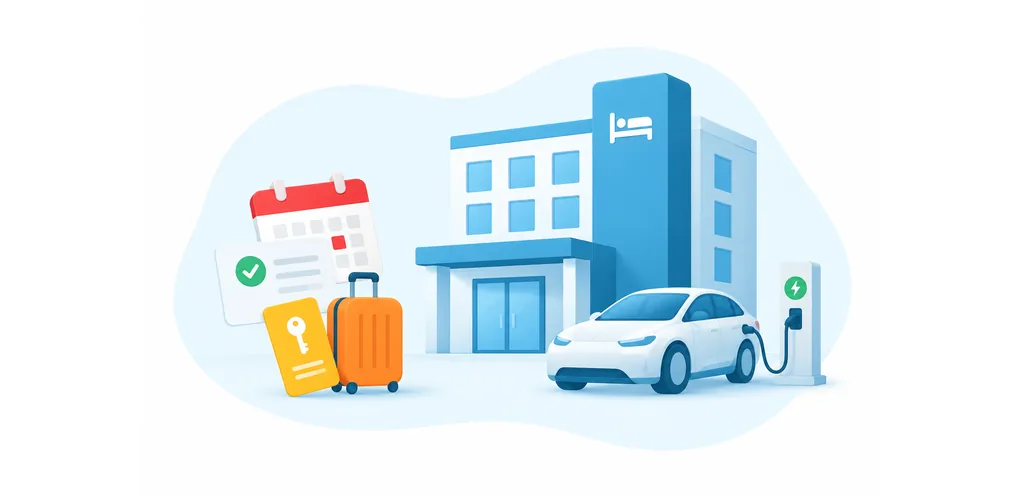


EV charging for hotels is part of the guest experience from the moment a traveler plans the trip to the moment the vehicle leaves the property.
For hotel operators, the challenge is not limited to installing chargers. Guests need to know charging is available, find the right parking area, understand the price, start without friction, and trust that the vehicle will be ready when they depart.
The hotel must also manage electrical capacity, access rules, payments, support, parking turnover, maintenance, and reporting. A clear operating model turns these tasks into a dependable service rather than another source of front-desk exceptions.
Why hotel EV charging needs its own operating model
Hotel charging differs from many public charging use cases because guests often park for several hours or overnight. That creates an opportunity to provide convenient destination charging, but it also changes the decisions around charger speed, bay availability, pricing, and support.
A guest who arrives late does not want to troubleshoot an unfamiliar app or move the vehicle in the middle of the night. The hotel therefore has to design around predictable access, clear instructions, realistic overnight charging, and a support path that works outside normal office hours.
Hotel groups face an additional challenge. Properties may have different parking layouts, electrical capacity, ownership structures, guest profiles, and local pricing requirements. The operating platform should provide central control without forcing every site into an identical configuration.
Choose what EV charging should achieve
Start with the commercial and service objective. Hardware and software choices become easier once the hotel knows what role charging should play.
An included guest amenity
The hotel can include charging in the stay, much like another property amenity. This keeps the guest proposition simple, but the operator still needs rules for eligibility, session limits, bay use, energy cost allocation, and non-guest access.
A paid charging service
The property can charge by measured energy, time, parking duration, or a combination. A paid model can recover operating costs and create a direct revenue stream. It also requires clear price disclosure, accurate session records, reliable payment processing, receipts, refunds, and support for billing questions.
A loyalty or package benefit
Charging may be included in selected room packages, offered at a discount to loyalty members, or connected to corporate travel agreements. This model can reinforce the hotel’s broader customer strategy, but it requires the charging service to identify eligibility and apply the right rule consistently.
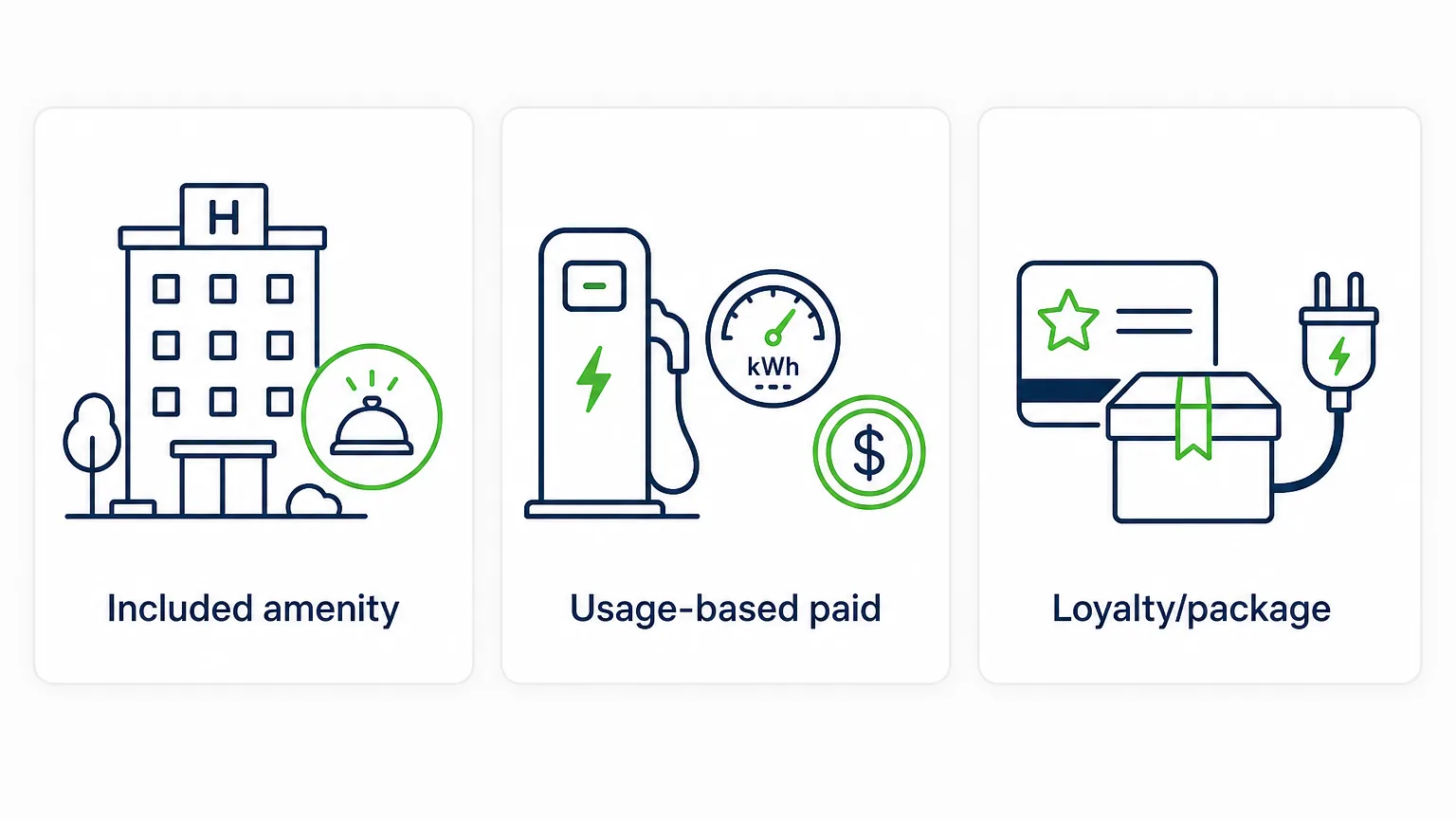
A hotel can also combine these approaches. For example, registered guests may receive a reduced tariff while visitors or roaming drivers pay the standard rate. The platform should make each rule understandable to both the guest and the hotel team.

Design the complete guest charging journey
A reliable charger is essential, but it is not the whole experience. Hotels should map the journey from booking and arrival through payment and departure.
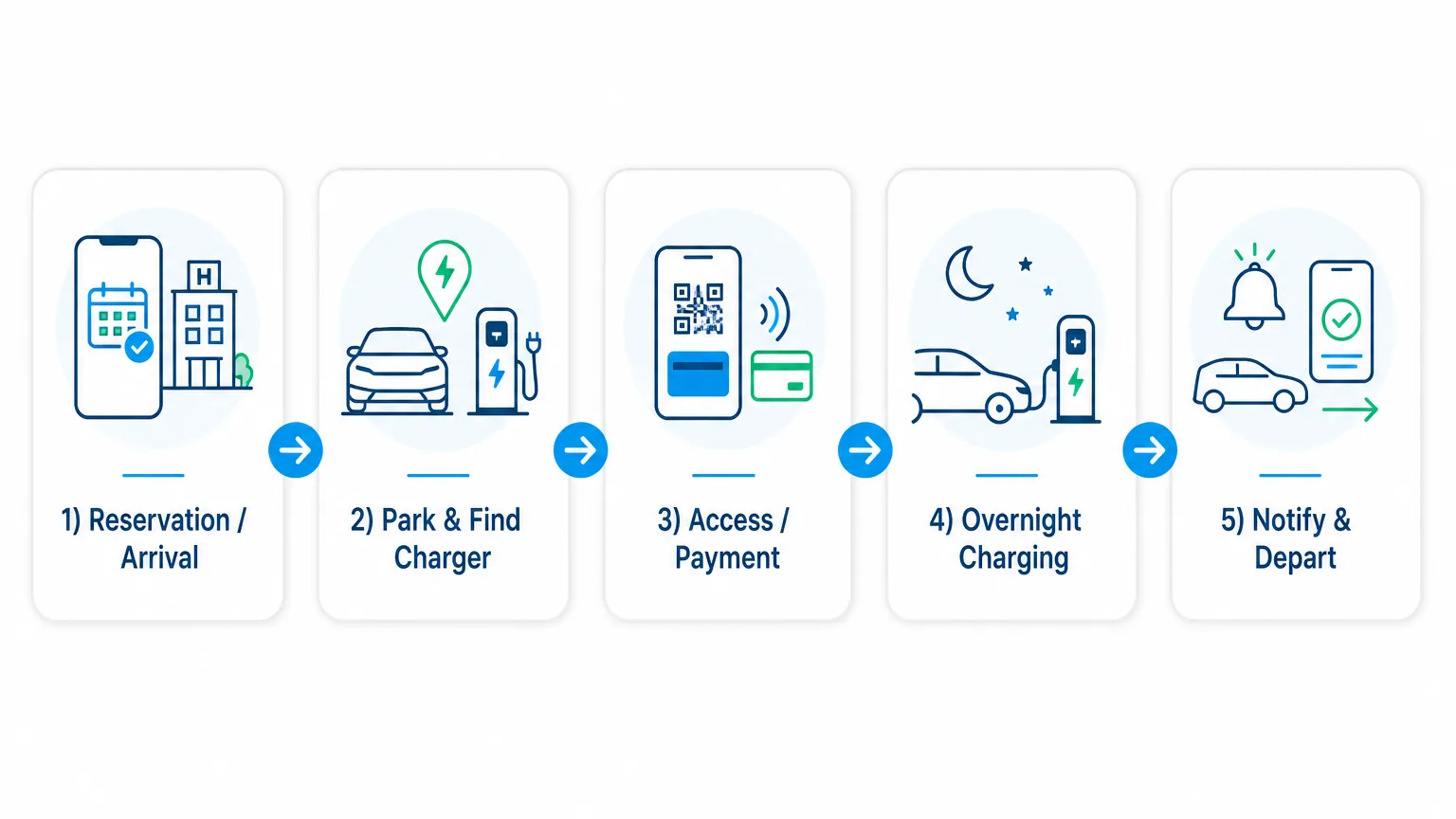
Set expectations before arrival
Guests should be able to understand whether charging is available, whether a space can be reserved, what connector or charger type is offered, who may use it, and how pricing works. The hotel should avoid promising a guaranteed charger unless the operational process can support that promise.
Make chargers easy to find
Arrival instructions, signs, bay markings, lighting, and parking access should guide a guest to the charger without a trip to reception. The location should also account for accessibility, cable reach, pedestrian movement, and safe circulation through the parking area.
Keep access and payment simple
The hotel may support an app, RFID card, ad hoc payment, room-linked access, loyalty identification, or roaming. The right mix depends on the guest profile and local requirements. Each path should show the price before charging and produce a clear transaction record afterward.
Plan for overnight behavior
Overnight parking creates different turnover expectations from a short public charging stop. The hotel should decide whether guests may remain connected until morning, whether charging stops after a target is reached, and how idle or parking rules apply.
Notifications can help guests know when a session starts, completes, stops unexpectedly, or requires action. Any request to move a vehicle should fit the realities of a hotel stay.
Plan chargers and power around the property
Match charging speed to dwell time
Many hotel guests park long enough for destination charging. That can make moderate charging power practical for overnight stays, while faster chargers may suit restaurants, conference visitors, taxis, or short-stay guests. The hotel should choose the mix based on real dwell patterns rather than assuming faster is always better.
The guide to EV charger types explains how charging levels and use cases differ. The final design should also consider supported vehicles, connector requirements, installation cost, and future expansion.
Assess electrical capacity early
A site assessment should review the available grid connection, existing building demand, expected charging use, seasonal peaks, future rooms or facilities, and the cost of upgrades. Chargers should not be planned separately from kitchens, HVAC, laundry, spas, conference areas, or other major hotel loads.
EV charging load balancing can distribute available power across active chargers and adjust charging as site demand changes. This helps the property add more charge points while keeping charging within defined power limits.
Separate guest, staff, and fleet rules
A property may need charging for overnight guests, restaurant visitors, conference attendees, employees, hotel vehicles, shuttles, or delivery partners. These groups can share infrastructure while using different access rights, tariffs, schedules, and reports.
Build pricing and billing that guests can understand
The commercial model should be easy to explain at booking, at the charger, on the receipt, and during a support conversation. Complexity behind the scenes must not create confusion for the guest.
| Charging model | Useful for | Operational requirements |
|---|---|---|
| Included in the stay | Simple premium amenity | Guest validation, usage policy, internal cost allocation |
| Energy-based price | Charging tied to measured consumption | Metered session data, tariff rules, taxes, receipt |
| Time or parking price | Managing bay occupation | Start and stop times, grace periods, clear parking rules |
| Hybrid tariff | Combining energy, time, or parking value | Accurate calculation and a readable charge breakdown |
| Loyalty or package benefit | Member tiers and selected bookings | Eligibility, discounts, package logic, customer identification |
| Different guest and visitor rates | Mixed public and private access | User groups, access permissions, separate tariffs and reporting |
EV charging billing software connects session records to tariffs, discounts, subscriptions, taxes, payments, invoices, refunds, and settlement. This matters when one hotel or group operates several pricing models across different properties.
Every transaction should remain traceable. When a guest questions a charge, the team should be able to see the session, measured usage, applied tariff, discount, payment, adjustment, and receipt without searching across disconnected systems.
Prepare operations before the first guest plugs in
Central monitoring and remote actions
A charge point management system gives the operator visibility into sites, chargers, connectors, availability, sessions, and faults. Remote diagnostics and actions help teams resolve suitable issues without waiting for a technician to visit the property.
Clear support ownership
Define what the front desk handles, what a centralized support team handles, and when a maintenance partner becomes involved. Staff need concise instructions for common cases such as failed authorization, an occupied bay, a stopped session, a payment question, or an offline charger.
Useful integrations
Depending on the service model, the charging platform may need to exchange data with reservation, property management, parking, payment, loyalty, accounting, or customer communication systems. API access helps the hotel connect these workflows without hard-coding every process into one platform.
Multi-property reporting
Hotel groups should be able to compare utilization, revenue, energy, faults, payments, and service performance by property. Central reporting also helps standardize operations while leaving room for site-specific tariffs and access policies.
A practical rollout plan for hotels
- Define the guest and business objective. Decide whether charging is an amenity, paid service, loyalty benefit, or mixed model.
- Audit demand and the site. Review expected users, parking flow, accessibility, connectivity, electrical capacity, and expansion options.
- Design the guest journey. Document discovery, reservation expectations, access, pricing, support, notifications, and departure.
- Select interoperable technology. Confirm hardware compatibility, standards support, remote operations, pricing flexibility, billing, and integration options.
- Pilot at a representative property. Measure session success, charger availability, support cases, payment failures, bay use, power demand, and guest feedback.
- Standardize before scaling. Create reusable policies for access, tariffs, support, maintenance, reporting, permissions, and site onboarding.
The pilot should test exceptions as well as normal sessions. A successful rollout is one that the property team can operate at night, during peak occupancy, and when a charger or payment does not behave as expected.

How Tridens EV Charge supports hotel charging
Tridens EV Charge connects charge point operations with native billing and monetization. Hotel operators can manage chargers, users, access, tariffs, payments, and reporting without adding a separate billing layer after deployment.
The platform is hardware-agnostic and works with OCPP-compliant chargers. It supports dynamic load balancing, personalized pricing, white-label customer experiences, and eRoaming through OCPI and OICP.
For hotel groups, the billing foundation supports different guest types, rates, discounts, subscriptions, payments, invoices, and partner settlement across multiple locations. Each action and transaction can remain tied to defined roles, permissions, and auditable records.
This allows a hotel to start with a focused guest service and expand into a consistent charging operation across a wider property portfolio.
FAQ about EV charging for hotels
Can I charge my EV at a hotel?
Some hotels provide EV charging for overnight guests, visitors, or both. Availability, access, supported chargers, pricing, and reservation rules vary by property, so drivers should check the hotel’s current information before arrival.
Do hotels offer free electric car charging?
Some hotels include charging as a guest amenity, while others charge by energy, time, parking duration, or a hybrid tariff. Hotels may also offer discounts or included charging through selected packages or loyalty tiers.
What type of EV charger is best for a hotel?
The choice depends on guest dwell time, vehicle mix, parking turnover, electrical capacity, and whether the property also serves restaurants, conferences, fleets, or public visitors. Many hotels can use a mix of charging speeds for different use cases.
Can hotel guests reserve an EV charging space?
A hotel can offer reservations if its parking and charging processes can reliably hold and release spaces. If reservations are not guaranteed, the property should state that clearly before arrival and provide an alternative plan when chargers are occupied.
How can hotels prevent charging bays from being blocked overnight?
Hotels can combine guest-only access, parking rules, session notifications, time limits, grace periods, or idle fees. The policy should match overnight guest behavior and be communicated before the session begins.
Can hotel EV charging connect to loyalty or room packages?
Yes. With suitable integrations, hotels can apply member discounts, package benefits, guest eligibility, or different rates for guests and visitors. The charging and billing systems must identify the customer and apply the correct rule.
