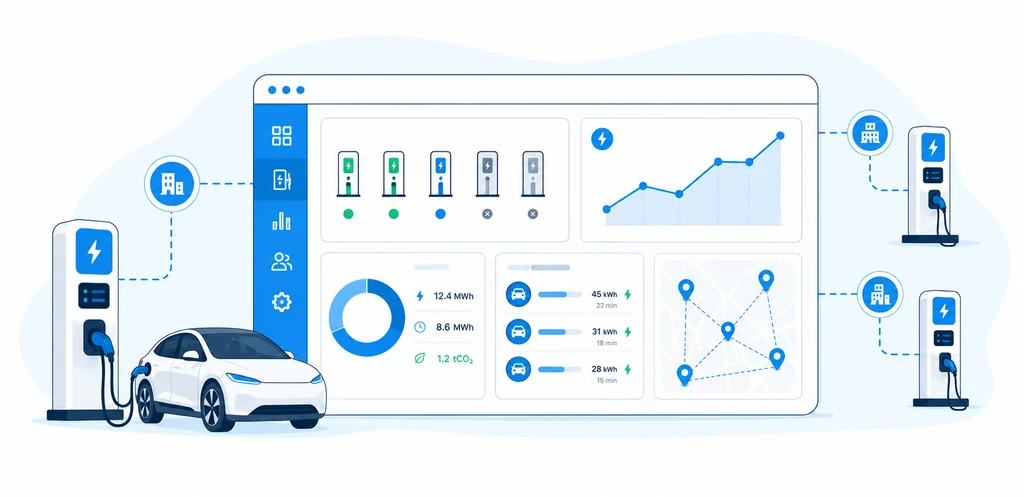


Learn how CPO software helps EV charging operators manage chargers, pricing, billing, roaming, payments, uptime, and growth from one platform.
Choosing the right CPO software is one of the most important decisions an operator can make. The platform you pick shapes your uptime, your driver experience, your tariffs, your roaming partners, and how fast you can launch in new markets or business models. Get it right, and your operations team scales without growing headcount. Get it wrong, and every new charger, partner, or country turns into a slow, expensive integration project.
This guide explains what CPO software is, what it should do, and how to evaluate vendors before you sign. It is written for operators who are launching, migrating, or comparing platforms, not for people looking for a one-line definition.
 Loading ...
What Is CPO Software?
CPO software, also called a Charge Point Management System (CPMS) or EV charging management software, is the platform a Charge Point Operator uses to run an EV charging network from a single back office. It connects every charger in the field to a central system that handles real-time monitoring, sessions, pricing, billing, user authentication, roaming, and reporting.
In practical terms, CPO software is the layer between hardware in the field and everything else, including drivers, EMSPs, payment gateways, energy systems, finance tools, and roaming hubs. Without it, every charger is an isolated asset. With it, hundreds or thousands of chargers behave as one coordinated network.
The category is closely related to, but distinct from, EMSP software. CPOs operate the infrastructure. EMSPs serve drivers and route them across networks. Many operators run both roles in the same platform, which is why the difference between a CPO and an EMSP matters when you build a shortlist.

What CPO Software Does for a Charge Point Operator
A modern CPO platform should handle the full operational lifecycle of a charging network. At minimum, that includes:
- Network operations: onboarding chargers, monitoring status in real time, running remote commands, and resolving faults without dispatching technicians.
- Session management: starting, stopping, authorizing, and recording every charging session, with accurate kWh and time data for billing.
- Pricing and tariffs: flexible tariff structures by site, time, customer segment, and connector type.
- Billing and payments: invoicing for drivers, fleets, and partners, reconciliation with payment gateways, and settlement with roaming partners.
- Driver experience: a branded mobile app or web flow for finding, starting, and paying for charging.
- Energy and smart charging: load balancing, ISO 15118 Plug and Charge, demand management, and integration with solar and storage.
- Analytics: dashboards for uptime, utilization, revenue, energy use, and customer behavior.
- Compliance and security: alignment with all the standards relevant to your market.
The right CPO software unifies these capabilities. The wrong one scatters them across spreadsheets, custom scripts, and stitched-together third-party tools, which is where margin and uptime quietly leak away.
Ready to get started?
Learn how your business can thrive with Tridens EV Charge.

Core Capabilities to Look for in CPO Software
If your software lacks flexibility, growth will inevitably lead to operational bottlenecks and high maintenance costs.
Below are the capabilities that decide whether a CPO platform will hold up as your network grows.
Hardware-agnostic, OCPP-compliant architecture
You should never be locked into one charger manufacturer. Your platform must communicate cleanly with any OCPP-compliant charger and support the protocol versions in active use today, including OCPP 1.6J, OCPP 2.0.1, and OCPP 2.1. Each version brings different capabilities. Version 2.0.1 adds stronger device management and security, while 2.1 supports advanced smart charging and bidirectional power flow. Multi-version support is essential for any operator running a mixed fleet.
Hardware-agnostic design protects your future hardware decisions. Tridens EV Charge seamlessly integrates with almost any charger on the market. This hardware-agnostic design gives you total freedom to negotiate equipment based on price and availability, completely eliminating vendor lock-in.
Remote operations, monitoring, and maintenance
A growing network produces a steady stream of small issues, including connectors that hang, chargers that lose connectivity, and firmware that drifts out of sync. Your platform should let your operations team see, diagnose, and resolve most of these without a site visit.
Look for real-time connector status, remote commands, OCPP log analysis, configurable alerts by email, SMS, in-app, or WhatsApp, and predictive maintenance signals. The goal is not just uptime. It is lower cost per fault and shorter time to resolution.
Smart EV charging and energy management
Energy is the largest controllable cost for most operators. CPO software earns its keep by managing how power flows across your sites. The capabilities that matter here include dynamic load balancing, schedule-based distribution, integration with solar and battery storage, and ISO 15118 support for Plug and Charge and vehicle-to-grid scenarios. A platform that exposes these as configurable rules instead of bespoke engineering pays back quickly. Tridens builds smart charging around this principle.
Smart EV Charging: Unlocking Its Full Potential

Tariffs, billing, and monetization
This is where many CPO platforms quietly fall short. Running a CPO is, in the end, a revenue operation. Your platform should give you full control over pricing logic, including per kWh, per minute, per session, idle fees, time-of-use tariffs, subscriptions, loyalty programs, and per-segment discounts, without engineering work.
Beyond pricing, the platform should automate invoicing, support multiple payment gateways, handle dunning, and settle accounts with partners. If your CPO software treats billing as an afterthought, your finance team rebuilds it in spreadsheets. Tridens approaches this differently. The EV charging platform is built on top of Tridens payments and billing architecture, with flexible plans and tariffs configurable without code. The broader logic behind monetization is covered in our guide to EV charging billing.
Roaming and interoperability
If you plan to serve drivers beyond your own network, OCPI and OICP support is essential. The platform should integrate natively with roaming hubs such as Hubject, Gireve, ENAPI, and handle CDR exchange, tariff publication, and settlement automatically. Interoperability problems compound as networks grow, and the deeper challenge is documented in our analysis of EV charging interoperability.
Driver experience and white-label apps
Your driver-facing surface, including the mobile app, web portal, and station signage, is the only part of your platform most users will ever see. It needs to be reliable, fast to authenticate, and branded as your business, not someone else’s. Look for a white-label app for iOS and Android with station discovery, session control, payment, invoices, and loyalty features.
Analytics that connect operations to revenue
Generic dashboards are not enough. You need configurable views that tie operational metrics such as uptime, faults, and energy delivered directly to business outcomes such as revenue per charger, utilization by segment, and partner settlement. Real-time analytics, exportable reports for finance, and predictive usage analytics separate platforms that look modern from platforms that actually help you run the business.
How CPO Software Connects to Billing and Monetization
The operations side of CPO software is well covered in most product demos. The monetization side is where vendors diverge, and where many operators discover problems only after launch.
The questions worth asking are concrete. Can you launch a new tariff in an hour, or does it require engineering? Can the platform invoice individual drivers, fleet accounts, and partners from the same system? Does it support subscriptions, prepaid balances, and loyalty programs without external tools? Can it sell more than charging, including hardware, installation, and services, through one checkout? Does it produce the formats your finance and tax teams need, in the markets you operate in?
A CPO platform that treats billing as a downstream export slows every commercial decision you make. A platform that treats billing as a first-class capability lets your commercial team move at the speed of the market. Tridens EV Charge is designed around this premise, so the same product manages chargers, sessions, tariffs, invoices, and revenue recognition end-to-end.
Build vs. Buy: When CPO Software Is the Right Decision
A small number of large operators build their own CPO software. Most should not. The trade-offs behind that choice are laid out in our guide on build vs. buy software.
Building a platform that handles OCPP 1.6J, 2.0.1, and 2.1, OCPI roaming, ISO 15118 Plug and Charge, PCI-DSS-compliant billing, and a production-grade mobile app is a multi-year engineering program. Maintaining it, by keeping pace with protocol updates, hardware quirks, regulatory changes, and roaming hub evolution, is a permanent commitment.
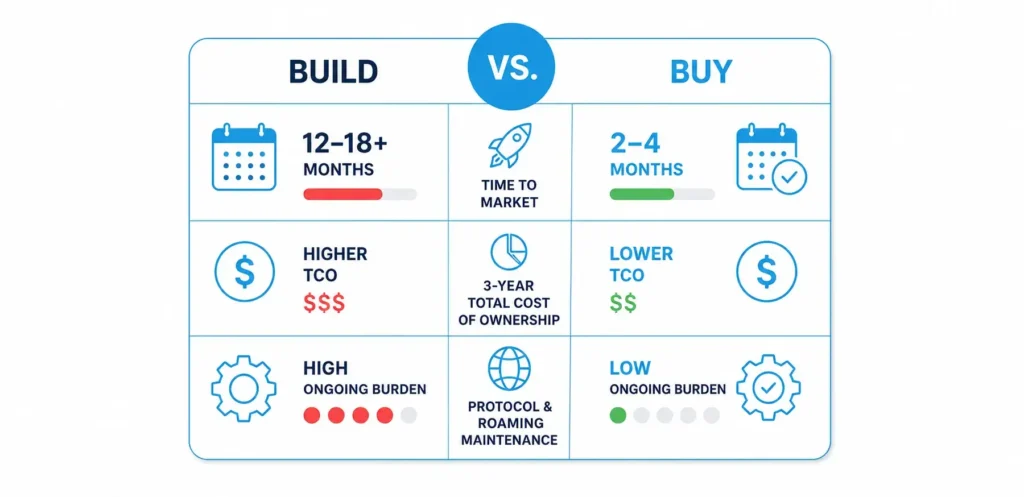
Buy makes sense if you need to launch in months rather than years, require immediate compliance, or want the flexibility to scale into new markets. It lets you focus on operations, partnerships, and customer experience instead of protocol engineering.
Build makes sense if you have massive scale, deep engineering resources, or unique custom hardware needs. For most operators, like utilities entering EV charging, fleet operators rolling out depots, and oil and gas companies adding charging to forecourts, the right answer is a mature, hardware-agnostic platform with strong roaming and billing.
Questions to Ask Before You Sign a CPO Software Contract
Use this as a short vendor checklist when you reach late-stage evaluation:
- Which OCPP versions are you certified for, and can I see the certificates?
- Which roaming hubs do you integrate with natively, and how is CDR exchange handled?
- How do you support multiple business models, including public, private, residential, fleet, and en-route, in the same instance?
- How do tariffs, subscriptions, and loyalty programs get configured, and by whom?
- How does the platform handle billing for fleets, partners, and roaming counterparties?
- What is your standard onboarding timeline, and what does the first 90 days look like?
- What hardware brands do you have in production, and where have customers run into issues?
- What is your security posture across ISO 27001, SOC 2, PCI-DSS, and GDPR?
- What is your roadmap for OCPP 2.1, ISO 15118, vehicle-to-grid, and AI-driven operations?
- How do you handle migration if I am coming from another platform or an in-house system?
A vendor that answers these clearly and with evidence is worth shortlisting. A vendor that handwaves any of them is showing you a future support ticket.
Build a More Scalable CPO Business with Tridens
The right CPO software runs your network reliably today and absorbs whatever the EV charging market brings next, including new protocols, new business models, new partners, and new markets. Tridens EV Charge is built for exactly that, with hardware-agnostic operations, full OCPP and ISO 15118 support, native OCPI and OICP roaming, and a converged billing and monetization engine that lets your commercial team move without waiting on engineering.
If you are evaluating CPO platforms, whether you are launching a new network, migrating from an existing system, or expanding into new countries or business models, we would be glad to walk through your specific scenario.