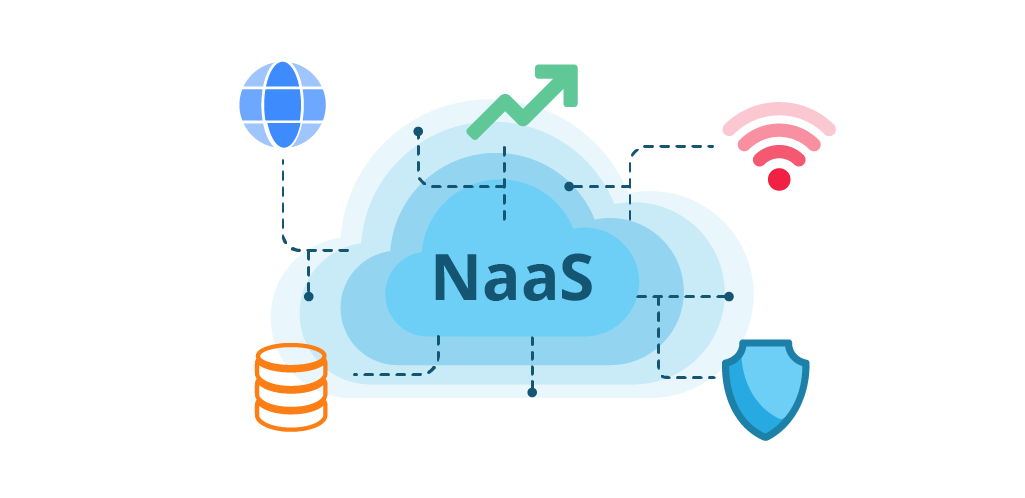


Learn what Network as a Service (NaaS) is, how it works, how Telcos can benefit from it, providers to learn from in 2026, and what the future has in store.
Table of contents
You probably know of the as-a-service (aaS) trend by now.
It’s a hot topic in the era of cloud computing and cloud providers.
With 94% of US businesses adopting cloud services, the networking industry needed a digital transformation.
In 2025, the global market for Network as a Service (NaaS) was estimated at USD 23.50 billion with a steady increase.
With the ability to replace any traditional networking features while providing extra security and scalability, it’s worth learning how telcos benefit from NaaS.

In this blog, you will learn what Network as a Service (NaaS) is, how it works, how telcos benefit from it, top providers to learn from in 2026, and what the future has in store.
Let’s get started.
What is Network as a Service (NaaS)?
Network as a Service (NaaS) is a cloud model that allows customers to rent networking services without setting up and maintaining the hardware themselves.
Think of it as outsourcing your network infrastructure to a provider, on the cloud.
The telecommunication industry has adopted cloud-native software for BSS, moving billing, customer and revenue management to the cloud.
Everything runs virtually, using cloud-native and API-driven systems, paired with SASE (Secure Access Service Edge) for security.
SASE is a stack of networking security features and protocols unified into a cloud-native framework.

While Software as a Service (SaaS) focuses on delivering applications to the end-user, NaaS delivers network connectivity, security and monitoring.
In case you’re wondering
Network as a Service can implement VPN, MPLS, QoS, DNS, DHCP, IPAM, NAC, firewalls, load balancers, dynamic routing, network monitoring and much more.
You don’t sacrifice functionality with NaaS.
NaaS vs. Traditional Networking
Cloud services have several advantages vs. on-premise solutions.
The table below shows how NaaS compares to traditional networking.
| Feature | Network as a Service | Traditional Networking |
|---|---|---|
| Setup & Deploy | Cloud software-based setup | Hardware-based setup |
| Infrastructure | Virtual routers, switches, firewalls | On-premise physical devices, maintenance required |
| Flexibility | Connections opened in NaaS dashboard in minutes | Installation and configuration of new sites can take weeks |
| Cost / Pricing | Pay-as-you-go, OpEx, subscription-based | Upfront investments, CapEx (hardware, licenses, installation) |
| Security | Secure Access Service Edge (SASE), Zero Trust | Hardware firewalls, VPN, more prone to attacks |
| Maintenance | Handled by provider, automatic updates | Requires professional team, manual updates |
| Access | Access from anywhere, good for remote work and hybrid teams | Limited to location and local network |
| Monitoring | Real-time analytics, AI insights, proactive | Reading logs, SNMP tools, reactive, hardware checks |
| Freedom | Dependent on vendor uptime and quality | Full control, higher operational burden |
How Implementing NaaS Benefits Your Business
Let’s say you’re a telecom operator managing a lot of subscribers, enterprise clients, and multiple network domains.
Your biggest challenges are likely legacy infrastructure, rising operational costs, and the pressure to launch new digital services.
Here are some ways you can benefit from implementing NaaS:
Lower Costs
With NaaS, telcos don’t have to maintain costly hardware.
Instead, they operate virtualized, cloud-based network environments.
- Reduce CapEx by shifting to subscription-based, pay-as-you-grow OpEx models
- Eliminate hardware maintenance costs
- Deploy services across multiple regions from a single control plane
For example, telcos can launch SD-WAN services without upfront infrastructure investment.
Flexibility & Scalability
Modern telcos provide on-demand connectivity for their customers.
- Create and manage new virtual networks for customers in minutes
- Offer bandwidth-on-demand or temporary connections for large events
- Support connectivity between different cloud services
Imagine your customer wants to open a new office. Your team can setup a connection in minutes – not days or weeks, without touching a single router.
Enhanced Security
As networks expand, the need for built-in security becomes crucial.

NaaS tackles this with Secure Access Service Edge (SASE) and Zero Trust.
- Zero Trust: Every connection is verified – even inside a network.
- Secure Access Service Edge: Unified cloud security features in a framework.
- Micro-segmentation: If one device is compromised, it can’t spread.
- Multi-factor authentication: Every user must verify their identity.
- Least-privilege access: Devices only get the access they need.
- Real-time DDoS protection and automated threat detection
The average cost of a data breach in 2025 was over $4 million.
Network Monitoring
Managing multi-domain networks can be complex.
Logging into routers and reading logs is a headache for your team.
NaaS dashboards provide:
- Real-time performance insights.
- Predictive alerts before downtime occurs.
- Automated rerouting to maintain uptime.
This primarily provides a smooth user experience for your customers and saves your IT team a lot of time.
Potential Drawbacks and Pitfalls
NaaS isn’t magic.
And it’s still relatively new, so it comes with its challenges.
- Legacy systems: Older data centers might not integrate easily.
- Operational overhead: Running legacy networks and NaaS simultaneously presents a challenge for your IT team and increases costs for you.
- Expertise: You’re going to need experts to implement NaaS. This means finding and paying those experts.
It’s important to consider if the benefits are worth the hassle.
Note
NaaS is not always a 100% no hardware solution. It depends on customer needs. It’s more of a 95% no hardware solution. Deploying, managing, securing and maintaining is done fully through software.
How Telcos Profit, Cut Costs and Monetize with NaaS
Modern telcos are not just connectivity providers.
They deliver on-demand network capabilities and features.
This opens up new opportunities for revenue.
Recurring Usage-Based Billing
NaaS is based on pay-as-you-go pricing and recurring billing.
These dynamic billing models give telcos flexibility in pricing:
- A customer can pay for extra bandwidth during seasonal peaks.
- Customers pay for what they use – increasing satisfaction.
- Introduce premium packages that deliver higher quality services.
- Use analytics to automatically recommend better packages for customers.
With Tridens Monetization, each service can be billed by consumption, ensuring that network usage turns into measurable revenue.
Lowering Operational Costs
Using AI and automation, telcos can reduce operational costs and human intervention.
This allows for:
- Self-healing networks
- Automated routing and optimization
- Proactive instead of reactive problem resolution
Outages can be resolved faster and issues can be solved automatically before they even happen.
This reduces OpEx and improves user experience.
Additional Streams of Revenue
Providers can monetize NaaS features to add multiple streams of revenue.
- 5G slicing as a Service – for segmenting networks.
- SD-WAN as a Service – for enterprise WAN connectivity.
- Network Security as a Service – for customers who already have connectivity.
- Network Monitoring as a Service – for those who only need monitoring.
And you can offer your full NaaS solution as a seperate offer.
This way you satisfy multiple customers’ needs.
Partner And Reseller Monetization
The cloud-native nature of NaaS allows for easier integration with other services.
Although traditional network providers do this also, NaaS offers more features to be integrated and easier integration.
Cloudflare does this well with their turnstile.
They offer it for free, but it increases brand awareness and reputation.
You can design features with integration in mind and monetize customers that integrate your service.
What You Can Learn from NaaS Providers
Many network providers have started offering NaaS as part of their service.
We will take a deeper look into three Network as a Service providers.
I’ll go over some things you can adopt from these companies and things you can learn from their ways of implementing NaaS.
Cisco
From a simple idea of connecting two network together in 1984 to offering networks on the cloud.

They set the standard for how networking is done.
What separates them from other providers is their time on the market and a well-established ecosystem.
In 2021, Cisco introduced it’s Cisco+ brand.
The idea for Cisco+ is to offer their products and software as a Service.
- Cisco Secure Connect for SASE security.
- Cisco Catalyst Center for monitoring and troubleshooting.
- Cisco+ Hybrid Cloud for data center, virtualization, VDI, bare metal and edge computing.
- Developer ecosystem with Cisco DevNet.
Cisco DevNet gives developers access to Cisco APIs, SKDs and other tools to develop their own code that improves or adds functionality to their systems. Users can share code on Cisco’s Code Exchange portal
One of the biggest advantages of Cisco+ is that if you know their products, you will feel at home.
If you already have hardware product or software solutions that many can benefit from, consider offering them as a service.
Or offer hardware as a bundle in your NaaS subscription.
Cloudflare
Back in 2004 the founder of Cloudflare were involved in project Honey Pot, focused on detecting e-mail spam and fraud.

Cloudflare was founded in 2009; the idea was to take Honey Pot to the next level.
By 2020, lots of companies had already adopted Cloud and SaaS technologies.
This meant cloud security and integration capabilities were in high demand.
In 2020 Cloudflare announced Cloudflare One™.
- Magic WAN: Cloud-based network connectivity.
- Magic Firewall: Traffic filtering and policy control.
- Magic Transit: DDoS protection and global routing.
In 2025 Cloudflare broke the world record for blocking the biggest DDoS attack yet.
They successfully blocked a 22.2 terabits per second and 10.6 billion packets per second attack that lasted only 40 seconds.
The Cloudflare Magic WAN connector comes as hardware or as a virtual connector (software).
Cloudflare has comprehensive documentation available on their website for setting up Magic WAN.
Users praise Cloudflare for their security.
It’s worth considering a standalone Firewall as a Service (FWaaS) offer in your suite.
Network Security as a Service (NSaaS) means offering firewalls, network segmentation, data loss prevention, access control and Zero Trust access as a service on the cloud.
There is demand and a market for NSaaS.
Megaport

Founded in 2013, with creating a global Software-Defined-Networking (SDN) platform as their main motivation.
Their Goodman Fielder case study highlights an example of what challenges a company faces when they have 78 sites that need to be connected and run 24/7.
- Megaport FWaaS: Firewall as a Service, providing cloud security.
- Megaport Cloud Router: Connect cloud services or endpoints with Megaport.
- Megaport Virtual Edge (MVE): Deploy SD-WAN gateways, virtual routers and firewalls.
- Megaport Virtual Cross Connect (VXC): On-demand layer 2 ethernet connections.
They connect over 1000 data centers globally and integrate directly with major cloud service providers.
Over 410 service providers to be exact.
They provide a vendor-agnostic NaaS solution.
When customers are choosing a provider, they might ignore offers that don’t integrate with their pre-existing services like AWS.
Consider integration with Amazon, Google, Azure, and Oracle cloud services.
Give your customers the experience of building their ecosystem, with you as a part of it.
What to Expect from NaaS in The Future
NaaS is still quite young and hasn’t reached it’s full potential yet.
But with increased demand for security, remote work and cloud services, the Network as a Service market is growing rapidly.
Let’s look at some statistics.
Market Analysis
The market share for NaaS has grown globally as seen below:

| Region | Market Share 2024 (%) |
|---|---|
| North America | 42% |
| Europe | 29% |
| Asia Pacific | 22% |
| Latin America | 5% |
| Middle East | 2% |
Source: Precedence Research
North America’s modern infrastructure, wide adoption of cloud services, and key industry players are the reasons why they hold most of the shares.
The figure below displays the countries which are showing the fastest growth in 2025:

| Country | CAGR (%) |
|---|---|
| China | 39% |
| India | 36% |
| Germany | 33% |
| France | 30% |
| U.K. | 28% |
| U.S. | 25% |
| Brazil | 22% |
Source: Future Market Insights
The figure below represents an estimated market forecast for NaaS from 2024 to 2034.

| Year | Estimated Market Size (USB Billion) |
|---|---|
| 2024 | $18.10B |
| 2025 | $23.50B |
| 2026 | $30.50B |
| 2027 | $39.60B |
| 2028 | $51.40B |
| 2029 | $66.80B |
| 2030 | $86.90B |
| 2031 | $113.20B |
| 2032 | $147.40B |
| 2033 | $192.30B |
| 2034 | $230.10B |
Source: Precedence Research
Considering the increased demand for remote work, the adoption of cloud services and the need for cloud security, this estimation makes sense.
What are the main drivers behind the rapid growth of NaaS?
| Driver | Estimated Impact on CAGR (%) |
|---|---|
| Wide adoption of cloud services | +6.2% |
| Shift from CapEx to OpEx | +5.8% |
| SD-WAN & SASE convergence | +4.9% |
| AI ready networks | +4.1% |
| Campus NaaS demand | +3.7% |
| 5G network slicing as a service | +3.6% |
Source: Mordor Intelligence
AI and Automation
With AI becoming a global trend, it’s important to weigh out if a service really benefits from AI.
“Every vendor out there is just putting AI on top of every product they built 10, 15, 20 years ago, services and customers want to get on the AI trend without even knowing what the outcomes they want are.”
Suresh Katukam, CEO of Nile
The two main goals of AI in NaaS are:
- Stronger security: Detecting threats across the entire cloud network, not just single devices.
- Minimize human intervention: Automatically resolving issues and optimizing performance.
AI will be the focus of providers for the next few years; training models to follow IT protocols will be the priority.
It’s almost crucial to implement some sort of AI into your product these days, or you run the risk of being beaten by your competition.
5G & 5G+
With the rise of 5G, many legacy systems weren’t built to handle the needs of modern networking.
NaaS is perfect for this for every reason I mentioned earlier in this blog.
With 5G also came network slicing.
Network slicing allows one network to be “sliced” into different segments.
- One segment can be optimized for high bandwidth.
- A second segment optimized for low latency.
- A third segment for maximum security.
You can offer 5G network slicing as a service in your NaaS solution.
Many vendors already provide 5G NaaS solutions.
In the next few years, more vendors will adopt 5G NaaS as this allows for flexible network configurations.

How to Monetize Your Services
NaaS is based on recurring and pay-as-you-go billing.
This requires flexible pricing.
Tridens Monetization is a cloud-native billing and revenue management platform.
Including a white-label web and mobile portal with customer insights on payments and subscriptions — ideal for subscription, usage-based, or hybrid billing models.
To learn more about Tridens Monetization, schedule a demo or talk with us.