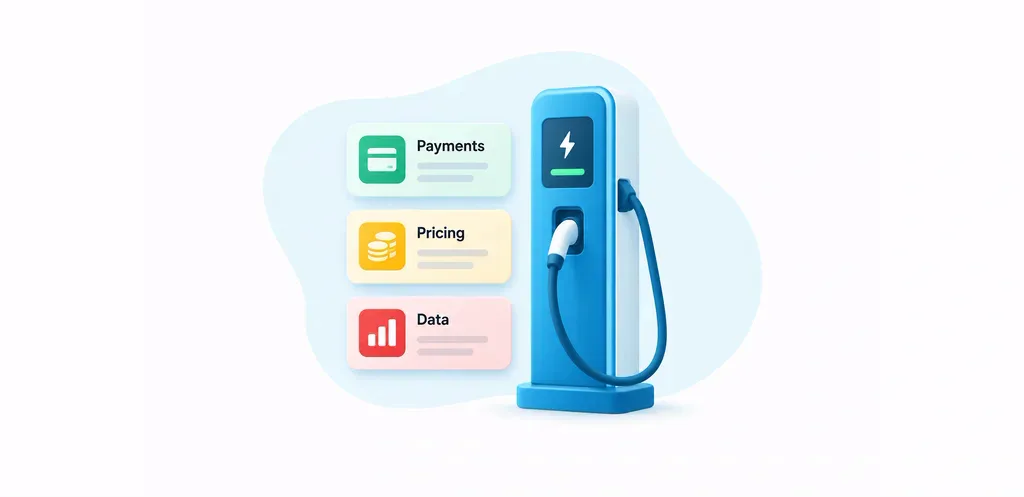


AFIR compliance for CPOs covers ad hoc charging, price disclosure and public charging data. The work spans payment terminals, tariffs, charger firmware and data interfaces.
Drivers must be able to charge without a subscription and see the applicable price before charging. Operators also need to make the required public charging data accessible. Installing a payment reader addresses only part of that work.
This guide maps the main requirements to your network, including obligations already in force and 2027 milestones. It uses EU legislation checked in September 2026 and supports operational planning, not a country-specific legal opinion.
What is AFIR compliance?
The Alternative Fuels Infrastructure Regulation, Regulation (EU) 2023/1804, has applied since April 13, 2024. For charge point operators, Article 5 governs public charging access, payments, prices and technical obligations. Article 20 covers data access.
Which charging sites are covered?
Public access matters more than ownership. A charger on private land can still be publicly accessible. Assess supermarket, visitor and hotel sites against their actual access conditions; do not exclude them simply because the property is private.
A genuinely restricted employee or fleet depot is different from a public charging site. However, being outside the public-payment rules does not remove every technical obligation. Record each site’s access status, deployment date, point power and location before deciding which requirements apply.
Article 5: ad hoc charging and payment requirements
Drivers must be able to use publicly accessible charging on an ad hoc basis. They should not need a subscription to your service to buy an individual charge. Article 5(1) sets different electronic-payment options for points deployed from April 13, 2024.
At least 50 kW: accept payment cards
These points need a payment-card reader or a contactless device that can at least read payment cards. An app-only route or QR payment page is not a substitute for that requirement. One terminal may serve several publicly accessible points within a charging pool.
Below 50 kW: secure internet payment is an option
Below 50 kW, the regulation also permits internet-connected devices allowing secure payment transactions, such as devices generating a specific QR code. A QR sticker is not proof that the payment journey meets the rule. Test the actual transaction, price disclosure and ability to start charging without a subscription.
Where charging is free, Article 5(1)’s requirements do not apply. Where automatic authentication is offered, Article 5(2) requires a clear, convenient option to decline it and choose ad hoc charging or another available contract-based solution.
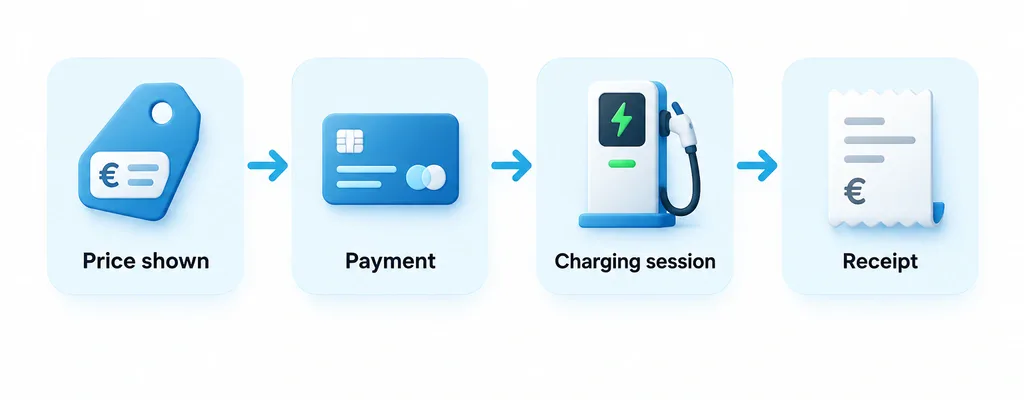
For terminal deployment, test authorization, charger selection, session start and final payment capture together. Confirm merchant processing and settlement responsibilities separately from the charging software configuration.

Article 5: pricing and disclosure before charging
Article 5(3) requires reasonable, transparent, comparable and non-discriminatory CPO prices. Different prices are permitted only when the differentiation is proportionate and objectively justified. Keep the commercial rationale for customer-group and partner tariffs, rather than assuming every configured discount is acceptable.
Show the correct components for each power band
For points deployed from April 13, 2024, Article 5(4) requires the following ad hoc pricing and display approach:
| Point power | Pricing and disclosure |
|---|---|
| 50 kW or more | Base the ad hoc price on electricity delivered per kWh. An additional per-minute occupancy fee may discourage long occupancy. Show both applicable rates at the station before charging starts. |
| Below 50 kW | Clearly provide every applicable component before charging: per kWh, per minute, per session, then any other component, in that order. |
Older points still need assessment under the general transparency rules and applicable national law. Do not interpret the newer-point provisions as permission to hide prices at an older site.
Separate CPO and mobility-provider responsibilities
An e-mobility service provider has its own Article 5(5) disclosure duties. It must show session-specific price information before charging, distinguish roaming costs and other fees, and not add extra charges for cross-border e-roaming. A CPO’s direct price and a mobility provider’s retail price are not interchangeable.
Review the full EV charging billing flow. The displayed tariff, session calculation, payment capture and receipt should agree. Check what happens when a tariff changes, a session stops early or an occupancy fee begins.
Article 20: public charging data and APIs
Since April 14, 2025, operators—or owners according to their arrangements—must make required static and dynamic public charging data available at no cost. Core examples include location, connectors, accessibility information, opening hours, point power, operational status, availability and ad hoc price. This is not an exhaustive data schema.
Article 20(3) requires an API providing free, unrestricted access to the required data, with information about that API submitted to the National Access Point (NAP). Free charging is exempt from the dynamic ad hoc price field, not from all dynamic or static data duties.
Meet the data-format and update rules
Implementing Regulation (EU) 2025/655 specifies data formats, frequency and quality. Static data must update when it changes, no later than 24 hours afterward. Dynamic data must update when it changes, no later than one minute afterward.
From April 14, 2026, the relevant DATEX II data model, including at least CEN/TS 16157-10:2022, applies alongside the regulation’s annex specifications. Validate the required fields, identifiers and data levels against those specifications and your national access arrangements.
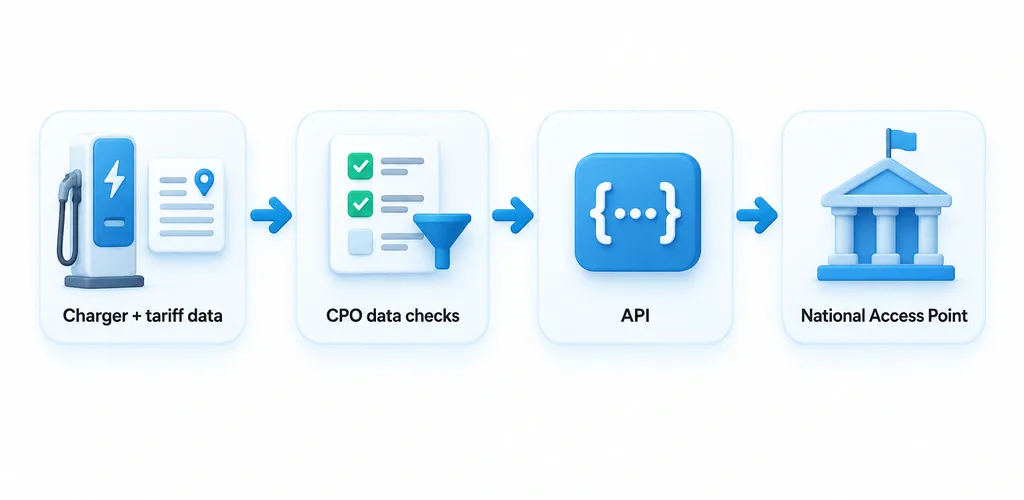
Data quality remains your responsibility when a partner supplies the API. Assign ownership for missing fields, stale availability and incorrect prices. OCPI data exchange can support partner workflows, but an OCPI connection alone does not establish conformity with the AFIR data specifications.
AFIR deadlines: 2025 through 2027
Use the date and the affected equipment together. Some milestones belong to public authorities, while others require changes at individual charging points.
| Date | Requirement or milestone | Who or what it concerns |
|---|---|---|
| April 14, 2025 | Required public charging data available; DC public points fitted with fixed charging cables | Article 20 data providers; Article 5(10) DC operators |
| April 14, 2026 | Relevant DATEX II data model applies | Public charging data providers under Regulation 2025/655 |
| December 31, 2026 | Common European access point to be established | Commission milestone; not a replacement for CPO API/NAP duties |
| January 1, 2027 | Card reader or contactless card-reading device required, including for older points | Public points at least 50 kW along TEN-T roads or on safe and secure parking areas |
| January 1, 2027 | Additional communication specifications for newly installed or renovated points | Applicable equipment under amended Annex II; assess separately from payment retrofit |
The communication provisions come from Delegated Regulation (EU) 2025/656. Check the relevant Annex II category with your equipment supplier. Do not turn a new-or-renovated-equipment requirement into a blanket instruction to replace every existing charger.
Earlier technical duties also remain important: public points had to be digitally connected by October 14, 2024. Public points built after April 13, 2024, or renovated after October 14, 2024, must be capable of smart charging under Article 5(8).
Penalties and national enforcement
Do not budget against a single supposed EU-wide AFIR fine. Identify the competent authorities, enforcement powers and applicable penalties in each country where you operate. Payment, price, technical and data questions may require different national contacts.
For example, Germany’s Bundesnetzagentur guidance explains that it can take measures when technical minimum requirements are not met. It identifies separate price authorities for pricing questions. That is not evidence of one fine amount applying across Europe.
Ask local counsel to confirm the penalty regime and corrective process for each market. Keep evidence of remediation, payment tests, tariff disclosures and data-quality controls so an authority can assess what your network actually does.
An AFIR compliance checklist for CPOs
Assign an owner and retain evidence for each check. An unchecked item is a gap to investigate, not an automatic finding that the entire network is unlawful.
- Classify public access, deployment and renovation dates, power bands and TEN-T or parking-area location.
- Test ad hoc access without a subscription and the applicable electronic-payment method.
- Check the visible price before session start, component order and occupancy-fee disclosure.
- Document objective reasons for differentiated tariffs and allocate mobility-provider disclosure duties.
- Verify connectivity, smart-charging capability and fixed cables where applicable.
- Map all required data fields and validate update timing, API access and NAP registration.
- Plan the 2027 card retrofit and applicable equipment specifications with suppliers.
- Record national enforcement contacts, local penalty advice, corrective actions and repeat-test results.
How Tridens supports the compliance work
Tridens EV Charge connects charging operations, tariffs and session data. Its billing foundation uses Tridens Monetization for pricing, invoices and payment workflows. Evaluate the configured system against each obligation; software does not certify the whole charging site.
| Requirement area | Supported workflow | What still needs verification |
|---|---|---|
| Ad hoc card payment | Documented Nayax VPOS integration exchanges charger, tariff and session data through OCPI | Terminal model, merchant setup, installation and complete payment journey |
| Pricing and billing | Tariff context and session data connect with pricing, invoices and payments through Tridens Monetization | Power-band rules, displayed prices, objective differentiation and national requirements |
| Data access | Documented APIs, webhooks and roaming interfaces support data integrations | Required fields, DATEX II mapping, update timing and the national access route |
| Technical obligations | Charger connectivity and operational monitoring support network management | Hardware, firmware, cables, communication standards and tested combinations |
For a software evaluation, bring one real site, its tariff and a sample session record. Ask the team to demonstrate the payment and billing flow and identify what requires a payment partner, equipment supplier or data integration. This guide does not establish a prebuilt DATEX II/NAP connector or an AFIR compliance certificate.

Keep the legal assessment and supplier acceptance tests separate. Record the verified setup for each site, then repeat the checks when tariffs, equipment or integrations change.
FAQs about AFIR
What is AFIR?
AFIR is the EU Alternative Fuels Infrastructure Regulation. For CPOs, it sets requirements for publicly accessible charging, including ad hoc access, payment methods, price transparency and data availability.
Does every public charger need a card terminal?
No. For points deployed from April 13, 2024, secure internet payment is also permitted below 50 kW. Points at least 50 kW need a card reader or contactless device able to read payment cards. The 2027 older-point retrofit has specific location criteria.
Does AFIR apply to chargers on private property?
It can. Public access, not property ownership alone, determines whether the public charging rules apply. Restricted depots and employee-only sites require a different assessment, and some technical rules can still apply to private charging equipment.
Is OCPI enough to meet AFIR data requirements?
Not by itself. Verify all required fields, data formats, update timing, free API access and national access arrangements. A roaming connection is not proof that the required public data is available in the prescribed format.
Is there one EU-wide AFIR fine?
Do not assume one common amount. Confirm the competent authority, available enforcement measures and applicable penalties in each operating country. National legal advice is needed to assess the specific exposure.
