

Learn how cloud billing software helps enterprises manage subscriptions, usage, invoicing, revenue recognition, and payments.
Cloud billing software has become a strategic system for companies that sell subscriptions, usage-based services, partner bundles, or hybrid offers. For telecom operators, SaaS companies, utilities, IoT businesses, and enterprises, the real question is whether the platform can support fast launches, accurate rating, compliant revenue recognition, and scalable revenue operations.
This guide is written for buyers who are already evaluating platforms. It explains what cloud billing software is, the capabilities that separate a real monetization platform from a basic invoicing tool, and how to scale your business with Tridens Monetization.
 Loading ...
What Is Cloud Billing Software?
Cloud billing software is a cloud-based platform that manages pricing, rating, invoicing, payments, revenue recognition, and customer billing operations. Unlike simple invoicing tools, enterprise cloud billing software supports recurring charges, consumption data, hybrid pricing, partner settlements, discounts, taxes, credits, and financial reporting across large customer bases.
For buyers evaluating billing and revenue management platforms, the key distinction is between basic cloud invoicing and a full monetization platform. Basic tools help issue invoices. A monetization platform connects product catalog, charging, billing, revenue, payment collection, customer self-care, and integrations across the order-to-revenue flow.
Many buyers search for cloud billing software while carrying larger requirements: subscriptions today, usage tomorrow, and partner-enabled models later. A narrow tool may solve invoices but leave product, finance, IT, and operations teams rebuilding workarounds.
Why Buyers Are Moving Billing to the Cloud
Cloud billing projects usually start with market pressure. Product teams want flexible offers. Finance needs cleaner revenue data. IT wants fewer brittle customizations. Operations needs fewer manual corrections. Customers expect transparent invoices, account access, and payment options.
Cloud billing software can reduce infrastructure burden and speed configuration. But cloud hosting alone is not enough. The platform should be cloud-native, API-first, and flexible enough for business users to configure offers without turning every pricing change into a long development project.
Ready to get started?
Learn how your business can thrive with Tridens Monetization.

What Enterprise Cloud Billing Software Should Include
Enterprise buyers should evaluate cloud billing software as a connected monetization stack, not as a single invoice generator. The strongest platforms cover the full lifecycle from offer design to payment collection and reporting.
Core capabilities of cloud billing software:
- Product catalog and pricing configuration.
- Online charging and real-time rating.
- Billing, invoicing, taxes, credits, and adjustments.
- Revenue recognition and reporting.
- Payments, collections, retries, and reminders.
- CPQ for governed quoting and discounting.
- Customer self-care for invoices, usage, payments, and subscriptions.
Tridens separates many of these areas into focused capabilities, including billing, charging, collect, and CPQ. That modular view matters because mature billing operations rarely fail at one isolated step. They fail when pricing, charging, finance, collections, and customer experience drift apart.
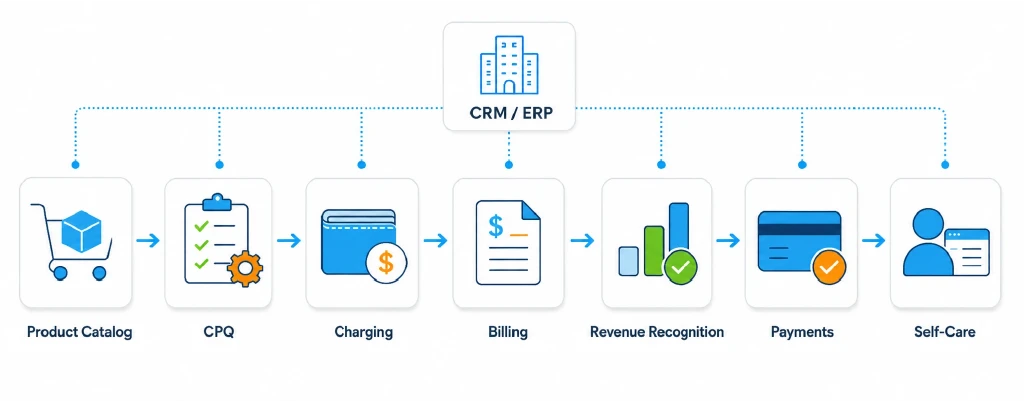
The platform should also expose APIs for CRM, ERP, tax engines, payment gateways, provisioning, data warehouses, and customer portals. For complex operations, access to clear developer API documentation is a practical signal that the platform is built to connect with the enterprise stack.
Real-Time Rating Matters When Usage Drives Revenue
For subscription-only companies, billing can often happen at the end of the billing cycle. For usage-based businesses, the system must understand consumption as it happens or soon after it happens. That is where online charging and real-time rating become important.
Real-time rating calculates charges, applies balances, checks allowances, and enforces pricing logic while usage events are still relevant. Telecom is the clearest example. Prepaid services, data bundles, overage rules, roaming, and convergent charging depend on fast rating. The same logic applies to SaaS, IoT, digital services, energy, and partners.
Cloud billing software should be tested against realistic event volumes, rating rules, pricing tiers, and customer hierarchies. Buyers should ask how the platform handles event ingestion, mediation, rating accuracy, retries, reversals, and auditability. Usage data should also feed customer views, alerts, analytics, and revenue reporting. A platform that rates accurately but cannot surface that data to customers and finance teams only solves half the problem.

Cloud-Native, API-First, and No-Code Are Not Buzzwords
Cloud billing software pages often use the same language: scalable, flexible, automated, integrated. Buyers should translate those words into testable requirements.
Cloud-native should mean the platform can scale with transaction volumes and reduce customer-managed infrastructure. API-first should mean billing, customer, product, pricing, event, payment, and invoice functions connect through documented interfaces. No-code configuration should mean trained users can create pricing, tariffs, bundles, discounts, and workflows without custom development.
Auto-scaling matters when event loads vary. Telecom usage, IoT events, seasonal SaaS activity, and energy demand can create peaks that fixed-capacity systems do not handle well. Buyers should ask how the platform scales rating, billing runs, invoice generation, and integrations, because commercial speed depends on it.
Monetizing 5G: Unlocking Its Full Potential

How to Evaluate Cloud Billing Software
A structured evaluation should begin with use cases, not feature lists. Document the revenue models, customer types, systems, transaction volumes, pricing rules, reporting needs, and migration constraints that matter most.
Use this checklist during vendor conversations:
- Can the platform support subscriptions, usage-based billing, hybrid pricing, prepaid and postpaid models, and partner revenue?
- Can rating happen in real time for high-volume events?
- Can business users configure product offers, tariffs, discounts, and bundles?
- Can billing, invoicing, payments, collections, and revenue recognition work from shared data?
- Can the system integrate with CRM, ERP, tax, payment, provisioning, and analytics tools through APIs?
- Can customer self-care expose invoices, balances, payments, subscriptions, and usage?
- Can the platform scale without a major reimplementation as customers, events, and products grow?
- Can migration from legacy systems happen in phases, with clear data mapping and operational controls?
Migration from Legacy Billing Systems
Migration is one of the biggest concerns for enterprise buyers. Billing touches customer data, contracts, balances, products, invoices, tax rules, accounting, payments, support, and reporting. A rushed migration can create customer disputes and finance reconciliation problems.
The safer approach is to define migration waves. Some companies start with a new product line, digital brand, MVNO, region, or partner offer before moving the full customer base.
Buyers should evaluate data migration, integration mapping, parallel runs, reconciliation, customer communications, training, and rollback planning. They should also decide which customizations should be retired instead of rebuilt.
For telecom and BSS teams, Tridens content on cloud BSS and digital BSS modernization is especially relevant because migration is often part of a broader program across charging, billing, customer management, and service operations.
Build a More Flexible Revenue Operation with Tridens
Cloud billing software should help your company launch offers faster, rate usage accurately, bill customers clearly, collect payments efficiently, and give finance trusted revenue data. It should support the models you have now and the ones you want to launch next.
Tridens Monetization is built for subscription, consumption-based, hybrid, and partner-enabled models across telecom, SaaS, energy and utilities, IoT, and enterprise markets. It brings charging, billing, revenue recognition, payments, CPQ, self-care, integrations, and analytics into a cloud-native monetization platform.
If you are evaluating cloud billing software, test your actual revenue model. Bring your product catalog, pricing rules, usage events, customer structures, payment needs, and reporting requirements into the conversation.