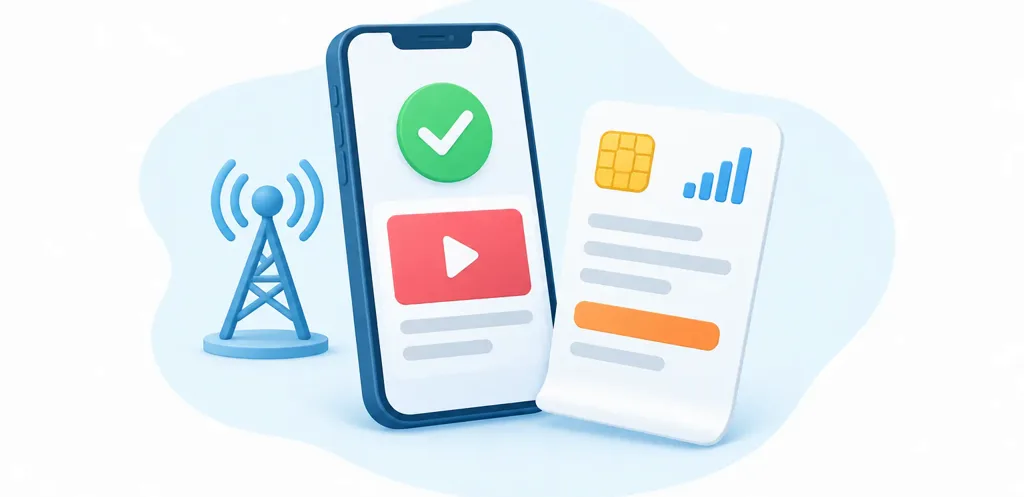


Direct carrier billing (DCB) lets people pay for purchases through their mobile phone bill or prepaid balance. Here is how the payment works and what telecom teams need to check.
What is direct carrier billing (DCB)?
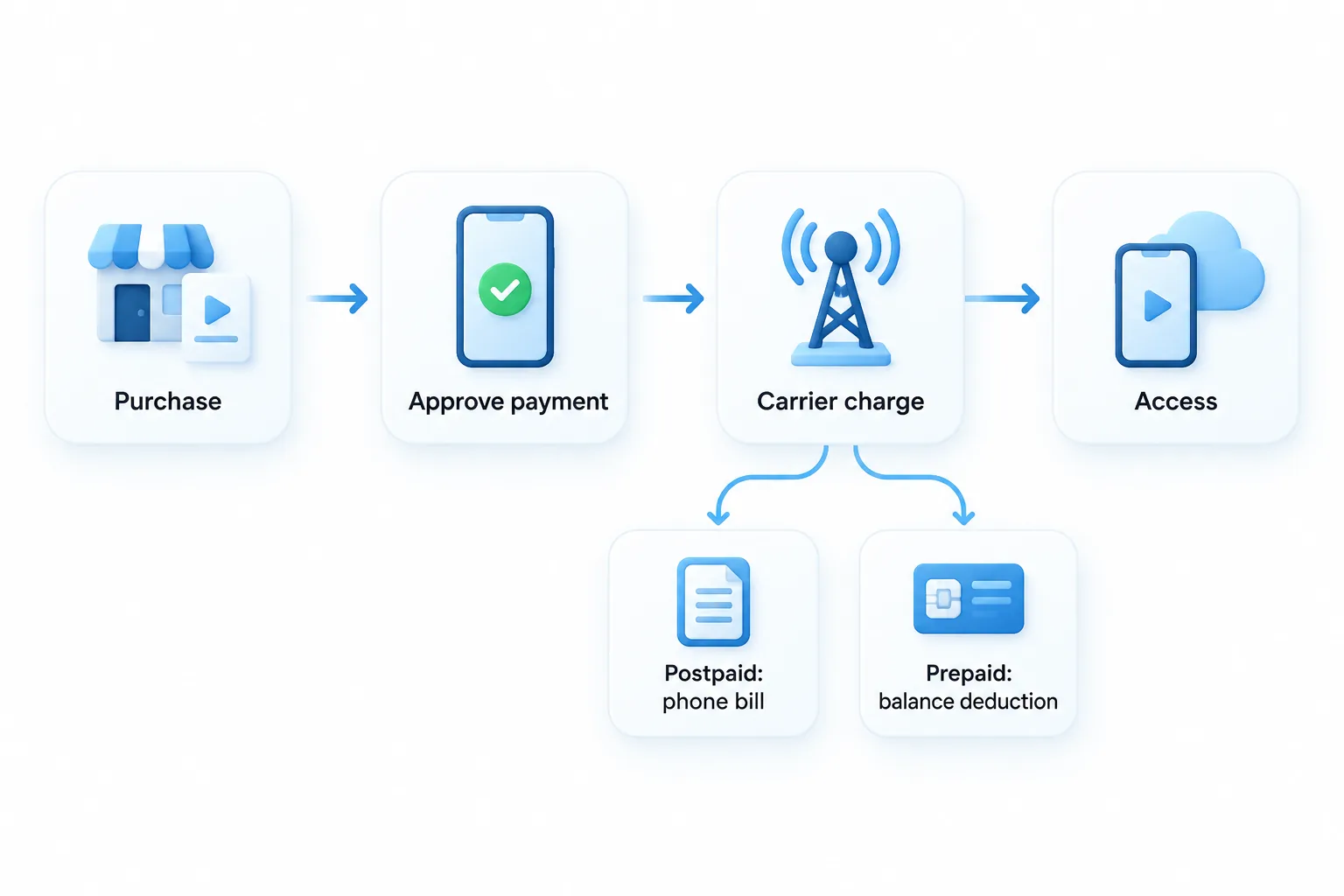
Direct carrier billing is a payment method that charges a purchase to a customer’s mobile account. For a postpaid subscriber, the charge appears on the phone bill. For a prepaid subscriber, it is deducted from the available balance.
The customer chooses carrier billing at checkout and approves the payment using the supported authentication flow. They do not need to enter card details for that purchase. Availability depends on the merchant, country, carrier, and account.
DCB is used for digital purchases such as apps, games, and content subscriptions. It is a payment method, not a mobile plan or a complete telecom billing system.
How does direct carrier billing work?
A typical payment connects the customer, merchant, mobile operator, and often a payment provider or aggregator. The provider can connect a merchant to participating carriers and process payment requests. The exact checkout and authentication steps depend on the integration.
- Select the payment method. The customer chooses the option to pay through their mobile account at a supported checkout.
- Identify the account. The flow identifies the customer’s mobile account, for example through a phone number.
- Approve the payment. The customer authorizes the purchase. Some flows use a one-time code sent by SMS; this is not a universal requirement.
- Process the charge. The supported service processes the request, then charges the postpaid account or deducts the prepaid balance.
- Confirm the outcome. The merchant receives the payment result and can grant access to the purchased content or service.
Payment confirmation, content delivery, and settlement are separate steps. The merchant still needs to deliver the purchase. Telecom teams should define how to reconcile successful purchases with billing and partner settlement records.
The CAMARA Carrier Billing project describes APIs for initiating and confirming purchases charged to an end user’s mobile account. An API specification does not establish that every carrier or merchant has deployed the same service.
Direct carrier billing example
Consider a customer buying a digital game item. This is an illustrative example, not a specific carrier’s offer.
The customer selects carrier billing, sees the price, and approves the payment. If the operator accepts the charge, the merchant receives a successful payment result and adds the item to the customer’s game account.
| Customer account | Where the purchase charge goes |
|---|---|
| Postpaid | Onto the mobile phone bill |
| Prepaid | Deducted from the available prepaid balance |
If the payment is declined, the checkout needs to show that outcome. A failed payment should not be presented as a completed purchase. For a recurring service, the renewal terms and payment authorization also need to be clear.
Benefits and limits of carrier billing
For customers, DCB removes the need to enter card details at checkout. It can make supported digital purchases accessible through a mobile account. Merchants gain an additional payment option for eligible customers.
It also has limits. A customer may have a valid mobile account but no access to DCB for a particular merchant or purchase. Prepaid purchases need an available balance, and the service must support the customer’s account.
For an operator or merchant assessing DCB, check:
- Which countries, carriers, customer accounts, and purchase categories are supported.
- How the customer sees the price and authorizes one-time or recurring charges.
- Who handles payment failures, refunds, cancellations, and customer support.
- How transaction records, fees, and settlement amounts are reconciled.
These are questions for the specific service and contract. Do not assume that a DCB integration provides automatic access to every carrier, a fixed fee structure, or identical refund rules.
Related billing terms
Prepaid and postpaid billing describe when a subscriber pays for mobile services. DCB uses the subscriber’s account to charge an additional purchase; it does not change the underlying mobile plan.
Subscription billing manages recurring charges for a service. DCB can be the payment method for a supported subscription, while the service still needs its own renewal and cancellation rules.
When evaluating partner settlement, confirm the fees, settlement timetable, and reconciliation responsibilities with the operator, merchant, and any provider involved. Check these commercial terms separately from the customer’s checkout approval.
Where DCB fits in telecom monetization
For MNOs and MVNOs, digital purchases introduce billing and partner workflows alongside connectivity services. Teams need to define account eligibility, charging rules, billing visibility, and responsibility for customer questions before launch.
For an MVNO planning its service mix, assess digital payments alongside its business model, carrier partnerships, and operating costs.

Tridens Monetization supports real-time charging, billing, and partner settlement for communications use cases. Its API-first architecture and no-code configuration support defined billing workflows. These broader capabilities do not, by themselves, establish a particular DCB provider integration or certification.
FAQs
Can direct carrier billing work with prepaid accounts?
Yes, where the service supports prepaid accounts. The purchase amount is deducted from the available mobile balance. A prepaid purchase needs sufficient funds and support for the customer’s account.
Is direct carrier billing the same as paying by SMS?
Not necessarily. Some DCB flows use an SMS code to authenticate a purchase, but SMS is not required for every implementation. The defining feature is that the purchase is charged to the customer’s mobile account.
Does every mobile carrier support direct carrier billing?
No. Availability depends on the carrier, country, merchant integration, and customer account. A customer should see carrier billing as a supported checkout option and review its terms before approving a payment.
