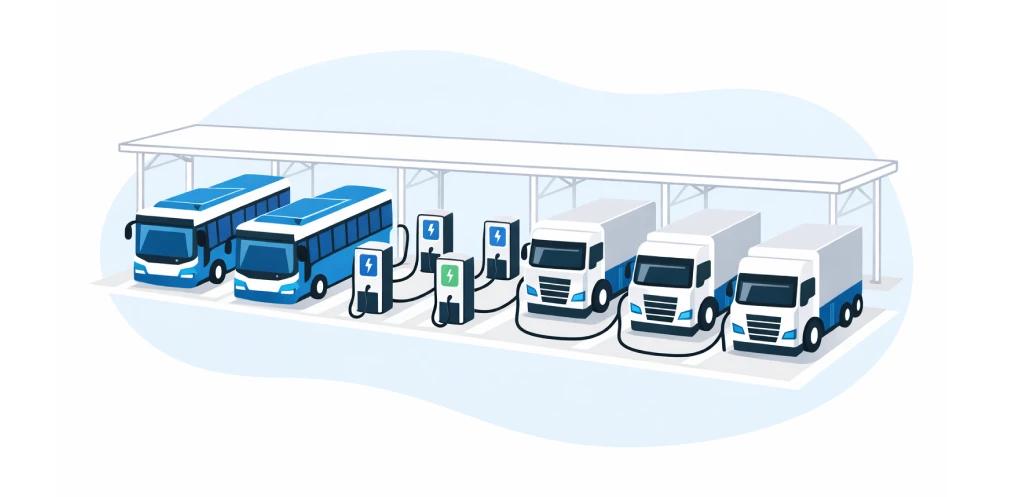


Electric vehicle fleet charging is a completely new operational layer — and your fleet management system was never built to handle it.
Electric vehicle fleet charging isn’t something you can simply add to your existing fleet software. It is a different job. A different system. A different category of operations. If you are managing buses, trucks, or delivery vans and you are about to electrify, this distinction will save you months of pain.
Your fleet management system was built for a world that runs on diesel. It tracks vehicles. It monitors drivers. It handles routes, tachographs, fuel cards, and maintenance schedules. It does all of that well. But the moment you plug in an electric bus or a truck, a whole new layer of operations appears. Chargers need to be controlled. Power needs to be distributed. Vehicles need to be charged on a schedule that matches tomorrow’s routes. Cabins need to be pre-conditioned before departure. The grid has limits your fleet software knows nothing about.
That is the job of electric vehicle fleet charging. And it requires a different system — a charging management system, or CMS.
This article explains what electric vehicle fleet charging actually involves, why your fleet management software is not built for it, and what a purpose-built CMS does instead. We will keep the language simple and the advice practical.
 加载中 ...
What electric vehicle fleet charging actually means
Electric vehicle fleet charging is the full process of managing how, when, and in what order your electric vehicles get charged at a depot or facility. It sounds simple. It is not.
When one electric car charges at a home outlet, there is no coordination problem. When 80 electric buses charge at a single depot overnight, everything changes. The depot has a grid connection with a hard power limit. If every charger draws full power at once, you trip the breaker. Some buses leave at 5:00 AM. Others at 7:30 AM. The ones leaving early need priority. Some need their batteries pre-warmed in winter. Some need their cabins heated before the driver walks in.
Electric vehicle fleet charging is the orchestration of all of this. It involves power distribution, schedule awareness, vehicle communication, pre-conditioning, monitoring, and reporting. No single piece of your existing IT stack does all of it. Especially not your fleet management system.
Fleet management vs. charging management — the real difference
This is the distinction most operators miss until they are deep into an electrification project. A fleet management system (FMS) and a charging management system (CMS) are not competing tools. They do different jobs in different layers.
A fleet management system manages the fleet. It knows where your vehicles are. It tracks mileage, driver behavior, fuel consumption, route compliance, and service schedules. It is the command center for operations while vehicles are on the road. Products in this space include names like Geotab, Samsara, Webfleet, and Motive. They are good at what they do.
A charging management system manages the chargers and the charging process. It knows the power state of every charger. It controls which vehicle charges at which connector. It distributes available power across the depot without exceeding grid limits. It receives schedules from upstream systems and turns them into charging sessions with the right timing, priority, and energy targets. It communicates with the vehicle to handle pre-conditioning. It monitors battery state of charge in real time. It reports faults and sends notifications.
These are fundamentally different jobs. Your FMS does not talk to chargers over OCPP. It does not manage WebSocket connections to a depot management system over VDV 463. It does not send pre-conditioning instructions to buses over VDV 261. It was never designed to.
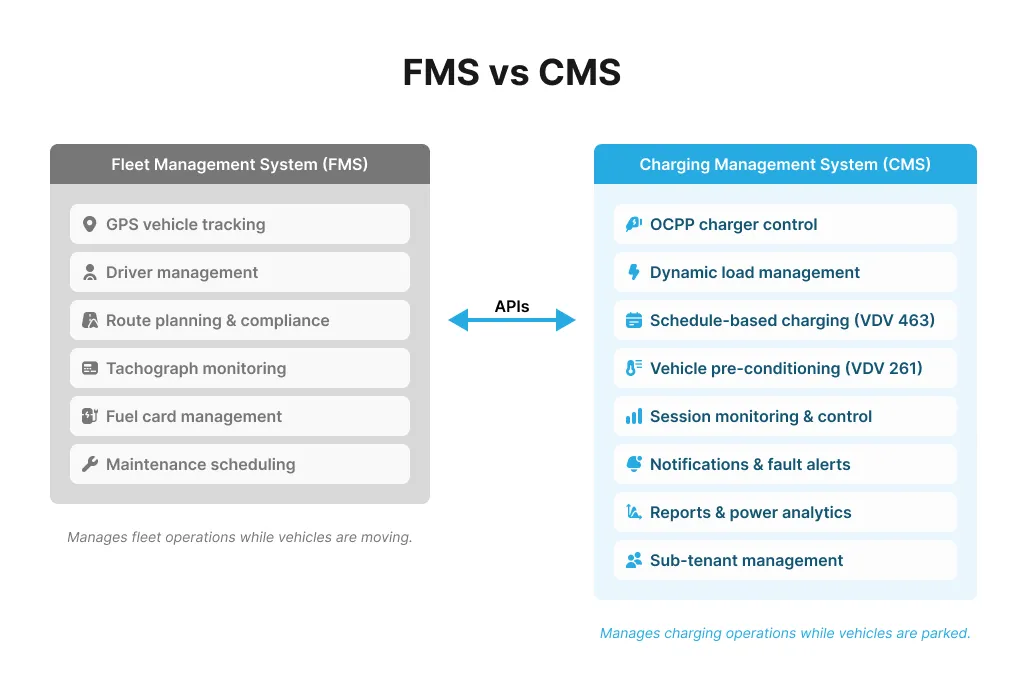
Electric vehicle fleet charging happens at the depot. Fleet management happens on the road. The two need to talk to each other, but they are not the same system.
How a charging management system handles electric vehicle fleet charging
A purpose-built CMS covers several operational layers that together make electric vehicle fleet charging reliable, efficient, and automatic. Here’s how those layers work.
Charging infrastructure control and monitoring
The CMS connects to every charger at your depot over OCPP — the open standard for charger communication. It sees which chargers are online, which are occupied, which have faults, and which are available. It determines who can charge at each point. In a shared facility, that matters — your fleet buses might need priority over visiting vehicles. The CMS enforces those rules. When margins are tight, as they always are in logistics and public transport, controlling charger access is not optional. It is how you protect uptime.
Reservations, schedules, and planning
This is where electric vehicle fleet charging separates from public charging entirely. Public chargers work on a first-come, first-served basis. Fleet charging works on a timetable.
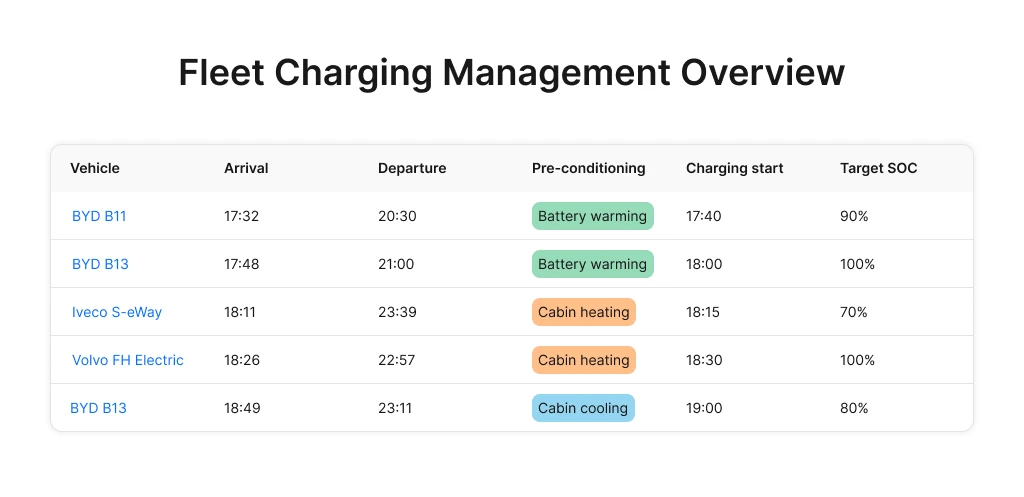
The CMS stores it as an operating timetable — a structured record of each vehicle’s arrival time, departure time, target battery state of charge, target energy, and pre-conditioning rules.
That timetable drives everything that happens next. The CMS turns each entry into a charging session with a defined start, a defined end, and a clear energy target. It knows when each vehicle arrives, when it must depart, and what state it needs to be in at departure. If the timetable says Bus 42 arrives at 22:15, departs at 05:30, needs 90% state of charge, and requires battery pre-warming starting at 04:45 — that is exactly what happens. Automatically.
This is timetable-based charging. It avoids the chaos of uncoordinated plug-ins. It prevents the situation where a bus that leaves at 5:00 AM is parked behind one that doesn’t leave until noon. It makes electric vehicle fleet charging predictable instead of reactive. Fleet operators can also reserve future charging spots when timing is critical — because in scheduled operations, a missed slot means a missed route.
Vehicle pre-conditioning and preparation
Electric vehicle fleet charging is not just about electrons. It is about getting the vehicle ready. In cold weather, a battery that has not been pre-warmed charges slowly and delivers less range. A cabin that is not pre-heated means the HVAC runs at full blast on the first route — draining range faster.
智能电动车充电:释放其全部潜力

Through VDV 261, the CMS communicates with the vehicle directly. The vehicle reports its battery state, cabin temperature, and preconditioning needs. The CMS responds with instructions: target departure time, pre-warming schedule, and HVAC start time. The operating timetable already contains the pre-conditioning rules — start time, end time, and type (heating, ventilation, or air conditioning). The CMS executes them without anyone touching a button. No driver intervention. No spreadsheet. Just a bus that rolls out warm, charged, and ready.
Reservation enforcement at the charger
Schedules only matter if they are enforced. A CMS built for electric vehicle fleet charging does not just plan sessions — it protects them.
When a charging spot is reserved for a specific vehicle at a specific time, the CMS enforces that reservation at the charger level. If the wrong vehicle is connected when the reserved vehicle is expected, the CMS can terminate that session. If a vehicle tries to start a session during a buffer period before the next reservation, the CMS blocks it. Only the expected vehicle is allowed to charge in the reserved window. And when departure time arrives, the CMS can automatically terminate the session so the spot is freed.
This enforcement is configurable. Some operators want strict rules. Others want softer enforcement with manual overrides. The CMS supports both. The physical side — making sure the parking lot is clear for the arriving fleet vehicle — remains the depot operator’s responsibility. But the charging side is handled by the system.
Departure notifications and reminders
Vehicles that overstay their charging slot disrupt the entire schedule. The CMS handles this with configurable notifications. Reminders go out before departure time — for example, 15 minutes before. Another notification fires at the exact departure time. If the vehicle is still connected after departure, the system escalates with post-departure alerts.
These notifications reach the right people by email, SMS, or API. The depot team, the fleet operator, or even the driver can be notified depending on how the system is configured. In electric vehicle fleet charging, a five-minute delay at one charger can cascade into a missed route. Proactive reminders prevent that.
Load management and power distribution
Every depot has a power limit. The grid connection can supply a certain number of kilowatts. If your 40 chargers all try to draw maximum power at midnight, you exceed it. The CMS prevents that.
动态负载管理 distributes available power across active sessions based on rules you define. Priority groups get power first. Time blocks allow you to reserve capacity for off-peak hours when electricity is cheaper. On-peak times get constrained automatically. If the depot shares power with other tenants or a community grid, the CMS can adjust based on real-time meter values.
In a mixed environment where fleet vehicles and public users share the same infrastructure, the CMS gives fleet charging higher priority. The fleet’s operating timetable takes precedence. Public sessions get the remaining capacity. This way, fleet vehicles are always charged on time, and public chargers still work — just within the power that is left over.
This is the core of 智能电动车充电 for fleets. It keeps you within your grid contract. It avoids demand charges. And it ensures the highest-priority vehicles always get charged first.
Charging session control and monitoring
The CMS gives depot teams full control over active sessions. Remote start and stop. Power limit adjustments mid-session. Schedule-based automation. Real-time visibility into energy consumed, current power draw, battery state of charge, and session duration.
When something goes wrong — a charger faults, a session stops unexpectedly, a vehicle does not accept power — the CMS flags it. Troubleshooting tools show OCPP message logs, error codes, and session history. A depot technician can diagnose problems from the office instead of walking to every charger with a laptop.
Notifications and alerts
Electric vehicle fleet charging requires fast reaction times. A bus that fails to charge overnight means a missed route in the morning. The CMS sends notifications — by email, SMS, or API — when critical events happen. Charger goes offline. Session stops unexpectedly. Vehicle battery is not progressing as expected. Power limit changes. Fault codes appear. Availability changes on a charger. Schedule impacts detected. Vehicle battery is not progressing as expected. Power limit changes. Fault codes appear.
Being notified early means you can fix it at 2 AM instead of discovering it at 5 AM when the driver arrives.
Reports and historical data
Fleet operations teams need data. The CMS captures every session, every meter reading, every fault, and every schedule execution. That data is filterable, exportable, and available for the life of the system. Session reports show which vehicles charged, how much energy they consumed, and whether they met their schedule targets. Charger performance reports show uptime, fault frequency, and utilization. Power usage reports show peak demand, average consumption, and grid contract compliance.
This is how you prove to management that electrification is working. And it is how you spot problems before they become patterns.
准备好开始了吗?
了解如何通过 Tridens EV Charge 实现车队业务的蓬勃发展。.

When fleet charging meets public charging
Here is a use case that is becoming more common every year. A charging network operator builds a public heavy-duty charging site — for trucks, buses, or work machines in logistics and port operations. The chargers are available to the public. But the real business comes from fleet operators who need guaranteed access, scheduled sessions, and vehicle preparation.
The CMS handles both at the same time. Public users charge on a first-come, first-served basis. Fleet operators get priority, reservations, and upstream integration. The same chargers serve both audiences, but fleet sessions always take precedence.
Each fleet operator is set up as a separate sub-tenant in the CMS. They get their own upstream platform configuration for VDV 463 schedules. They get their own operating timetables, pre-conditioning rules, and charging targets. They can optionally be bound to specific depot areas with restricted charger access. Their sessions are tracked, reported, and billed separately. Everything stays clean.
The depot operator — who is also the CPO — manages the shared infrastructure from a single depot map view showing all chargers, all sessions, and all insights in one place. Fleet sessions are flagged with their operator. Public sessions run in the remaining capacity. Load management ensures the grid limit is never exceeded, with fleet priority built into the power distribution logic.
This model works for highway truck stops, logistics hubs, port terminals, and bus depots that occasionally serve visiting fleets. It is also how a CMS earns its keep — by letting one piece of infrastructure serve multiple revenue streams without operational chaos.
Sub-tenant management — when multiple fleets share a depot
ot every depot serves a single operator. Logistics hubs, shared bus depots, and multi-tenant facilities need to handle electric vehicle fleet charging for more than one fleet at a time.
A CMS with sub-tenant management lets you set permissions per operator. Each tenant gets their own charging access, reservation rights, priority levels, and pre-conditioning settings. Their upstream system connects over VDV 463 with its own schedules and operating timetables. Charging can be cost-based or contract-based. The CMS keeps it all separated while managing the shared infrastructure as one unified system.
Optionally, fleet operators can be bound to specific depot areas. This means a tenant’s vehicles can only charge at designated chargers — useful when physical space and electrical capacity are allocated per operator. Combined with reservation enforcement and departure notifications, this gives each fleet operator the experience of having their own dedicated depot, even when infrastructure is shared.
This matters more than people expect. As fleet electrification grows, shared depots are becoming common. A CMS without sub-tenant support forces you into workarounds that get messy fast.
Interoperability — where the CMS connects to everything else
Electric vehicle fleet charging does not happen in isolation. The CMS sits at the center of a web of integrations.
It connects to chargers through OCPP (1.6J or 2.0.1). It connects to depot and traffic control systems through VDV 463. It connects to vehicles through VDV 261 and ISO 15118 (Plug and Charge). It connects to roaming networks through OCPI, so third-party vehicles can charge at your depot when permitted. It exposes APIs for integration with fleet management systems, ERP, energy providers, and automation platforms.
The CMS does not replace your fleet management system. It works alongside it. Your FMS remains the hub for fleet operations — routes, drivers, compliance. The CMS handles everything that happens at the charger. Data flows between them through APIs or middleware. Each system does what it was designed for.
This is how modern electric vehicle fleet charging infrastructure works. Not one system doing everything poorly. Two systems, each doing their job well, connected through standards.
What to look for when choosing a CMS for electric vehicle fleet charging
Not every charging management system is built for fleet operations. Many were designed for public charging and later added a “fleet” label to their marketing. Here is what actually matters.
Does it support VDV 463 for schedule-based charging from upstream systems? Does it support VDV 261 for vehicle pre-conditioning? Does it handle dynamic load management with priority groups and time blocks? Can it enforce reservations at the charger — blocking wrong vehicles, protecting buffer times, and auto-terminating at departure? Can it manage sub-tenants on shared infrastructure with per-operator upstream configuration? Does it have full OCPP support with remote session control and troubleshooting? Can it send departure reminders and operational notifications by email, SMS, and API? Does it export session, performance, and power usage data in formats your team can use?
If a vendor checks all of those boxes in production — not on a roadmap — you are looking at a system built for electric vehicle fleet charging. If some are missing, you are looking at a public charging backend with fleet branding.
How Tridens handles electric vehicle fleet charging
Tridens EV Charge is a 充电管理系统 built for CPOs, EMSPs, and fleet operators. It is not a fleet management system. It does not track vehicles on the road. It manages what happens when those vehicles arrive at the depot and plug in.
The platform supports VDV 463 for schedule-based charging from depot management and transport control systems. Schedules are stored as operating timetables with full arrival, departure, energy target, and pre-conditioning configuration. It supports VDV 261 for vehicle pre-conditioning through ISO 15118. It provides dynamic load management with fleet priority over public charging, reservation enforcement at the charger with configurable rules, departure notifications, sub-tenant access control with optional depot-bounding, and a depot map view showing chargers, sessions, and operational insights.
We are already working with a major European bus operator on this exact setup. We are extending the same approach to heavy-duty truck fleets and depot-based charging networks. The platform is hardware-agnostic — it works with any OCPP-compliant charger from ABB, Kempower, Alfen, Siemens, and 90+ other manufacturers.
If you are planning electric vehicle fleet charging for your depot, we would rather show you the platform than talk about it. 预约演示 and we will walk you through the depot view, the scheduling logic, and the integration points.
Summary: electric vehicle fleet charging needs its own system
Electric vehicle fleet charging is a new operational layer that did not exist in the diesel world. Your fleet management system was never built for it. Trying to stretch it into charger control, load management, reservation enforcement, and vehicle pre-conditioning.
The answer is not to replace your fleet management system. It is to add a dedicated charging management system next to it. The CMS handles what happens at the depot — chargers, power, schedules, vehicles, and pre-conditioning. The FMS handles what happens on the road. Both do their job. Both stay connected.
If you are looking at electric vehicle fleet charging for your operation, start by understanding what a CMS actually does. Then evaluate vendors on real capabilities — VDV support, load management, reservation enforcement, sub-tenant handling, session control — not marketing labels. We built Tridens EV Charge for exactly this. When you are ready, 预约演示 and see it working.
FAQs about EV fleet charging
Fleet management covers vehicle tracking, driver management, route planning, and maintenance. Charging management covers charger control, power distribution, schedule-based charging, pre-conditioning, and session monitoring. They are separate systems that work together through APIs.
Not fully. Fleet management platforms were designed for ICE fleet operations. They lack OCPP charger communication, load management, VDV 463 schedule integration, and VDV 261 vehicle pre-conditioning. A dedicated CMS fills those gaps.
VDV 463 is the standard for communication between depot planning systems (DMS/ITCS) and the charging management system. It enables schedule-based charging — the CMS knows when each vehicle must leave and plans the session accordingly. Read our full guide on VDV 261 and VDV 463.
VDV 261 handles communication between the CMS and the vehicle itself, through the charger and ISO 15118. It enables pre-conditioning — warming or cooling the battery and cabin before departure — and exchanges data like battery state, mileage, and vehicle readiness.
The VDV standards were designed for buses but work for any heavy-duty fleet with scheduled depot operations. Logistics trucks, refuse collection vehicles, municipal fleets, and airport ground support equipment all benefit.
Dynamic load management distributes available power across all active charging sessions at a depot to stay within the grid limit. It uses priority groups, time blocks, and real-time meter data to decide which vehicle gets how much power at any moment.
Yes, with sub-tenant management in the CMS. Each operator gets their own access, priorities, schedules, upstream configuration, and pre-conditioning settings. Operators can optionally be restricted to specific depot areas. The CMS manages the shared infrastructure while keeping tenants separated.
The CMS sends configurable departure notifications — before, at, and after the scheduled departure time. If the vehicle remains connected, the CMS can automatically terminate the session. This keeps the schedule running and prevents cascading delays.
At minimum: OCPP for charger communication, VDV 463 for upstream schedule integration, and VDV 261 for vehicle pre-conditioning. OCPI for roaming and ISO 15118 for Plug and Charge are also important.
Through APIs. The fleet management system remains the hub for fleet operations. The CMS handles charging operations at the depot. Data — session records, vehicle battery state, charging completion — flows between them via REST API or middleware integration.