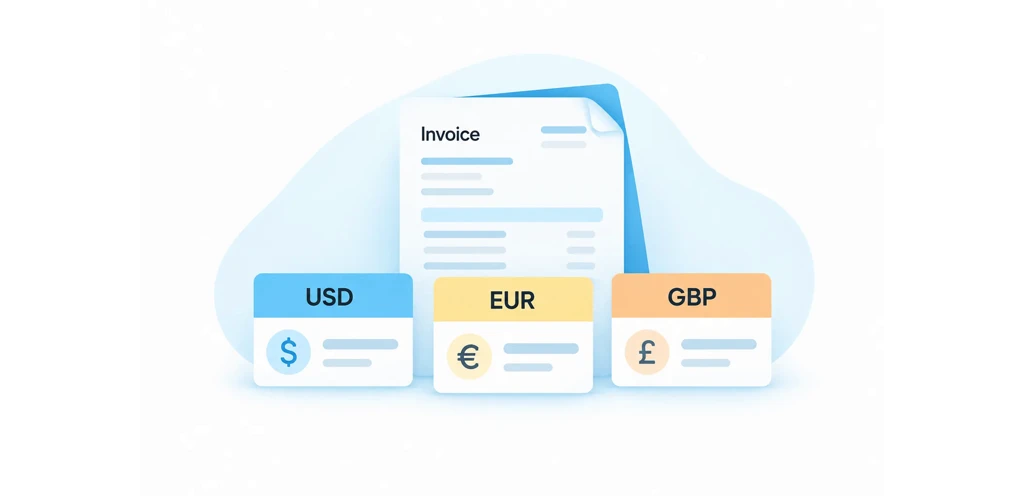


Multi-currency billing connects local prices, invoices, payments, and financial reporting. Choose how each currency works before launching a new market.
A customer accepts a quote in euros. Your payment provider settles the transaction in dollars. Finance reports revenue in another currency. Each amount can be valid, but they represent different steps in the same sale.
Multi-currency billing lets a business price and invoice customers in different currencies. Price localization adds a commercial decision: whether to convert a base price using foreign exchange rates or set a separate price for each market. The billing workflow must preserve those choices through renewals, usage charges, credits, and refunds.
For SaaS finance and billing teams, the starting point is a currency policy that connects the product catalog to collection and accounting. A longer list of supported currencies does not establish that every payment method or settlement route will work.
Key takeaways
- Separate the price-book, invoice, payment, settlement, and reporting currencies.
- Choose fixed local prices or FX-based conversion deliberately. They serve different commercial goals.
- Test the entire subscription lifecycle, including usage, discounts, tax, refunds, and currency changes.
- Keep the original currency amounts, applied rates, and price versions available for reconciliation.
How multi-currency billing works
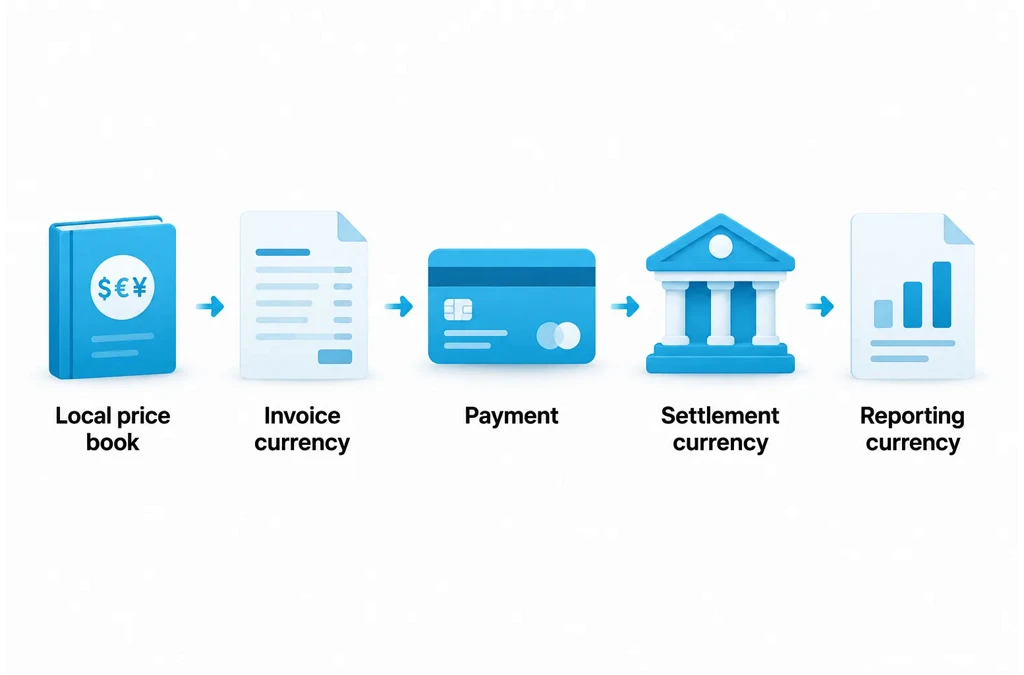
Start by mapping the currency at each stage. The table below illustrates a possible workflow; it is not a customer example or an exchange-rate quotation.
| Stage | Illustrative choice | Decision to document |
|---|---|---|
| Local price book | EUR price for a European offer | Fixed local price or converted base price? |
| Invoice | EUR | Which currency does the contract specify? |
| Payment | Customer is charged in EUR | Can the selected payment method process it? |
| Settlement | Provider pays out in USD | Where does conversion occur, and which fees apply? |
| Reporting | Finance reports in GBP | Which accounting rate and date apply? |
The invoice currency is the commercial amount the customer owes. Settlement currency is the currency paid into your merchant or bank account. Reporting currency is used for consolidated financial views. Converting a transaction for reporting does not itself change the customer’s invoice.
Stripe’s currency documentation distinguishes presentment from settlement and describes payment-method and country constraints. Treat those as processor-specific conditions. A currency enabled in a billing catalog still needs a compatible collection and payout path.
Price localization: fixed local prices or FX conversion?
Showing a local currency and choosing a local price are separate decisions. An FX-converted price follows a base-currency amount. A fixed local price is a commercial price point approved for that market, which can stay unchanged when exchange rates move.
Fixed local price books
Use fixed local prices when procurement, contracts, or renewals need predictable amounts. Product and finance teams can choose price points for each market without treating a daily exchange rate as a pricing strategy. The trade-off is exposure to FX movements between customer revenue and your costs or settlement currency.
Define who approves a local price, when changes take effect, and which existing customers retain their contracted price. Store a price-book version with each offer. Otherwise, a later catalog change can make an old invoice difficult to explain.
FX-converted prices
Use conversion when the commercial policy ties local prices to a base price. Specify the rate source, refresh schedule, markup if applicable, rounding rule, and fallback when a rate is unavailable. Decide whether a displayed quote remains valid until acceptance or can change before checkout.
For example, Stripe Adaptive Pricing localizes eligible checkout prices through currency conversion. That is a specific payment-product workflow, not proof that a billing platform offers the same function. Confirm where your chosen system sets the price and where it merely converts a payment.
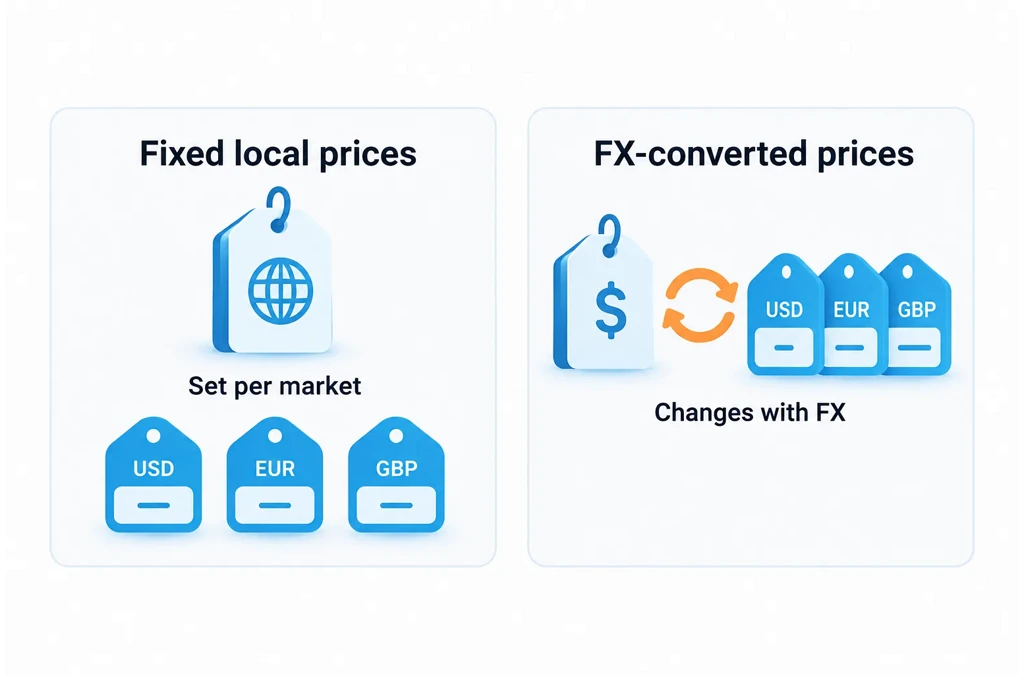
A hybrid policy can also make sense: fixed prices for contracted subscriptions and a separately documented conversion rule for selected charges. Make the distinction visible in your terms and configuration. Do not assume that changing a settlement currency changes a subscription’s commercial price.
Build local price books for subscriptions and usage
For a subscription, define the plan, billing frequency, currency, effective date, and renewal policy together. Carry the same policy into add-ons and contract exceptions. A local plan price is incomplete if an associated charge unexpectedly arrives in another currency.
Chargebee’s multicurrency documentation illustrates why lifecycle rules need explicit checks: it supports plan price points by currency and billing frequency, while changing an existing subscription’s currency requires canceling and recreating it. That restriction is specific to Chargebee; ask each provider how it handles your migration case.
Keep usage rate cards consistent
For usage-based billing, localize the rate card as well as the recurring fee. Document the billable unit, unit price, tier boundaries, commitments, included usage, and overage treatment. Metering an API call and assigning its price are different steps; the event itself does not need a new definition for each currency.
Decide whether a commitment represents a quantity of usage or a monetary balance. Currency matters for monetary credits, minimum spends, and fixed-amount discounts. Test how each is consumed and what happens when a customer changes plans or invoice currency.

Control tax, rounding, and invoice details
Choose the currency workflow before configuring tax and invoice presentation. Your tax treatment also needs the relevant customer, seller, product, and jurisdiction information. A local-currency price alone does not determine the correct tax treatment.
- Confirm whether the offer displays tax-inclusive or tax-exclusive prices.
- Validate the customer location, business status, and required tax identifiers for each market.
- Check invoice fields, credit-note requirements, and any currency-conversion obligations with your tax adviser.
- Test line-level and invoice-level rounding, including discounts and prorated charges.
- Confirm that invoice, payment API, and accounting export formats agree on currency codes and decimal handling.
Do not apply the same decimal assumption to every payment currency. Processor rules include zero-decimal currencies and special cases, so use the selected provider’s current specification. A billing amount formatted for display is not necessarily the integer amount an API expects.
Reconcile payments, refunds, and FX exposure
A paid invoice and a bank payout are different records. Reconciliation needs to connect the invoiced amount to the collected amount, provider fees, conversions, refunds, and final settlement. Keep the original transaction currency even when finance also needs a reporting-currency value.
Record the rate source and timestamp wherever conversion occurs. A refund processed later can produce a different settlement impact if FX rates or fees differ. Do not overwrite the original invoice amount to force it to match the payout.
Test full and partial refunds, payment failures, retries, and unused credits. Assign responsibility for exceptions: billing explains the charge; payments handles collection; finance reviews settlement and accounting. Tridens explains the provider-facing workflow in its guide to processing payments.
What to test before launching another currency
Run an end-to-end test for each supported market and payment route. Use a normal purchase, then repeat it with an exception. A successful first checkout says little about the next renewal or a credit issued months later.
- Quote to invoice: confirm the displayed price, contract currency, price-book version, discount, and tax treatment.
- Renewal and plan change: test price changes, prorations, add-ons, and grandfathered terms.
- Usage billing: validate tier boundaries, commitments, credits, and overages against the correct local rate card.
- Collection: test the payment method, merchant account, decline handling, and retry behavior.
- Settlement and reporting: trace the payout, fees, conversion records, and accounting export.
- Currency migration: confirm whether existing subscriptions can change currency and how balances, credits, and historic invoices are preserved.
For an FX-based policy, add a missing-rate test and a rate change between quoting and charging. For fixed local prices, verify that a reporting-rate update leaves the contracted customer price unchanged. Keep these tests in the release checklist for future catalog changes.
Evaluate the billing workflow, not just the currency count
Tridens Monetization supports subscription, usage-based, and hybrid billing, with no-code configuration and API-first integration. Its SaaS billing solution connects usage rating, billing, and revenue workflows. That scope is relevant when local offers include more than a recurring subscription fee.
Evaluate the exact implementation with your currencies and contracts. Bring a local price book, a usage rate card, a prorated invoice, and a refund case to the demo. Confirm the supported payment providers, tax integration, FX responsibilities, and accounting export instead of assuming that a platform’s currency count covers every combination.
Base the launch decision on a traceable link from the customer’s agreed price to finance’s reconciled revenue. Keep the approved currency policy with the catalog and release checklist.
FAQ about multi-currency billing
What is multi-currency billing?
Multi-currency billing lets a business price and invoice customers in different currencies. It connects those invoices to payment collection, settlement, and financial reporting. A complete workflow also accounts for renewals, usage charges, credits, and refunds.
What is the difference between price localization and currency conversion?
Currency conversion derives an amount from a base price using an exchange rate. Price localization can instead set a fixed commercial price for each market. Choose the policy deliberately because a fixed local price can remain unchanged while exchange rates move.
Can invoice currency differ from settlement currency?
Yes, when the payment provider and merchant setup support that route. The customer can be invoiced and charged in one currency while the provider pays out in another. Finance needs the conversion and fee records to reconcile the payout with the invoice.
How should usage-based pricing work across currencies?
Define a local rate card or an explicit FX conversion policy for billable usage. Include tier boundaries, commitments, credits, and overages as well as unit prices. Keep the billable unit consistent and test which price version applies to each billing period.
Can an existing subscription change currency?
That depends on the billing system and contract workflow. Some systems require canceling and recreating the subscription, while others may support a different migration process. Confirm how the change affects balances, credits, renewals, and historical invoices before promising it to customers.
How do refunds affect foreign exchange reconciliation?
A refund made after the original payment can have a different settlement impact when exchange rates or fees differ. Preserve the original invoice and payment records, then record the refund and related conversion separately. Test partial refunds as well as full refunds.
