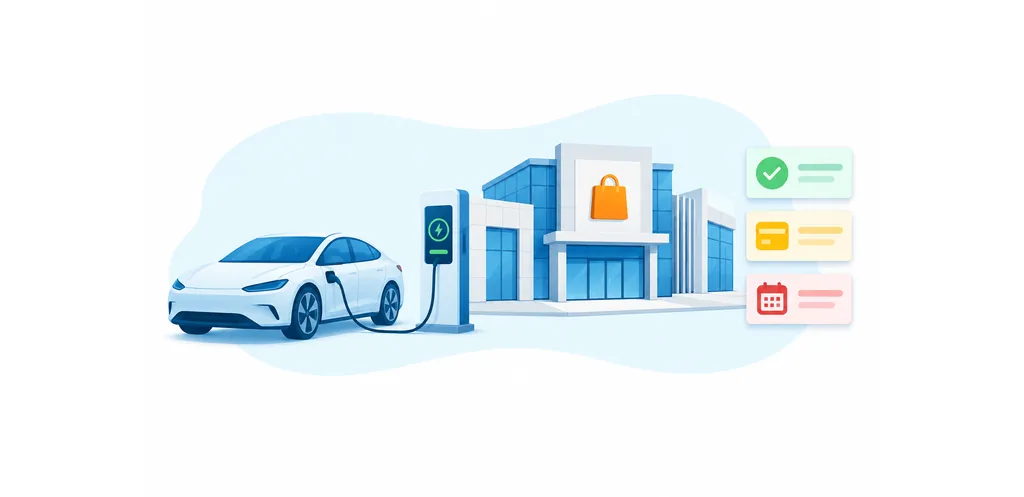


EV charging for shopping malls works best when it is designed as part of the property experience—not treated as a few chargers added to the edge of a parking lot.
For a shopping mall operator, the decision reaches beyond hardware. Charger mix, parking rules, power capacity, pricing, payments, uptime, and reporting all affect whether the service is useful to visitors and manageable for the property team.
A clear operating model turns charging into a customer service that can also support parking revenue, loyalty programs, tenant offers, and broader sustainability goals. This guide explains the decisions that matter before procurement and during rollout.
Why EV charging for shopping malls needs a business objective
A mall should decide what charging is meant to achieve before choosing chargers or software. The same parking area can support very different services depending on the property’s commercial goal.
Improve the visitor experience
Charging can give drivers a practical reason to choose one property over another. The value is strongest when the service fits a normal visit: drivers can find a charger, start a session without confusion, spend time inside the mall, and return to a clear receipt or session summary.
This model depends on reliable access and a simple customer journey. A free charger that is regularly unavailable can create more frustration than a paid service that works consistently.
Create a direct revenue stream
Paid charging can generate revenue from energy, time, parking, or a combination of these elements. The commercial model must account for energy costs, payment fees, maintenance, support, roaming, taxes, and the cost of occupying a parking space.
The goal is not simply to apply the highest tariff. Pricing should encourage useful charging behavior while protecting the economics of the service.
Strengthen loyalty and tenant programs
Charging can be connected to a mall membership, parking validation, retailer promotion, or premium customer tier. For example, a property may offer a charging discount after a qualifying purchase or reserve selected benefits for registered members.
This approach requires more than a charger payment terminal. The charging platform must exchange the right data with customer, parking, payment, or loyalty systems while keeping each offer easy to explain.
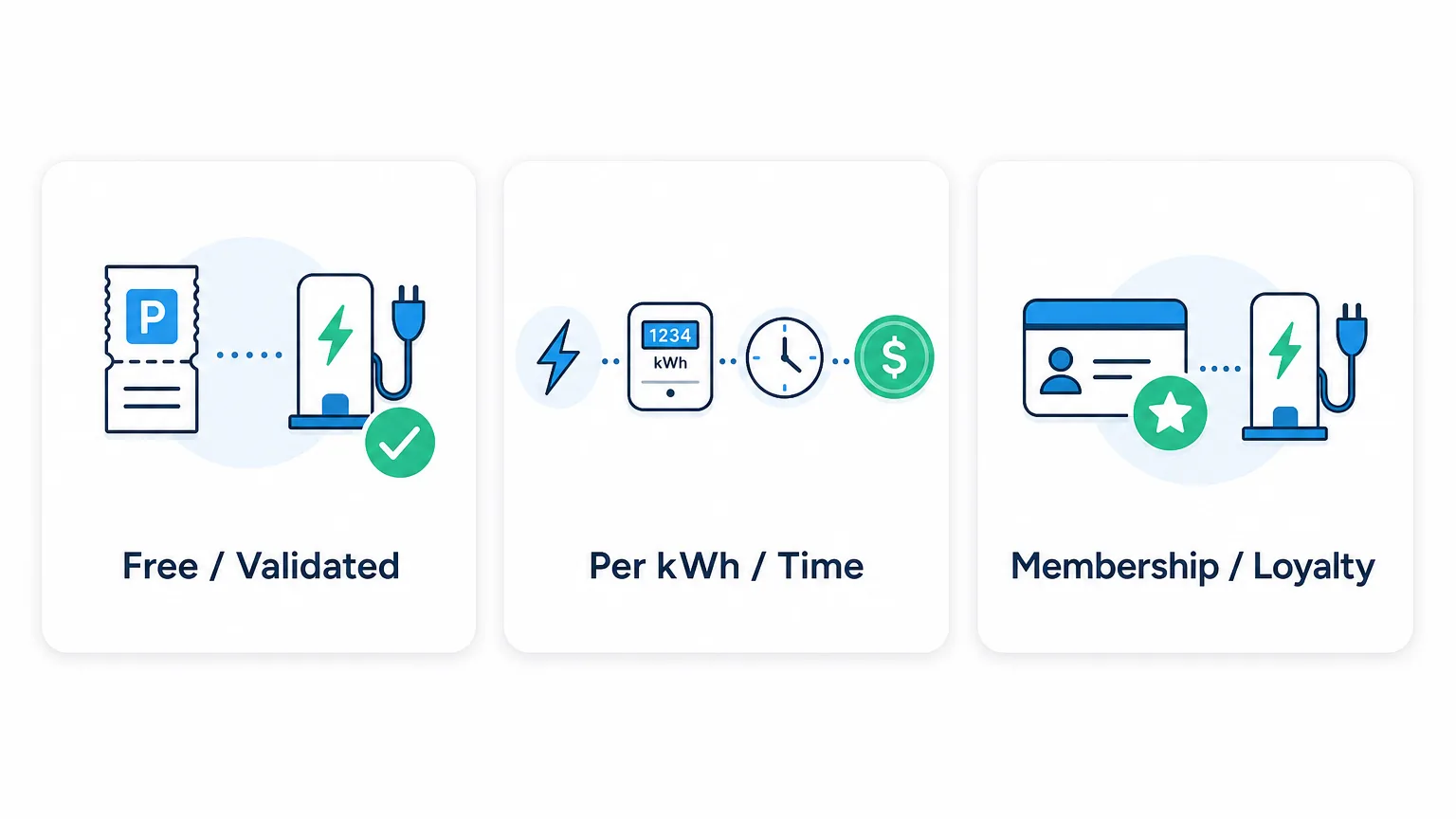
The right model may also change by location, customer group, or time of day. A platform should let the operator adjust offers without replacing the charging infrastructure.

Plan the charging service around the property
Shopping malls vary in size, tenant mix, parking layout, visitor profile, and average dwell time. Those differences should shape the charging design.
Match charger speed to dwell time
Visitors who stay for several hours may not need the same charging speed as drivers making a short stop. A balanced site can use different charger types for different parking zones instead of applying one specification everywhere.
The property team should consider how long vehicles normally remain, how quickly spaces need to turn over, and whether charging is intended for visitors, staff, tenants, delivery vehicles, or several groups.
Treat parking and charging as one journey
Drivers experience the parking facility and charging service together. Signage, wayfinding, bay markings, accessibility, parking validation, overstay rules, and support should therefore be planned as one process.
Clear rules matter when demand grows. The operator may need idle fees, time limits, or notifications to reduce unnecessary bay occupancy. Those rules should be visible before a session begins.
Check electrical capacity before scaling
A site assessment should review the available connection, expected peak demand, existing building loads, expansion plans, and the cost of electrical upgrades. The first installation should not create a dead end for the second phase.
EV charging load balancing can distribute available power across active chargers. This helps the site support more charge points within a defined capacity and adapt charging power as demand changes.
How a shopping mall EV charging operation works
The physical charger is only one part of the service. A connected operation must identify users, control chargers, apply prices, process transactions, support drivers, and give the operator a consistent view of performance.
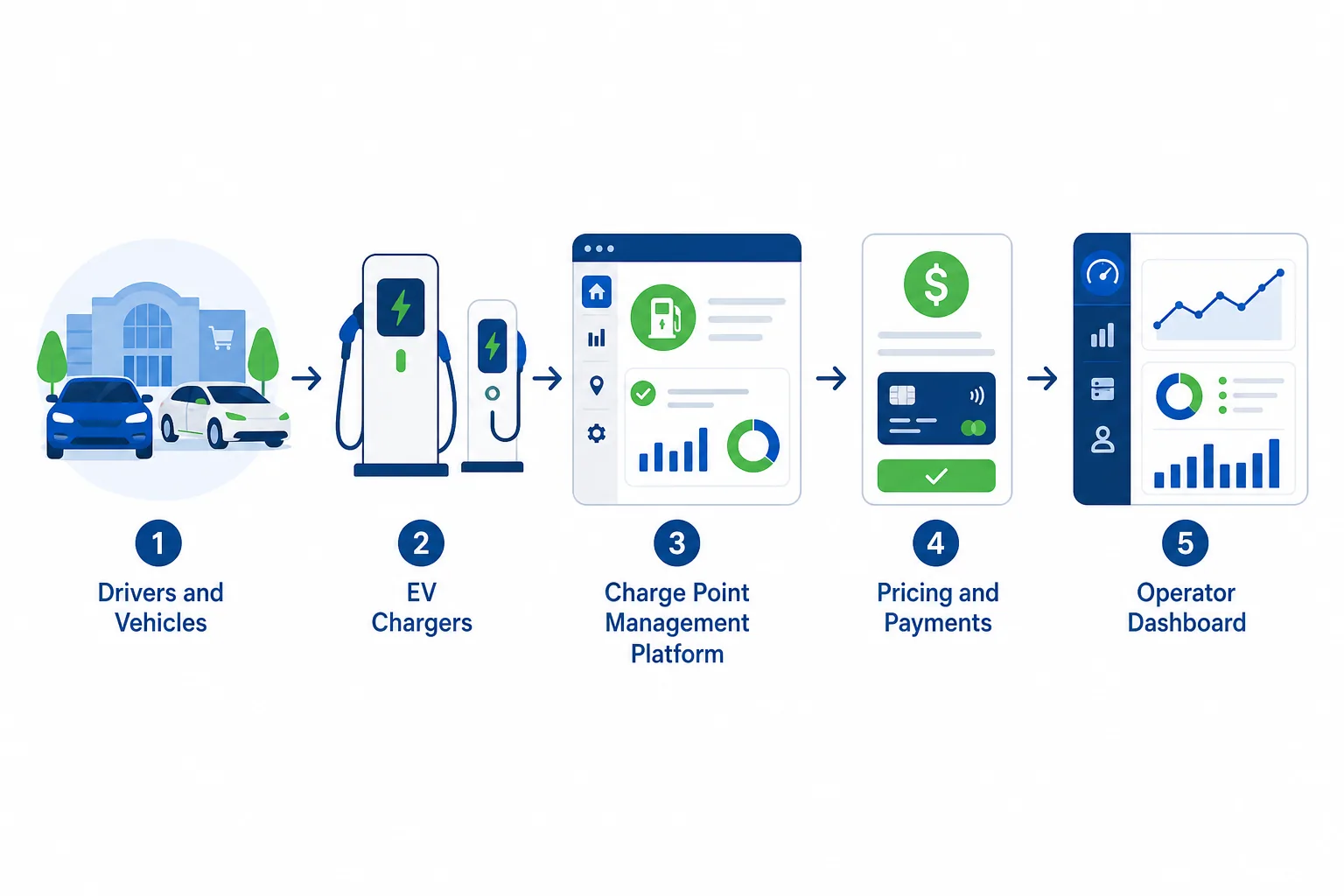
A charge point management system connects these tasks. It gives the operator a central layer for charger status, sessions, access, tariffs, payments, and operational reporting.
Charger monitoring and remote operations
Property teams need to know whether chargers are available, occupied, offline, or reporting a fault. Remote monitoring and diagnostics reduce the need to discover problems through driver complaints.
Support workflows should define who receives alerts, who can take remote action, when a field visit is required, and how visitors are informed. The process becomes more important when one team manages several properties.
Driver access and payments
A mall may support app users, RFID cards, ad hoc payments, registered members, roaming customers, or a mix of access methods. The best choice depends on the target audience and local requirements.
Each method should lead to the same basic outcome: a clear price before charging, reliable session authorization, accurate measurement, successful payment, and understandable transaction records.
Billing and revenue control
EV charging billing software connects charging records with tariffs, payments, invoices, subscriptions, discounts, taxes, and settlement. This becomes essential when the mall uses different prices for visitors, tenants, staff, members, or roaming drivers.
Billing records should also help the operator explain a charge when a customer contacts support. A session, applied tariff, payment, adjustment, and invoice should be traceable without reconstructing the transaction across several disconnected tools.
Choose a pricing model that matches the goal
Shopping malls do not need one universal EV charging price. They need rules that reflect the property strategy and can be changed as usage develops.
| Pricing approach | Best suited to | What the operator must manage |
|---|---|---|
| Free or validated charging | Visitor benefit, launch promotion, loyalty reward | Eligibility, session limits, abuse prevention, cost allocation |
| Energy-based pricing | Direct recovery of charging consumption | Metered usage, tariff rules, taxes, receipts, price disclosure |
| Time-based or idle pricing | Parking turnover and bay availability | Time rules, grace periods, notifications, customer communication |
| Hybrid pricing | Properties balancing energy, time, and parking value | Multiple charge components and clear invoice presentation |
| Membership or loyalty pricing | Registered visitors, premium tiers, tenant promotions | Customer identity, eligibility, discounts, partner integration |
The operator should test how each rule affects drivers and parking behavior. A tariff that is difficult to understand will increase support requests even when the calculation is technically correct.
A practical rollout plan for mall operators
A phased rollout creates room to learn before committing every site and parking zone to the same design.
1. Define users and success criteria
Identify the main user groups and the behavior the service should support. Define success in operational terms such as availability, completed sessions, repeat use, cost recovery, parking turnover, or membership adoption.
2. Audit the site and parking flow
Review electrical capacity, charger locations, accessibility, cable routes, mobile connectivity, signage, safety, parking controls, and future expansion. Include facilities, parking, IT, finance, customer service, and commercial teams early.
3. Design the service and commercial rules
Choose access methods, pricing, validation rules, member benefits, receipts, support channels, overstay policies, and tenant responsibilities. Document exceptions before they turn into manual work.
4. Select interoperable hardware and software
Confirm that chargers and the management platform use supported standards and that the operator retains flexibility as the network grows. A hardware-agnostic software layer helps reduce dependence on a single charger vendor.
5. Pilot, measure, and adjust
Start with a representative area or property. Monitor charger availability, session completion, support issues, payment failures, peak load, bay occupancy, and pricing behavior. Use the findings to adjust the service before expansion.
6. Scale with consistent controls
Standardize roles, permissions, tariffs, reporting, support escalation, maintenance, and tenant settlement. Keep enough flexibility for differences between properties without creating a separate operating model for every location.

What to look for in a shopping mall charging platform
The platform should support the operating model rather than force the property to simplify it. Evaluate how the system handles everyday exceptions, not only the ideal demo flow.
- Hardware flexibility: connect compatible chargers without tying the network to one manufacturer.
- Central operations: monitor sites, chargers, connectors, sessions, faults, and support activity from one environment.
- Flexible tariffs: manage energy, time, parking, idle, member, promotional, and location-specific rules.
- Billing and payments: connect session data to accurate charges, receipts, invoices, refunds, and settlement.
- Customer experience: support clear onboarding, access, pricing, notifications, and self-service.
- Integration: connect parking, loyalty, payment, tenant, finance, and reporting systems through APIs.
- Scalable power control: coordinate available power as the number of chargers and active sessions grows.
- Roaming readiness: support drivers from external mobility providers where roaming fits the strategy.
- Roles and auditability: give internal teams and partners appropriate access while keeping actions traceable.
Ask vendors to demonstrate how they create a new tariff, investigate a failed session, correct a billing issue, add another charger model, apply a loyalty benefit, and report revenue by site. These workflows reveal more than a feature checklist.
How Tridens EV Charge supports mall charging operations
Tridens EV Charge connects charger operations with native billing and monetization. Mall operators can manage chargers, users, tariffs, payments, and reporting without treating billing as a separate layer added after deployment.
The platform is hardware-agnostic and supports OCPP-compliant chargers. It also supports dynamic load balancing, white-label customer experiences, personalized pricing, and eRoaming through OCPI and OICP.
Its billing foundation is especially relevant for multi-site properties and mixed customer groups. The operator can connect measured charging activity to different tariffs, discounts, subscriptions, invoices, payments, and partner settlement while keeping the transaction traceable.
The result is a charging service that can evolve with the property—from a simple visitor amenity to a structured commercial offering across several locations.
FAQ about EV charging for shopping malls
Are EV charging stations in shopping malls free?
Some malls offer free or validated charging, while others charge by energy, time, parking duration, or a hybrid tariff. The model depends on the property’s customer and revenue strategy.
How many EV chargers should a shopping mall install?
The number should follow parking demand, typical dwell time, electrical capacity, expected utilization, user groups, and expansion plans. A phased rollout helps the operator validate these assumptions.
What type of EV charger is suitable for a shopping mall?
The choice depends on how long visitors stay and how quickly parking spaces need to turn over. Many properties use a mix of charger speeds for different parking zones and user groups.
Can shopping mall charging connect to a loyalty program?
Yes. A charging platform can apply member discounts, parking validation, promotional charging, or other eligibility rules when it integrates with the mall’s customer and loyalty systems.
How can a mall prevent EV charging bays from being occupied too long?
Operators can use clear parking rules, time limits, notifications, grace periods, and idle fees. The selected policy should be visible before charging starts and applied consistently.
